

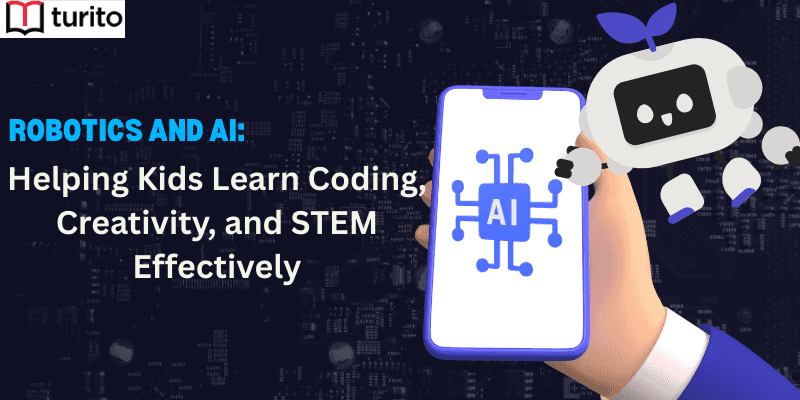
How Robotics and AI Help Kids Learn Coding, Creativity, and STEM Smarter

In recent times, it’s evident that technology has taken over our home, workplace, and day-to-day lives. As technology becomes a necessity, parents often worry about screen time and safety. Highlighting how robotics and AI can be integrated safely and productively can help reassure them that these skills are beneficial and manageable for children.
Robotics, AI, and education, all combined, are a boon that sparks curiosity and makes a child smarter, encouraging them to explore and learn with enthusiasm.

With the right guidance and training, these young minds can make the best use of technology and prepare themselves for the competitive world in the future.
What Is Robotics and Why Should Kids Learn It Early?
It’s simple to define robotics; it’s a high-end technology that works like a human, for a human, on the instructions of a human. Robots are not always giant man-like machines but simple machine systems that work faster than humans. Nowadays, you can find the use of robotics at every corner, be it an AI-powered refrigerator or a small vacuum cleaner running under your space. Robotics is flourishing in every field, like medical surgeries, restaurant hosts, conventional stores, and even in household management. So, why should students learn?

- Robotics activities tailored for various age groups make children more aware of technologies and help parents and teachers choose suitable projects, reducing confusion and ensuring age-appropriate engagement.
- Exposing kids early to robotics makes them more confident and proud of their achievements, boosting their motivation to excel in coding, engineering, and automation.
- It also helps the creative minds to relate STEM skills to real-life issues and to inculcate them in practical activities.
- It gives a space to be creative, invent, hustle, and improve ideas
- Robotics also helps in bringing out the best and encouraging children to communicate their ideas and collaborate with others more.
- Most importantly, it prepares them for a future where intelligent systems, automation, and advanced technology will be part of daily life and career opportunities.
How Robotics Combines Coding, Engineering, and Problem-Solving for Kids
Robotics joins hands with multiple ways of learning through real practices. For instance, a child builds robots by understanding the key principles, like how to fit parts, how to attach sensors, etc. Now, along with this, they also learn coding side by side to give robot instructions, testing outcomes, and correcting issues. Through this process, children naturally build strong problem-solving skills and learn the life skills of observation, correction, analysis, and reformation.
It’s evident in families where robotics go hand in hand, the integration of coding, engineering, and critical thinking creates a way for more creative learning, especially as AI and education continue to evolve in classrooms and learning environments.

The Rise of AI and Robotics in Modern Learning
Let’s learn how AI and robotics are becoming a significant part of learning:
- A Global Shift in Education
Globally, schools are curating new educational programs based on recent trends, incorporating essential learning resources and skill-based learning over rigorous pressure on memorisation of subjects.

- Hands-On STEM Application
Robotics supports students in applying math, science, and engineering concepts through experimentation, which helps them study effectively. It’s a dream for kids to work with real-life rockets, drones, and satellites, so when imagination comes to reality, it gives birth to innovations.
- AI-Powered Adaptive Learning
As the AI-powered tools work upon instructions, they help each child to curate study materials as per their learning style and capacity. UNESCO reports that more than 58 countries are developing national strategies to integrate AI and education

- Preparing for a Changing Workforce
The World Economic Forum notes that analytical thinking, creativity, and technological literacy are among the fastest-growing skills needed as automation increases.
What Makes a Robot? A Simple Guide for Kids
Robots are the new heroes for the kids; it’s not just a machine but a hero every child saves their shelf for. Most robots include a few essential parts:

- The frame holds the entire body together. It can be made of metal or plastic material
- Motors and wheels to give it momentum
- Sensors are a must for spatial coordination, like lights, touch, and distance
- A remote control or microcontroller to control the movement
- Programming or coding to instruct and upgrade the robot
- And finally, the heart of the robot, the Power or the battery system
When these parts work together, the robot can move, react, and perform actions while building confidence and zest in children to learn further.
How AI and Machine Learning Are Transforming Robotics for Children
AI and machine learning coordinate with robotics to give the children a rare but interesting experience. There was a time when students used to code manually, spending hours in front of the screen, juggling with the keyboards. But as AI and education came into space, it not only saved time but also trained the robots to work automatically under certain conditions.

For example, now with AI-generated commands and codings, the robots and robotic gadgets can respond to voice or motion, and upgrade their own versions through apps. This shift helps young learners understand how intelligent systems recognise patterns, predict outcomes, and improve performance over time.
Moreover, seeing the demand and broad usage of AI tools, learning platforms are creating personalised AI-based models for each student as per their capabilities and learning styles to help them learn more quickly without losing attention or finding bypass methods of studying like open AI tools.
Further, machine learning is a cherry on the cake for the kids because it helps robots detect emotions, navigate mazes, or solve problems using real-time data. When paired with coding with robotics, children begin to explore how thinking machines are designed and trained.
Why Coding and Robotics Are the Perfect Learning Combination
The coding and robotics curriculum is the perfect learning combination, as it is a clear representation of seeing the output being generated from the input. Codes are mere texts unless the functioning of the robots comes into the scenario. They support deep understanding and long-term skill development in several ways:
- Imagination comes to reality when a student dreams of A design, codes accordingly, and sees the final 3D model fully functioning.
- It builds concepts more intensively, like sequencing, logic, debugging, and structured problem-solving, making the child perfect in all terms.
- During mistakes and corrections, consistently working and finding solutions generate resilience and analytical thinking in children.
- Children design, test, and refine their ideas using coding with a robotics curriculum, which enhances their creative skills. Children under the guidance of Turito can apply both skills through guided practice and hands-on training.
Why Robotics Education Is a Game-Changer for Kids
Education in general means to make a person perfect in terms of thinking, performing, and understanding. Robotic education is deeply connected to this principle because it aims to provide a child all rounder support. It views intellectual development as an instant goal where designing, programming, and improving the creations play the key role. A child’s mindset is filled with creativity, colours, and enthusiasm, and so drawing it out and making them think independently, logically, and apply academic knowledge in the best way is achieved through it.
Builds Creativity and Critical Thinking
Robotics makes children understand various concepts regarding automation, 3-D framework, circuits, AI and education-related mechanisms, etc. These concepts are easier to adapt and process at this rapid growth age. Also, combining these concepts as per their imagination and desires, children enhance their creativity and critical thinking.
Strengthens STEM Foundations
Robotics is born from the Combination of all the subjects- science, mathematics, and technology. Children at such an age are introduced to the application of mathematical formulas in coding, programming, and finding ways in mechanical engineering. In this way, they get more experience rather than memorisation from textbooks.
Encourages Innovation Through Hands-On Learning
Robotics is a practical field where bookish knowledge is of no use until tried and tested. Hands-on learning focuses on making children tech savvy and indulge in experiments. Instead of observing, children hold the command to dream, build, test, and achieve. It gives more meaning to theoretical knowledge and mirrors a real engineering and research environment.
Improves Teamwork and Communication Skills
Robotics projects often require collaboration, planning, and shared problem-solving. When working in a team, children are exposed to others’ ideas and are encouraged to present their own ideas and practices. They all work together with a common goal, encouraging teamwork and a cohesive environment.
Boosts Confidence Through Real Problem-Solving
Robotics not only enhances creativity and makes ideas come to reality, but watching one’s own creations boosts confidence in children. They take mistakes as a part of learning and constantly learn by being persistent, devoted, and improving continuously.
Age-Wise Robotics Learning Paths for Kids
Kids learn robotics best when it fits their age and skill level. As they improve, lessons go from basic play to solving problems and getting creative, and they learn to adapt more of the machines, concepts, and experiments. So, robotics is divided specifically according to the age criteria, not to overload the children.
Robotics for 5-Year-Olds
Robotics at age four is fun; here, kids are made to play with lights, buttons, and the movements make them more attentive, sparking curiosity. Making robotics for 4 years old a gentle first step. By five years, simple drag-and-drop coding introduces sequencing and logic. Also, learning about various machine movements, like rolling, twisting, helps them in problem-solving and creative thinking.
Robotics for 8- Year- Olds
At six, children start understanding the concept of command and how instructions can affect the movement of machines. This makes robotics for 6 years olds ideal for structured exposure. By eight, learning gets more detailed as sensors, motors, and coding blocks come into the scenario. Activities like movements, picking objects, or following a line are taught to them.
Robotics for 10- Year- Olds
By ten, learners can engage in more advanced robotics for 10 year olds. Understanding microcontrollers, text-based transitions, and purposeful innovations, along with AI usage and basic practicals of building robots, comes into the frame. This stage aligns closely with moves ahead towards robotics for 1st graders.
Fun Starter Robotics Projects Kids Can Try Today
Robotics does not follow limits; any idea, any inspiration is welcomed here. And as children are the reservoir of creativity, robotics encourages them to create more and more. Children might create their own robotic pet or a moving doll using motor blocks and coding. Small builds like these turn curiosity into confidence and make robotics exciting, approachable, and meaningful from the very beginning.
Build a Simple Robot Buggy
A robot buggy is an ideal beginner project that can be easily done by kids. It only requires motors, wheels, and sensors, and a smart kid to program the movement through basic coding blocks. This helps them understand direction control, speed adjustments, and how small code changes affect real-world motion.
Learn MicroPython With a Beginner Board
Using MicroPython is critical, but it helps children to be proficient at text-based coding in a gradual and supportive way. It’s done through boards like the bit or Raspberry Pi Pico, and simple codes, and kids watch how LEDs light up, and sensors coordinate. Such simple tasks help them do projects like alarms, nightlamps and many more sensor-based projects. It programs lights, motions, and other robotic behaviour, which can sum up and boost their confidence to do more.
Try Easy AI-Based Coding Challenges
Easy AI-based challenges have two benefits. First, they are easy to learn; second, there’s always scope for improvement. Simple challenges like training a robot to avoid obstacles or respond to voice or motion will help children understand how intelligent systems learn.
How Turito’s AI Robotics Program Empowers Young Innovators
Turito’s AI Robotics programme provides children with a structured approach to learn robotics through live online classes, guided practice , and real hands-on building. Classes are hands-on, tailored, and can scale with the user from beginner to advanced, culminating in certification for their accomplishments. This unique approach prepares kids with a solid foundation in robotics, AI and education while making learning fun and practical.
Live Classes + Hands-On AI Projects: What Makes Turito Different
Turito’s RoboNinja-style robotics programs combine live online sessions with 1:1 guidance from robotics experts and structured classes over multiple weeks. Children work through 100+ DIY projects using robotics kits, building real robots step by step. This mix of live teaching and hands-on practice makes learning both engaging and deeply practical.
Adaptive Learning: How Turito Personalises Robotics and Coding for Every Child
Turito makes use of AI-supported learning to customise education for each child according to their pace, level, and progress. To make sure each child gets the right-sized challenge, feedback, or help-as well as personalised tasks instead of one-size-fits-all assignments. Children can get started independently or progress quickly. With this coding and robotics curriculum, it is both ways out perfect for their pace and fit to contact-most importantly, child-centred education.
How Robotics Education Prepares Kids for Future Tech Careers
From robotics, children learn some of the core concepts related to S.T.E.M., such as coding, electronics, and engineering design, that are the foundation of most careers in modern technology.
With robotics for kids, children learn to code and solve problems at home as they have fun designing their own robot toys and mastering 21st-century learning skills that prepare them for a future of jobs that may not exist yet.
- Hands-on projects mirror real engineering work: ideating, building, testing, and iterating on solutions informed by data and feedback.
- Robotics competitive events like World Robot Olympiad and FIRST LEGO League cultivate teamwork, leadership, and on-the-ground problem-solving challenges with performance pressures.
- Introducing children to sensors, automation, and intelligent systems is also an excellent way for them to get exposed to what AI and education connect to fields like robotics, software, and data science.
Final Thoughts: Give Your Child a Head Start in AI and Robotics Innovation
Introducing robotics and AI to kids early brings them so much more than just technical skills. Studies show it builds problem-solving ability, capacity for creativity, a sense of teamwork, and confidence skills that are transferable across any career path.
As AI and learning increasingly converge, children who build, code, and experiment with intelligent systems learn to relate to technology from the inside out; they do not just consume.
By providing support for that expedition today, you will be offering your child a real head start in a world where creative thinking, flexibility, and wise application.
Frequently Asked questions
What is robotics for kids, and why is it important?
Robotics for kids uses kits and tools that are friendly to children, in order to let them build and program simple machines that move, sense, or respond to stimuli. It’s important for both the child and parent together: suddenly, science and mathematics become something real-life, and kids can touch. Over time, it allows them to understand modern technology, instead of feeling afraid to approach it.
At what age can children start learning robotics?
Children can start learning robotics at a very young age, like 4-5 years, where it’s taught in simple ways like pressing buttons, cause and effect relationships, play-based activities, etc.
How does AI help kids learn robotics and coding faster?
Artificial intelligence (AI) is helping to give children educational support by adjusting the level of problems they work on and providing hints when needed. When paired with robotics, AI speeds children ‘s comprehension of what they have done wrong and helps them refine their work step by step until even slow learners begin to develop very intricate creations.
Do kids need prior coding experience to start robotics?
No, most beginner robotics programs assume children have never coded before. Learning usually starts with visual blocks or simple instructions, making it approachable.
What skills do children develop through robotics education?
Robotics builds logical thinking, patience, problem-solving, creativity, and communication. It also strengthens STEM understanding by turning ideas into working results.
What is the difference between coding and robotics for kids?
Coding is writing instructions on a screen. Robotics uses those instructions inside a machine that can move or sense.
Are robotics kits safe and suitable for young children?
Most robotics for kids kits are designed by age and safety-tested. Younger children use larger parts and simple tools, while older learners use smaller components. Adult supervision helps ensure safe use and supports learning during building and troubleshooting.
How can beginners start building simple robots at home?
Even beginners can start with a small starter kit that comes with clear instructions and all the basic parts like wheels, a simple controller, maybe a few sensors, etc. Short sessions work best; there, they build a tiny part, test it, and tell us what happened. Simple robotics activities like line-following robots, light-reactive robots, or a basic “robot car” are enough to generate children’s curiosity.
What types of robotics projects are best for kids ages 5–10?
For ages five to seven, projects should be playful and visual: robots that move along a path, react to a clap, or light up when a button is pressed. From eight to ten, children can handle slightly more involved builds, small rovers, obstacle-avoiding robots, or drawing robots that follow code. The key is that each project has a clear goal, quick feedback, and room for the child to change and improve their design.
How does Turito’s AI Robotics Program personalise learning for every child?
Turito is a system that employs AI to monitor a student’s progress. The program gauges children’s progress related to their age, language level, and ability, and adjusts the level of difficulty according to the child’s reaction. This is done in real-time. Live classes and guided projects allow teachers to see where a child is running into difficulty or excelling. By blending AI insights with human guidance, teachers can tailor robotics and coding lessons to each child’s pace, confidence, and current understanding. Not everyone has to go down the same road.
Relevant Articles

How Kids Can Learn Coding Smarter with AI-Powered Guidance?
As time goes on, more and more children will be …
How Kids Can Learn Coding Smarter with AI-Powered Guidance? Read More »
Read More >>
Why AI-Powered Personalized Learning Platform Is the Future of Education
AI-Powered Personalized AI is the new norm. Influencing our decisions …
Why AI-Powered Personalized Learning Platform Is the Future of Education Read More »
Read More >>
AI for Math Problems: A Smarter Way for Students to Learn and Solve Math
Math has never been an easy subject for students. Some …
AI for Math Problems: A Smarter Way for Students to Learn and Solve Math Read More »
Read More >>Study Abroad

With Turito Study Abroad

With Turito Study Abroad

Get an Expert Advice from Turito

Get an Expert Advice from Turito
CAP

With Turito CAP.
Coding

With Turito Coding.
Robotics
With Turito RoboNinja
Tutoring

1-on-1 tutoring for the undivided attention

Comments: