

Newton’s First Law of Motion: Definition, Formula, and Examples

Statement of Newton’s First Law of Motion
Newton proposed three laws of motion in 1687 that constitute the base of classical mechanics. They explain everything from how an object stays at rest to how it gets into motion, gains speed, overcomes opposite forces or surrenders to them. Isaac Newton established the laws and brought clarity to physical systems and phenomena. What is Newton’s first law of motion? The following article explores Newton’s first law definition and examples to provide a complete understanding of the concept.
Table of Contents

- What is Newton’s First Law of Motion?
- Formula
- Examples from Real Life
- What is Force? How is it Different from Net Force
- Inertia in Newton’s First Law
- Applications of Newton’s First Law in Daily Life
What Is Newton’s First Law of Motion?
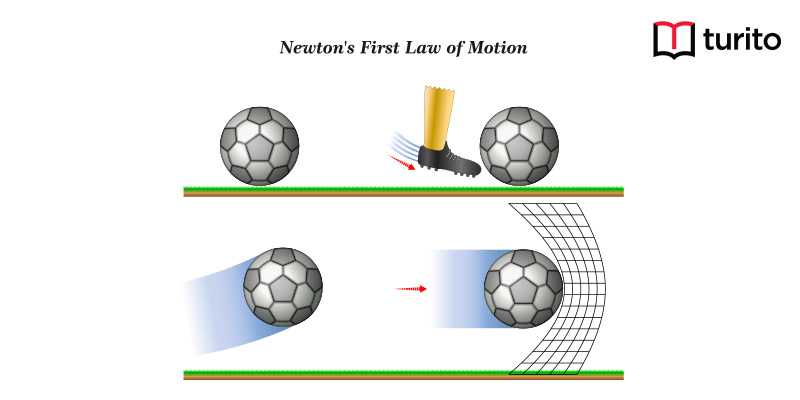
According to the first law of motion, a body at rest or in motion stays in the same state unless acted on by an external force.
Understanding Newton’s First Law of Motion
The statement means that a body in motion will not change its direction or decrease/increase its speed without being influenced by an unbalanced force. So, if nothing happens to the body at rest, it won’t go elsewhere, and if it is moving in a certain direction, it will continue to move unless something happens to it.

So, Newton’s first law of motion explained why objects slow down. Before Newton proposed his theory, people assumed that objects slow down after a while because of their natural built-in tendency. They did not consider the force of gravitation, friction, and air resistance.
In terms of Physics, if the body is acted upon by a resultant force such that the forces’ vector sum is zero, its velocity will be constant. It should be noted that the term velocity implies that both the magnitude and the direction of the movement will be constant.

You can understand this concept with the help of an astronaut’s example. If you observe a video of astronauts, you will find their tools floating because there is no force of gravity. They stay in one place as no force changes their situation. Also, if they drop an object in space, it continues to move at the same speed in the same direction.
Newton’s First Law of Motion Formula
The equation for Newton’s first law formula is as follows:

- F= dp /dt
or
- F= d(mv)/dt
In the first statement, p is the momentum. As p=mv, the second equation replaces p with mv. V is the object’s velocity, t is the time, and F is the force.

What is Force? How is it Different from Net Force?
A force is a push or pull. It is expressed in Newton or kg m/s2. Force can be internal or external. An external force originates from outside an object, while an internal force originates from within an object. An example of external force is gravitation excited by Earth on the moon, and internal force examples include the gravitational force that the moon’s inner core exerts on its outer crust.
The net force, on the other hand, represented by ΣF, is the total force experienced by an object. It is the vector sum of all the forces acting on a body.

What is Inertia in Newton’s First Law?
Inertia is the tendency of an object to resist any change of state of motion. When at rest, something desires to remain at rest. When it is in motion, it will desire to continue moving in the same direction at the same speed.
Inertia is a Latin word which means “laziness” or “idleness”; objects are “lazy” and prefer not to be disrupted in the state they are in.

Key Points About Inertia:
- An object will always be at rest unless some force is exerted on it.
- Similarly, a moving object will also remain moving in the same direction at the same speed unless it is acted upon by some external force.
- Mass contributes significantly to inertia–the heavier the object, the more resistant it is to acceleration or deceleration.
It is inertia that causes objects to remain at their present position (either rest or motion). The absence of inertia would make motion random and disordered.
To take an example, it is much easier to push a shopping cart in comparison to a car, since a car is much heavier and this increases its inertia. This is the reason why light objects can be moved easily as compared to heavy ones, which require more force.
Applications of Newton’s First Law in Daily Life
Newton’s 1st law of motion happens around you constantly. Its practical uses can be found in the daily activities of engineers, designers, and safety professionals to tackle real-life issues.
In Vehicle Safety:
Car manufacturers use Newton’s first law in designing safety features. All seatbelts, airbags, and crumple zones are based on this law. When a car collides, the occupants still remain in motion as a result of inertia. Seatbelts create an external force that prevents this forward movement, hence securing you. Engineers could not develop efficient safety systems without knowing the first law of Newton.
This is also applicable in braking systems. The knowledge of inertia in moving vehicles assists engineers in estimating the stopping distance and developing braking systems that are robust enough to counter the movement of a vehicle.
In Sports & Training:
Newton’s first law is used by athletes and coaches to enhance performance. Knowledge of inertia enables them to train better. Gymnasts use the inertia to get into flips- they generate some momentum, and their body tends to keep moving towards that circular motion.
In Engineering & Design:
- Cars have suspension systems that are meant to absorb the inertial effects in sudden stops or turns.
- Playground equipment is built with safety features that account for children’s inertia when jumping or sliding
- Escalators slow down to a gradual pace to prevent jerking the passengers (which would be uncomfortable due to the force of inertia).
In Everyday Practical Use:
- When loading a truck, workers are aware of the fact that heavy objects have to be pushed by their greater force, which is a direct application of both inertia and mass.
- Handrails on stairs and buses are designed by engineers to create an external force to overcome inertia when forced to make a sudden stop.
Why is Newton’s First Law of Motion Also Called the Law of Inertia?
It is also called the law of inertia because inertia refers to the amount of resistance of an object to a velocity change. Velocity change can be in terms of the speed of the object or its direction. Another aspect of inertia is the tendency to continue moving in the same direction line at a constant speed when no forces act on them.
Did you know: The law of inertia was first introduced by Galileo Galilei during the early seventeenth century.
Types of Inertia
Inertia is of the following three types:
- The inertia of rest: When a body resists and stays in the state of rest until external forces act on it.
- The inertia of motion: When a body resists change and continues motion in the same direction until an external force acts on it.
- The inertia of direction: The tendency of an object to continue moving in the same direction unless an external force acts on it.
Think about it: A driver puts his seat belt on and heads on for a drive at a uniform velocity of 100 km/hr. He then collides, head-on, with some other car. The driver suffers head injuries even though he has his seat belt on. Why?
Newton’s First Law Examples from Real Life
The following are some of Newton’s first law of motion examples from everyday life:
1. An Electric fan
The blades of an electric fan move for some time, even after it is turned off, due to inertia of motion. The blades were in a state of motion, so they will take some time to change their state and come to rest when you switch them off.
2. Travelling in a Bus
Have you felt a jerk when the driver applies brakes or the bus stops, or it starts moving after a stop?
These jerks have different explanations. The passengers that are standing in a moving bus experience a sudden forward fall when the driver applies the brakes due to inertia of motion. Similarly, when a speeding bus comes to a sudden halt, the body moves forward because the lower part of the body comes to rest with the vehicle while the upper part tries to maintain the state of motion that it was in earlier. Hence, the passengers feel a forward push.
On the contrary, people sitting on a bus feel a backward pull when a stationary bus begins to move due to the inertia of rest. The upper parts of the body continue to stay in the state of rest while the lower part moves forward along with the vehicle.
3. The coin on a Card Placed on a Glass
When a card is placed on top of a glass with a coin on top of it and the card is quickly removed, the coin falls into the glass. The coin demonstrates inertia of rest. It continues to be at its position even when the card below it is moved. Hence, it falls into the glass.
4. Moving Train
In a moving train, when a ball is tossed into the air, it goes up and then comes down straight in your hand because, like the train and the passengers, it has inertia too. However, this happens only when the train is moving at a uniform speed; otherwise, when the train is accelerating, it will fall backwards.
5. Jumping off a Vehicle
Jumping off a moving car or bus can cause you to stumble because your body continues to stay in the state of motion in the vehicle’s direction. When your feet touch the ground, they come to rest, but the upper part of the body doesn’t stop. Consequently, you tend to fall in the direction of the movement.
6. A Carpet is Beaten to Remove Dust
When you beat a carpet with a stick, the dust particles fall off because as the carpet is beaten, it moves backwards, i.e., it gets into motion, but the dust particles continue to remain at rest. This example again explains the inertia of rest, i.e., the tendency of a body to remain in its initial state.
7. Fruits and Leaves Fall Off on Shaking Tree Branches
Have you ever wondered why fruits and leaves fall off when you vigorously shake the branches of trees? It is because when the tree branch is shaken, it comes in the state of motion under the influence of the force you apply, but the leaves and fruits continue to stay the same due to inertia of rest and tend to fall down.
8. Riding on a Skateboard
While you ride on a skateboard or a cart and you strike a rock or hit a sidewalk, why do you fly forward? It happens because your skateboard stops the movement; it hits a surface, but your body continues to move in the forward direction. As a result, you tend to fall forward.
Conclusion
Newton’s first law of motion is vital because it explains why an object continues to stay in its position even after hours. It gives you an explanation of your everyday life situations, like the movement of the bus and a sudden backward pull. The first law, in addition to the other laws, forms the basic foundation of Physics that helps you understand advanced concepts.
Frequently Asked Questions on Newton’s First Law
What is a normal force?
The force that acts perpendicular to the surface of contact of a body is called the normal force. It is the force exerted by surfaces to prevent solid objects from running and passing through each other. It is a contact force, so if the surfaces of two objects are not in contact, they will not experience any normal force.
How can a car remain at rest on a hill?
It is possible for a car to be parked at rest on a hill when the three forces acting on it have zero resultant force. The three forces are weight, friction, and the normal reaction force. The frictional force balances the weight component down a slope.
Why is luggage tied on top of a bus?
Luggage is always tied to the roof of the bus using a rope so that the luggage doesn’t fall off when the bus comes to a stop due to the inertia of motion. The inertia of motion makes the luggage stay in the state of motion even when the vehicle stops.
What is inertia in Newton’s first law?
The concept of inertia is the inherent tendency of an object against changes in its state of motion. Objects that are at rest desire to remain in the same position, and those that are moving desire to continue moving in that direction at the same rate. This resistance is based on the mass of the object; a heavier object has higher inertia.
Is Newton’s first law applicable in daily life?
Yes, absolutely. Newton’s first law applies constantly in daily life. Seatbelts protect you during car brakes due to inertia, the tea continues spinning after you stop stirring, and you lurch forward when a bus stops suddenly. It governs motion in vehicles, sports, and everyday activities we experience.
5.
Relevant Articles

Equations of Motion : Definition, Formulas, & FAQs
Introduction to Equations of Motion? Physics equations of motion are …
Equations of Motion : Definition, Formulas, & FAQs Read More »
Read More >>
Types of Switches – Definition, Classification, and Characteristics
What Is a Switch? In electrical circuits and electronics, a …
Types of Switches – Definition, Classification, and Characteristics Read More »
Read More >>
Six Simple Machines Explained: Definition, Types & Examples
What Is a Simple Machine? (Definition & Purpose) Simple machines …
Six Simple Machines Explained: Definition, Types & Examples Read More »
Read More >>Study Abroad

With Turito Study Abroad

With Turito Study Abroad

Get an Expert Advice from Turito

Get an Expert Advice from Turito
CAP

With Turito CAP.
Coding

With Turito Coding.
Robotics

With Turito RoboNinja
Tutoring

1-on-1 tutoring for the undivided attention

Comments: