



Alkali and Alkaline Earth of Metals

Key Concepts
• Valence electron
• Group
• Alkali metals
• Alkaline earth metals
Introduction
Elements:
Elements constitute of only one kind of atom. There are nearly 118 known elements. On the bases of their properties, elements are placed in the form of table. This table is called the Periodic table.


The Modern Periodic Table:
The arrangement of the elements in the form of table according to the properties of the atom and atomic number is called the periodic table. The alignment of the elements has some properties and the fixed number of electrons. The rows in the periodic table are called as the periods and the columns of the table are called as the groups.
Valence Electron:
The electrons revolve around the nucleus in the atom. The revolution of the electrons occurs in some circular orbits. Each orbit contains some electrons in each orbit. The distance of the orbit from the center of the nucleus increases from the first orbit to the second orbit. The number of the electrons in the outermost orbit of the atom is called valence electrons.
Alkali elements:
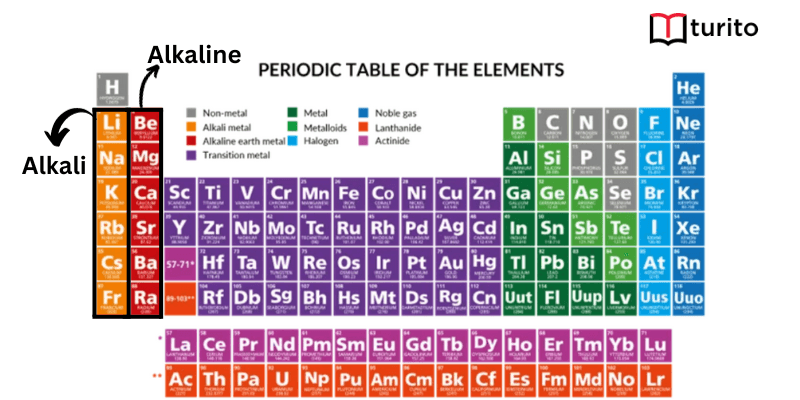
The first column of the periodic table has only one electron in its outermost orbit. The group is called Group I. The elements in this group are called the alkali elements. The elements in Group I are Lithium, Sodium, Potassium, Rubidium, Caesium, Francium. The smallest atom among all these is lithium and the size of the atom grows gradually and the largest atom among the following is francium.

All alkali elements are metallic in nature and are highly reactive in nature. The reactivity rate grows as we go down the periodic table. Alkali metals readily react with hydrogen and oxygen and even with nonmetals. The melting point of the alkali metals is very low. The alkali metals are soft and can be cut easily by knife. Caesium is more soft and highly reactive as compared to lithium.
The reactivity rate goes as follows: Cs > Rb > k > Na > Li
The size of the atom increases as follows: Cs > Rb > K > Na > Li

The electronic configuration is the notation for the arrangement of the electrons in the atom. The electronic configuration of the alkali metals is nS1.
Alkaline earth metals:
The second column of the periodic table has two electrons in its outermost orbit. The group is called Group II. The elements in the group are called the alkaline earth metals. The elements in the Group II are Beryllium, Magnesium, Calcium, Strontium, Barium, Radium. The smallest atom among all these is the beryllium and the size of the atom grows gradually and the largest atom among the following is the radium.
The reactivity nature of these metals is less as compared to the alkali metals. The same property can be applied for alkali metals about the reactivity nature. The elements at the bottom of the group are highly reactive as compared to the elements at the top of the periodic table. The alkaline metals are less reactive compared to alkali metals but burn in air when heated. The produce bright and different colored flames and are mostly used in making it the fireworks. Alkaline reacts to the water but not as rigorously as the alkali metals.
The reactivity rate goes as follows: Ra > Ba > Sr > Ca > Mg > Be
The size of the atom increases as follows: Ra > Ba > Sr > Ca > Mg > Be
The electronic configuration of the alkaline elements is nS2

In the above figure the orange line in the first column are the alkali metals. The hydrogen is excluded from the group in the alkali metals.
Summary
• Elements are the combination of one atom.
• The arrangements of the elements in the form of the table is called the periodic table.
• The rows of the periodic table are called the period and the column of the periodic table are the groups.
• The first group of the periodic table is called the Group I and the elements are called the alkali metals excluding the hydrogen.
• The second group of the periodic table is called the Group II and the elements are called the alkaline earth metals.
Related topics
Acid–Base Indicators: Types, Examples, and Uses
Key Concepts Introduction: Indicators – Acids and Bases By now, we know that substances like tomatoes, lemon, pineapples taste sour because they contain acids. In contrast, substances like detergents and soaps feel bitter and slippery because they contain the substance known as base. How do we find it acidic or basic if we cannot taste every […]
Read More >>Importance of pH in Everyday Life – Class 10 Chemistry
Importance of pH in Everyday Life The importance of pH in everyday life class 10 is an important topic of Chemistry. We use the concept of pH in many situations around us, even without realizing it. It is about knowing about the application of pH in daily life. It tells you how acidic or basic […]
Read More >>
Versatile Nature of Carbon: Saturated Hydrocarbons (Alkanes)
Introduction: Carbon is one of the most important non-metallic elements. This is because carbon atoms make up the backbone of many important molecules in the human body, including proteins, DNA and RNA, sugars, and fats. The special significance of carbon lies in forming two types of compounds—organic and inorganic compounds. The entire field of organic […]
Read More >>
Details and Examples of Inorganic Carbon Compounds
Introduction: Carbon is one of the most valuable non-metallic elements. Carbon atoms make up the backbone of many important molecules in the human body, including proteins, DNA, RNA, sugars, and fats. The special significance of carbon lies in forming two types of compounds—organic and inorganic compounds. The study of the chemistry of carbon and its […]
Read More >>

Other topics





Comments: