



Define Compound and its Formula

Key Concepts
• Symbols
• Chemical name
• Formula
Introduction
Compound:
A compound is the combination of two or more atoms called a compound.
Each compound has a name that identifies the ions or atoms it contains. A compound also has a chemical formula that shows the ratio of the ions or atoms present in the compound. In an ionic compound with only two elements, the first ion represents the positive metal ion, and the second ion represents the negative non-metal ion. When naming ionic compounds, the suffix of the first ion is unchanged, while the suffix of the second ion is changed to “ide.” In a covalent compound, the atoms are always non-metals. Prefixes are used to express the ratio of atoms in the molecule.

The different types of salts are table salt, road salt, rock salt, and sea salt. Table salt and road salt are pure substances. The chemical name of table salt is sodium chloride, and road salt is calcium chloride. Rock salt and sea salt are not pure substances. Names are important to human beings and even pets we keep: we name ourselves, our pets, and the places where we live. What is important in naming a chemical?
Each compound has a unique name and the name represents the elements present in the compound.
A compound has both name and formula, and sometimes the names are common names and chemical names. All ionic compounds contain both positive and negative ions.
We can describe ionic compounds using the name or by formula. A chemical name represents the elements present in the compound. The International Union of Pure and Applied Chemistry (IUPAC) is an organization that represents chemists around the world and is responsible for
the rules for naming compounds. The chemical name of an ionic compound has two parts, one for each type of ion in it. For example, the chemical name of table salt is sodium chloride.
- The first part of “sodium chloride” names the positive ion, sodium, which represents the presence of the sodium atom. The positive ion is always metal in the compound containing two elements.
- The second part of “sodium chloride” names the negative ion, chloride, which represents the presence of the chlorine atom. The negative ion is always a non-metal in the compound containing two elements.
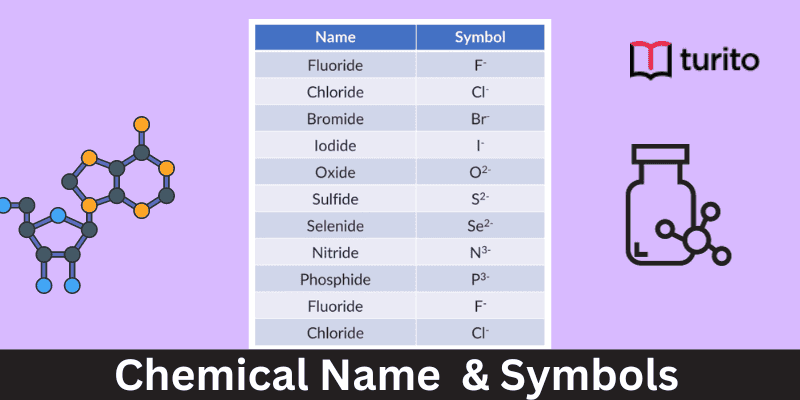
- The non-metal ion’s name always ends with the suffix “-ide.” In this example, “chlorine” changed to “chloride.” The changes of some of the elements are shown in the table.


The chemical formula
The chemical formula contains the symbols of elements present in the ionic compound, and these symbols are used to identify each ion. It also shows the relative numbers of ions in the compound. These numbers are indicated by a subscript set to the right of the element symbol. Three examples are explained below:
- NaCl is formed from one sodium ion (Na+) and one chloride ion (Cl–)
- CaF2 is formed from one calcium ion (Ca2+) and two fluoride ions (F–)
- Na3P is formed from three sodium ions (Na+) and one phosphide ion (P3–)
Summary
• Compound is the combination of two or more atoms.
• Each compound is named, and the name is called a chemical name.
• The symbol of the compound depends on the ions each atom in the compound possesses.
• The name depends on the element with positive ions and the element with negative ions.
Related topics
Acid–Base Indicators: Types, Examples, and Uses
Key Concepts Introduction: Indicators – Acids and Bases By now, we know that substances like tomatoes, lemon, pineapples taste sour because they contain acids. In contrast, substances like detergents and soaps feel bitter and slippery because they contain the substance known as base. How do we find it acidic or basic if we cannot taste every […]
Read More >>Importance of pH in Everyday Life – Class 10 Chemistry
Importance of pH in Everyday Life The importance of pH in everyday life class 10 is an important topic of Chemistry. We use the concept of pH in many situations around us, even without realizing it. It is about knowing about the application of pH in daily life. It tells you how acidic or basic […]
Read More >>
Versatile Nature of Carbon: Saturated Hydrocarbons (Alkanes)
Introduction: Carbon is one of the most important non-metallic elements. This is because carbon atoms make up the backbone of many important molecules in the human body, including proteins, DNA and RNA, sugars, and fats. The special significance of carbon lies in forming two types of compounds—organic and inorganic compounds. The entire field of organic […]
Read More >>
Details and Examples of Inorganic Carbon Compounds
Introduction: Carbon is one of the most valuable non-metallic elements. Carbon atoms make up the backbone of many important molecules in the human body, including proteins, DNA, RNA, sugars, and fats. The special significance of carbon lies in forming two types of compounds—organic and inorganic compounds. The study of the chemistry of carbon and its […]
Read More >>

Other topics





Comments: