



Composition of Matter

Key Concepts
- Solids.
- Liquids.
- Gases.
- NaCl crystal
- Structure of NaCl.
Introduction:
Matter is anything that takes up space and has mass. Matter cannot always be seen. Whatever we look at our surroundings is made of ‘matter’. All matter is made up of tiny particles, such as atoms, molecules or ions. Each particle attracts other particles. In other words, each particle attracts other particles towards itself. These particles are always moving.
There are four states, or forms of matter. They are solids, liquids, gases.
States of Matter
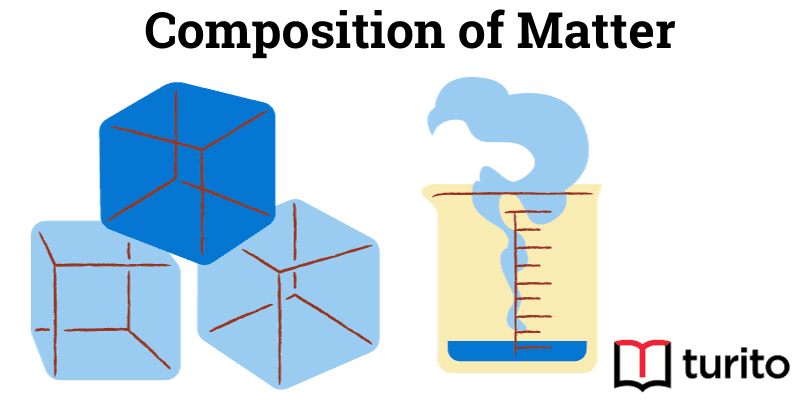
The three states of matter are solids, liquids and gases.
Solids:
A solid is a matter with a definite shape and volume. A solid does not change to take the shape of the container it is in. This is because the particles of a solid are packed closely together. The particles in all types of matter are always moving. A solid’s particles are vibrating in place. However, they do not have enough to move out of their fixed positions.
There are two different types of solids.

- Crystalline solids:
Some solids have particles arranged in a three-dimensional pattern. This repeating pattern is called a crystal. Solids with this pattern are crystalline solids. The particles are arranged in the shape of a cube. Examples: Sugar, sand, and snow are other crystalline solids.
- Amorphous solids:
Some solids come together without forming crystals. They are called amorphous solids. The particles are arranged randomly. Examples: Rubber, plastic, and glass are amorphous solids.

Liquids:
A liquid is a matter that has definite volume but no definite shape. A liquid takes the shape of its container but keeps the volume the same. Particles in a liquid move more freely than those in a solid. A liquid can have different shapes. The particles in the liquid have more energy so that they can move over one another.

We know that honey flows more slowly than water due to viscosity. Some liquids flow more easily than others. Honey has a high viscosity. It does not flow easily. Water has a lower viscosity; it flows very easily. For many liquids, viscosity increases as the liquids become colder.

Gases:
Gas is a matter that does not have a definite shape or volume. The particles in gas are much farther apart than those in a liquid or solid. Gas particles move at high speed in all directions. A gas will fill the container it is in.
What happens if you squeeze the air into a smaller part of the balloon?
The gas particles get closer together. This happens because we can decrease the volume of the container the gas was in. Most gases are invisible. The air you breathe is a mixture of gases such as nitrogen, oxygen, and water vapor.
What is a Vapor?
When water gets heated and boils, it forms vapors. The gaseous state of water is called water vapor. Vapor is a matter that exists in the gas state.

Structure and Arrangement of NaCl Crystal:
Sodium chloride has a giant ionic lattice. This is formed due to ionic bonding, which involves the transfer of electrons from one atom to another to ensure each atom has a full outer shell of electrons. Sodium will lose an electron to become Na+ whilst chloride will gain an electron to form Cl-.
Sodium chloride also crystallizes in a cubic lattice but with a different unit cell. The Na+ are blue and the Cl- is red.

NaCl has a cubic unit cell. It is best thought of as a face-centered cubic array of anions with an interpenetrating cation lattice. Each ion has 6-coordinates and has a local octahedral geometry.

The three-dimensional arrangement or crystal lattice of ions in sodium chloride is such that each Na+ is surrounded by six anions (Cl-), and each Cl- is surrounded by six cations (Na+). Thus, the ionic compound has a balance of oppositely charged ions, and the total positive and negative charges are equal.
It has 1 : 1 stoichiometry ratio of NaCl with a molar mass of 58.4 g/mol.
Summary:
- Matter is anything that takes up space and has mass. Matter cannot always be seen. Whatever we look at our surroundings is of ‘matter.
- A solid is a matter with a definite shape and volume. A solid does not change to take the shape of the container it is in.
- Some solids have particles arranged in a three-dimensional pattern. This repeating pattern is called a crystal. Some solids come together without forming crystals. They are called amorphous solids.
- A liquid is a matter that has definite volume but no definite shape. A liquid takes the shape of its container but keeps the volume the same.
- Gas is a matter that does not have a definite shape or volume. The particles in gas are much farther apart than those in a liquid or solid. Gas particles move at high speeds in all directions.
- Sodium chloride has a giant ionic lattice. The three-dimensional arrangement or crystal lattice of ions in sodium chloride is such that each Na+ is surrounded by six anions (Cl-), and each Cl- is surrounded by six cations (Na+).
Related topics
Acid–Base Indicators: Types, Examples, and Uses
Key Concepts Introduction: Indicators – Acids and Bases By now, we know that substances like tomatoes, lemon, pineapples taste sour because they contain acids. In contrast, substances like detergents and soaps feel bitter and slippery because they contain the substance known as base. How do we find it acidic or basic if we cannot taste every […]
Read More >>Importance of pH in Everyday Life – Class 10 Chemistry
Importance of pH in Everyday Life The importance of pH in everyday life class 10 is an important topic of Chemistry. We use the concept of pH in many situations around us, even without realizing it. It is about knowing about the application of pH in daily life. It tells you how acidic or basic […]
Read More >>
Versatile Nature of Carbon: Saturated Hydrocarbons (Alkanes)
Introduction: Carbon is one of the most important non-metallic elements. This is because carbon atoms make up the backbone of many important molecules in the human body, including proteins, DNA and RNA, sugars, and fats. The special significance of carbon lies in forming two types of compounds—organic and inorganic compounds. The entire field of organic […]
Read More >>
Details and Examples of Inorganic Carbon Compounds
Introduction: Carbon is one of the most valuable non-metallic elements. Carbon atoms make up the backbone of many important molecules in the human body, including proteins, DNA, RNA, sugars, and fats. The special significance of carbon lies in forming two types of compounds—organic and inorganic compounds. The study of the chemistry of carbon and its […]
Read More >>

Other topics



Comments: