



Constituents of Matter – Atoms & Elements

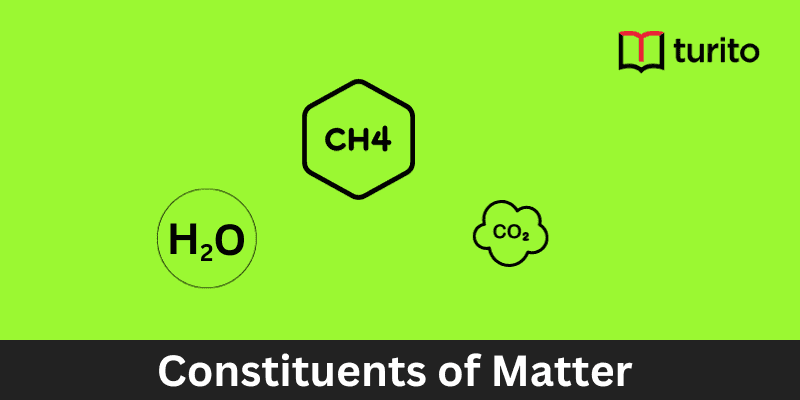
Constituents of Matter
 Introduction
An atom is the smallest unit of matter that retains all the properties of an element. Atoms combine to form molecules. An atom is the basic form of matter. The matter has mass and occupies space. The matter is defined as everything composed of elementary particles. All matter is made up of tiny particles, such as atoms, molecules or ions.
Each particle attracts other particles. In other words, each particle attracts other particles towards itself. These particles are always moving.
There are four states or forms of matter.
- Solid
- Liquid
- Gas
 Explanation
Building blocks of matter consists of all explanations of atoms, states of matter and etc.
The matter has mass and occupies space. Matter is defined as everything composed of elementary fermions.

The matter is classified into mixtures and pure substances.
Atom:
An atom consists of the nucleus at the center. An atom is the basic unit of matter. Atom consists of three sub-atomic particles. Electron, proton and neutrons are the sub-atomic particles of an atom. An atom is the basic constituent unit of matter, which does not exist independently and forms ions and molecules.
Explaining the atom by taking the example of the solar system: In the solar system, the sun is in the center, and the planets revolve around the sun in a circular orbit in the same way as in the atom. The nucleus is in the center and the electrons revolve around the nucleus in a circular orbit.

Elements:
An element is a pure substance formed with atoms that contain the same number of protons. Element is the basic form of matter which cannot be broken down into simpler particles.
Examples: Hydrogen (H2)
Oxygen (O2)

Molecule and compound.
Two or more atoms combine to form a molecule, in which molecule is an independently existing. It won’t be dependent on any other.
A compound is a substance composed of the same or an identical atom with two or more elements.
A molecule consisting of atoms of only one element is, therefore, not a compound.

There are three different states of matter, they are solid, liquid and gases.
Solid:
A solid is a matter with a definite shape and volume. A solid does not change to take the shape of the container it is in. As molecules spread apart, they take up more space.
Example: Spong, chalk, blackboard.
Liquid:
A liquid is a matter that has a definite volume but no definite shape. A liquid takes the shape of its container but keeps the volume the same. The molecules in most liquids are spread out more than those in solids but not nearly as much as those in gases.
Example: Juice, water, milk.
Gases:
Gas is a matter that does not have a definite shape or volume. A gas will fill the container it is in.
Example: Balloon, gas cylinder.

Summary
- An atom is the smallest unit of matter that retains all the properties of an element.
- Gas is a matter that does not have a definite shape or volume.
- The molecules in most liquids are spread out more than those in solids but not nearly as
much as those in gases. - All matter is made up of tiny particles, such as atoms, molecules or ions.
- Two or more atoms combine to form a molecule. A compound is a substance composed of
the same or an identical atom with two or more elements. - An atom consists of three sub-atomic particles. Electron, proton, and neutrons are the
sub-atomic particles of an atom. - An element is a pure substance formed with atoms that contain the same number of protons.
Related topics
Acid–Base Indicators: Types, Examples, and Uses
Key Concepts Introduction: Indicators – Acids and Bases By now, we know that substances like tomatoes, lemon, pineapples taste sour because they contain acids. In contrast, substances like detergents and soaps feel bitter and slippery because they contain the substance known as base. How do we find it acidic or basic if we cannot taste every […]
Read More >>Importance of pH in Everyday Life – Class 10 Chemistry
Importance of pH in Everyday Life The importance of pH in everyday life class 10 is an important topic of Chemistry. We use the concept of pH in many situations around us, even without realizing it. It is about knowing about the application of pH in daily life. It tells you how acidic or basic […]
Read More >>
Versatile Nature of Carbon: Saturated Hydrocarbons (Alkanes)
Introduction: Carbon is one of the most important non-metallic elements. This is because carbon atoms make up the backbone of many important molecules in the human body, including proteins, DNA and RNA, sugars, and fats. The special significance of carbon lies in forming two types of compounds—organic and inorganic compounds. The entire field of organic […]
Read More >>
Details and Examples of Inorganic Carbon Compounds
Introduction: Carbon is one of the most valuable non-metallic elements. Carbon atoms make up the backbone of many important molecules in the human body, including proteins, DNA, RNA, sugars, and fats. The special significance of carbon lies in forming two types of compounds—organic and inorganic compounds. The study of the chemistry of carbon and its […]
Read More >>

Other topics



Comments: