



Classification of Elements: Metals, Non Metals and Metalloids

Key Concepts
• Elements
• Metals
• Non-Metals
• Metalloids
Metals, Non-Metals and Metalloids
Elements:
The combination of the one and only one atom is called the element. Examples of the elements are carbon, oxygen, hydrogen, and so on.

The elements are classified based on the properties like appearance, malleability, and others. There are a total of three types of classification of the elements, and they are:
- Metals
- Non-metals
- Metalloids
Metals:
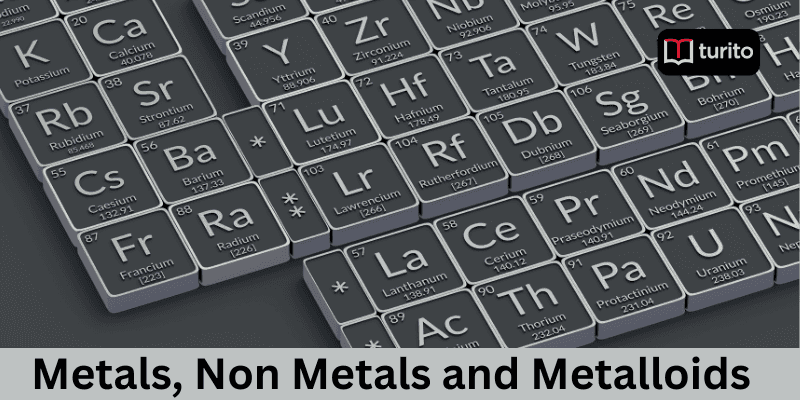
Metals are elements that have some specific properties and are present on the extreme left corner of the periodic table. Some of their properties are:
- Physical state: Metals are usually solid at room temperature.
- Appearance: Metals look shiny luster when light reflects from them.
- Conductivity: Metals are very good conductors of electricity.
- Malleability and Ductility: It is the property of beating the metal hard to a thin sheet and then to a wire. Metals have this property.

Non-metals:
Most non-metals are found naturally as gasses in the air. A few are solids found in the Earth’s crust, such as the sulfur that occurs around volcanoes. The elements that are not metals are called non-metals. The physical properties of non-metals are very different from those of metals. The non-metals are present towards the right side of the periodic table. The count of non-metals is less than that of metals.
- Physical state: Non-metals can exist in any of the states. They can be either solid, liquid, or gas at room temperature.
- Appearance: Non-metals lack the property of shiny luster in them.
- Conductivity: Non-metals do not conduct electricity and act as the insulators.
- Malleability and Ductility: Non-metals do not show the property of malleability and ductility. When they are beaten, they turn into powder.

Metalloids:
Metalloids act like non-metals. However, they also have some properties that are more like those of metals. Metalloids are semiconductors, meaning that they can conduct electricity under certain conditions. This ability has made silicon and germanium ideal materials from which to build electronic components. These components are used in devices such as laptops, LED TVs and smartphones. Metalloids are the elements that have the property of both metals and non-metals as well. The quantity of the metalloids in the periodic table is very less in quantity when compared to the other.
- Physical State: Metalloids are solid in structure.
- Appearance: Metalloids can be shiny like metals, and some others are dull like non-metals. There is no fixed look for the metalloids.
- Conductivity: The metalloids act like the conductors for heat and electricity as metals, and some others act as insulators. In general, they are semiconductors.
- Malleability and Ductility: Metalloids can be brittle in nature but not ductile.

A clear comparison of all three types of elements is shown in the below table:

Summary
• Elements are the combination of the same type of atoms.
• The elements are of three types:
1. Metals
2. Non-metals
3. Metalloids
• Alloys are the combinations of metals in some particular ratio.
Related topics
Acid–Base Indicators: Types, Examples, and Uses
Key Concepts Introduction: Indicators – Acids and Bases By now, we know that substances like tomatoes, lemon, pineapples taste sour because they contain acids. In contrast, substances like detergents and soaps feel bitter and slippery because they contain the substance known as base. How do we find it acidic or basic if we cannot taste every […]
Read More >>Importance of pH in Everyday Life – Class 10 Chemistry
Importance of pH in Everyday Life The importance of pH in everyday life class 10 is an important topic of Chemistry. We use the concept of pH in many situations around us, even without realizing it. It is about knowing about the application of pH in daily life. It tells you how acidic or basic […]
Read More >>
Versatile Nature of Carbon: Saturated Hydrocarbons (Alkanes)
Introduction: Carbon is one of the most important non-metallic elements. This is because carbon atoms make up the backbone of many important molecules in the human body, including proteins, DNA and RNA, sugars, and fats. The special significance of carbon lies in forming two types of compounds—organic and inorganic compounds. The entire field of organic […]
Read More >>
Details and Examples of Inorganic Carbon Compounds
Introduction: Carbon is one of the most valuable non-metallic elements. Carbon atoms make up the backbone of many important molecules in the human body, including proteins, DNA, RNA, sugars, and fats. The special significance of carbon lies in forming two types of compounds—organic and inorganic compounds. The study of the chemistry of carbon and its […]
Read More >>

Other topics



Comments: