



pH of Salts

Key Concepts
- pH of salts
- Acidic salts
- Basic salts
- Neutral salts
Introduction:
pH in everyday life:
pH is used for digestion. pH is used to crop plants in soil. pH is used as self-defence by plants and animals. pH knowledge helps prevent tooth decay, maintain the health of plants, etc.
Explanation:
Salts:
Salts are substances usually formed by reacting an acid with a base. Salts are neutralized products.
Salt formation:
Salts are formed by exchanging ions between an acid and a base called a neutralization reaction.
Example: HCl + NaOH → NaCl + H2O
The pH of salts:
Salts have a wide range of pH; accordingly, their nature varies.

- Acidic salts
- Basic salts
- Neutral salts

Acidic salts:
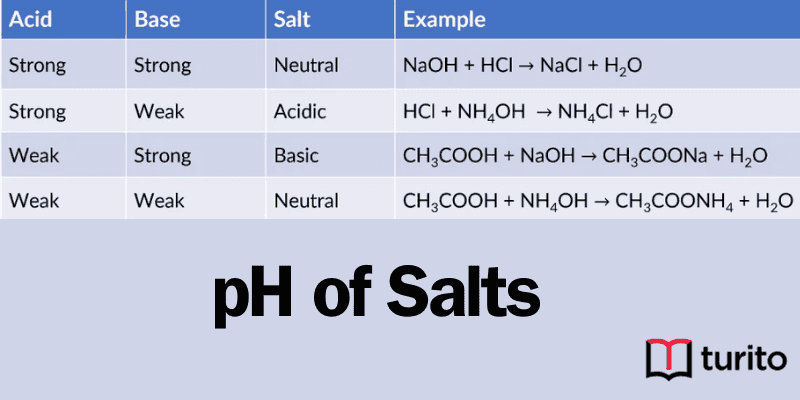
Salts that have a pH of less than 7 are acidic salts. Acidic salts are formed from a strong acid and weak base.
Example: HCl + NH4OH → NH4Cl + H2O
Basic salts:
Salts that have a pH greater than 7 are basic salts. Basic salts are formed from a strong base and weak acid.
Example: CH3COOH + NaOH → CH3COONa + H2O
Neutral salts:
Salts that have a pH equal to 7 are neutral salts. Neutral salts are formed from a strong base and strong acid.
Example: HCl + NaOH → NaCl + H2O
Salts family:
Sodium salts
Salts that contain sodium cation or positive radicals are considered sodium salts.
Example: Sodium chloride and Sodium sulfate
Chloride salts:
Salts that contain chloride anion or negative radicals are considered chloride salts.
Example: Sodium chloride and Potassium chloride


Activity:
Write the chemical formula for the following compounds:
- Sodium chloride
- Sodium sulfate
- Potassium chloride
- Potassium sulfate
- Aluminum chloride
Identify from which acid and base they are obtained. Find the family of salts.
Results:
Sodium chloride & sodium sulfate belongs to the sodium family. Potassium chloride & potassium sulfate belongs to the potassium family. Sodium chloride & aluminum chloride belongs to the chloride family.
Ionic salts and Covalent salts:
Salts that can be dissolved in water completely and turn into ions are called ionic salts.
Example: Magnesium carbonate, Sodium carbonate
Salts that are partially dissolved or not dissolved in water are called covalent salts.
Example: Glucose, Fructose
Activity:
Collect salts samples –
- Sodium chloride
- Potassium nitrate
- Aluminum chloride
- Zinc sulfate
- Copper sulfate
- Sodium acetate
- Sodium carbonate
- Sodium hydrogen carbonate
Check the solubility in distilled water. Find the pH of solutions with litmus paper. List them as acidic, basic and neutral salts.
Observations:
Salts that are soluble in water –
- Sodium chloride – sodium ion & chloride ion
- Potassium ion & nitrate ion
- Aluminum ion & chloride ion
- Zinc ion & sulfate ion
- Copper sulfate
- Sodium acetate
- Sodium carbonate
- Sodium hydrogen carbonate
Results:
Acidic salts (turns blue to red) –
- Aluminum chloride
- Zinc sulfate
- Copper sulfate
Basic salts (turns red to blue) –
- Sodium acetate
- Sodium carbonate
- Sodium hydrogen carbonate
Neutral salts (no change in litmus) – Sodium chloride
Chemical formula and common names of salts:
Salts are given a chemical formula based on the number of cations and anions present in the substance.
Chemical names –
- Sodium chloride – NaCl Sodium chloride – Table salt
- Potassium nitrate- KNO3 – saltpeter
- Aluminum chloride-AlCl3
- Zinc sulfate-ZnSO4 – White vitriol
- Copper sulfate-CuSO4 -Blue vitriol
- Sodium acetate-CH3COONa
- Potassium nitrate
- Sodium carbonate-Na2CO3-Washing soda
- Sodium hydrogen carbonate-NaHCO3 – Baking soda
Summary
- Salts have different pH values and according to they are three types-Acidic, basic and neutral.
- Salts pH can be identified by dissolving them in water and forming ions and testing with litmus paper.
- Acidic salts are formed from strong acid and weak base.
- Basic salts are formed from strong base and weak acid.
- Neutral salts are formed by strong acid and strong base.
Related topics
Acid–Base Indicators: Types, Examples, and Uses
Key Concepts Introduction: Indicators – Acids and Bases By now, we know that substances like tomatoes, lemon, pineapples taste sour because they contain acids. In contrast, substances like detergents and soaps feel bitter and slippery because they contain the substance known as base. How do we find it acidic or basic if we cannot taste every […]
Read More >>Importance of pH in Everyday Life – Class 10 Chemistry
Importance of pH in Everyday Life The importance of pH in everyday life class 10 is an important topic of Chemistry. We use the concept of pH in many situations around us, even without realizing it. It is about knowing about the application of pH in daily life. It tells you how acidic or basic […]
Read More >>
Versatile Nature of Carbon: Saturated Hydrocarbons (Alkanes)
Introduction: Carbon is one of the most important non-metallic elements. This is because carbon atoms make up the backbone of many important molecules in the human body, including proteins, DNA and RNA, sugars, and fats. The special significance of carbon lies in forming two types of compounds—organic and inorganic compounds. The entire field of organic […]
Read More >>
Details and Examples of Inorganic Carbon Compounds
Introduction: Carbon is one of the most valuable non-metallic elements. Carbon atoms make up the backbone of many important molecules in the human body, including proteins, DNA, RNA, sugars, and fats. The special significance of carbon lies in forming two types of compounds—organic and inorganic compounds. The study of the chemistry of carbon and its […]
Read More >>

Other topics





Comments: