



Potential Energy and Potential Difference

Key Concepts
- Explaining potential energy
- Explaining potential difference
Introduction:
When a free positive charge is left, it has some potential energy in it. This potential energy is converted into kinetic energy when it moves towards the negative charge. In this section, we will be looking at the various basic concepts that one requires to bear in mind about potential energy due to charges and the potential difference created between the positive charges and negative charges. We are also going to apply the formula and calculate the potential difference when work done on or by the charges is given to us along with the amount of charge.
Explanation:
Potential energy:
Consider a charge “q”. This charge is analogous to the mass “m”. When this mass “m” is raised to a height, it acquires gravitational potential energy because of its height and mass. Similarly, this charge “q”, when moved, has some potential energy stored it known as electrical potential energy.
In the case of the object of mass “m” or in the charge “q”, work is done on both of them and this work gets stored in the form of energy.

Potential difference:
When this mass “m” is dropped from a height, the potential energy stored in it gets converted to kinetic energy, and it tends to move from a higher potential to a lower potential.

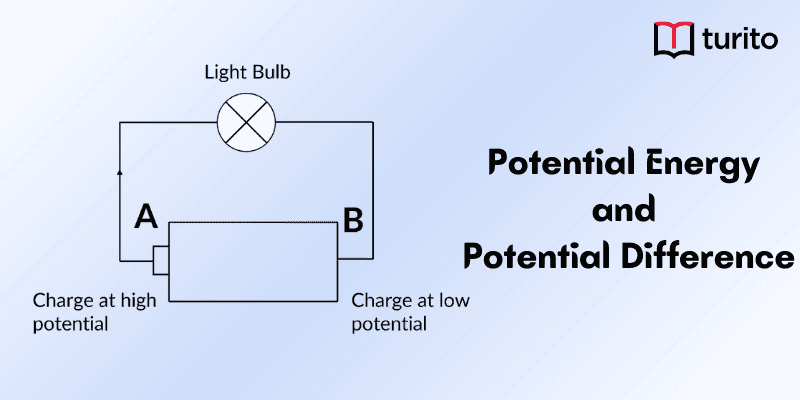
In this process, work is done by the mass “m”. Similarly, when a test charge “+q” is placed near a group of positive charges and at some distance from negative charges, the charge “+q” experiences repulsion from positive charges and attraction from negative charges. Positive charges are at higher potential as compared to the negative charges, and thus work is done by the positive test charge in moving from positive charges to negative charges.

This is the reason why the direction of charges in the battery is from a positive terminal to a negative terminal or, in other words, from higher potential to lower potential.

Potential Difference across points A and B = VAB = VA – VB
Questions and answers:
Q1. Two positive charges are equal. Which has more electric potential energy?

Ans 1: Point A
Q2. Calculate the electric potential difference across the component.


Ans 2:
VA= +8 V
VB = +5 V
VAB = VA – VB
= 8 – 5
= 3 V
Q3. Calculate the electric potential difference across the component.


Ans 2: VA= +6 V
VB = -2 V
VAB = VA – VB
= 6 – (-2)
= 8 V
Summary
- Current flow is from high potential to low potential
- Potential difference between two points is the work done to move a point charge from one point to another.
- Work is done by the cell to move electrons through the wire.
Related topics
Acid–Base Indicators: Types, Examples, and Uses
Key Concepts Introduction: Indicators – Acids and Bases By now, we know that substances like tomatoes, lemon, pineapples taste sour because they contain acids. In contrast, substances like detergents and soaps feel bitter and slippery because they contain the substance known as base. How do we find it acidic or basic if we cannot taste every […]
Read More >>Importance of pH in Everyday Life – Class 10 Chemistry
Importance of pH in Everyday Life The importance of pH in everyday life class 10 is an important topic of Chemistry. We use the concept of pH in many situations around us, even without realizing it. It is about knowing about the application of pH in daily life. It tells you how acidic or basic […]
Read More >>
Versatile Nature of Carbon: Saturated Hydrocarbons (Alkanes)
Introduction: Carbon is one of the most important non-metallic elements. This is because carbon atoms make up the backbone of many important molecules in the human body, including proteins, DNA and RNA, sugars, and fats. The special significance of carbon lies in forming two types of compounds—organic and inorganic compounds. The entire field of organic […]
Read More >>
Details and Examples of Inorganic Carbon Compounds
Introduction: Carbon is one of the most valuable non-metallic elements. Carbon atoms make up the backbone of many important molecules in the human body, including proteins, DNA, RNA, sugars, and fats. The special significance of carbon lies in forming two types of compounds—organic and inorganic compounds. The study of the chemistry of carbon and its […]
Read More >>

Other topics



Comments: