



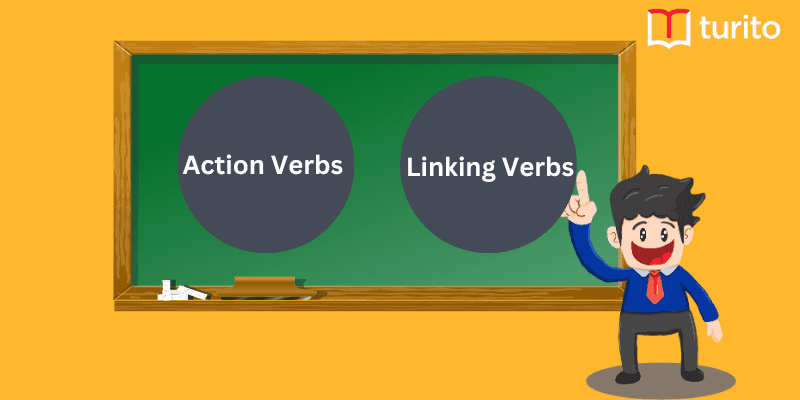
Action Verbs and Linking Verbs

Read the following sentences:
- Richard is an eye specialist.
- Rebecca seems like a nice person.
- Ross is a paleontologist.
The verbs underlined in the sentences are called the linking verbs.
These sentences talk only about the subject. The predicate parts in the said sentences simply elaborate on the subjects and give the reader an extra layer of information about the subjects in question. And these subjects and their complements do not appear together. They are separated by verbs. But these verbs do not tell the reader what action the subject is currently performing, which leaves a sense of incompleteness. They just describe the condition the subject is in. Therefore, they are called the linking verbs.
Read the following sentences:
- Martin cooked food.
- Tom writes novels.
- Simona will be typing the notes.
The verbs underlined in the sentences are called the action verbs.
In these sentences, the predicate part has an object upon which the subject does the action. Here, the state of being of the subject is not mentioned. Rather, the emphasis is on the subject and the action that it does. To put it in a simple way, the verbs in these sentences indicate what the subject is doing at the timeline in which the sentence is placed and even if the objects are removed, the sentences still look complete because of these verbs. Therefore, they are called the action verbs.

Linking Verbs:
Linking verbs are the verbs that connect the subject of a sentence with a word or a phrase that gives the reader further information about the subject. The information shared by these words will be, in most cases, the condition of the subject.
The most frequently used linking verbs in English are all forms of to be and all the sense verbs, like;
- Mark is a politician.
- Tim was an engineer.
- Sam has become a very responsible citizen.
- Becky seems like a very nice person.
All forms of to be are called true linking verbs.
But given the ambiguous nature of the English language, some linking verbs serve dual purpose;i.e., they act both as linking verbs and as action verbs. Some verbs that perform the functions of both the linking verbs and action verbs are all the sense verbs like look, touch, smell, sound, taste, feel,etc.
Yet, with the help of the following test, we can decide whether the given verb is a linking verb or an action verb.
Read the sentence:
I tasted the soup that Harry made yesterday.
Now, substitute taste with a true linking verb that agrees with the subject. In this case, it would be amand the sentence would read:
I am the soup that Harry made yesterday.
Here, after substituting the given verb with a true linking verb, the sentence doesn’t make any sense. Therefore, in the given sentence, tasted is not a linking verb.
Read the sentence:
The soup tasted delicious.
Now, substitute taste with a true linking verb that agrees with the subject. In this case, it would be wasand the sentence would read:
The soup was delicious.
Here, even after substitution, the meaning of the sentence remains the same and it still makes sense. Therefore, in the given sentence, tasted is a linking verb.
Action Verbs:
Action verbs are the ones that tell us what the subject of the sentence is doing. They express the physical and the mental actions.
One major peculiarity of the action verbs is that they can provide the reader with instant information that can have an impact. They help the reader in forming a clear, precise image of the subject engaged in the action. Furthermore, action verbs help the flow of an article or speech by eliminating the need for unnecessary transitional words like also.
Examples:
- Bill is talking to the doctor.
- Andrew plays football.
- The referee blew the whistle.
Action verbs are of two types: Transitive verbs and intransitive verbs.
1. Transitive Verbs:
Transitive verbs are the ones that have a noun upon which the action is done. This noun, that receives the action of the subject is called the direct object.
Examples:
- Carmella wrote a book.
- Sasha invited Jack to the party.
- Melvin gifted Martha a watch.
In these sentences, the direct objects that receive the action done by the subjects are:
The book, which was written by Carmella.Jack, who was invited by Sasha. The watch, which was gifted by Melvin.
2. Intransitive Verbs:
Intransitive verbs are the ones that do not have a direct object. They just express the state or being of the subject.
Examples:
- Morgan ran quickly to the school.
- I was sleeping in my room.
- My grandfather passed away.
Related topics
Naming Words for Class 2: Simple English Guide
Naming words are names of people, animals, birds, places or things. E.g. Leo, Rat, Crow, London, Book Four types of naming words E.g. Leo, Andrea, Father, Mother E.g. School, London, Park, New york E.g. Tiger, Monkey, Cow, Parrots E.g. Box, Pen, Apples, Car Everything that we can touch, feel, see and talk about is represented by […]
Read More >>Types of Nouns: Definition, Kinds, and Examples
If you’ve developed a nascent interest in the English language already, or your child enjoys reading from the English signboards and alphabet books, it’s time that they were introduced to nouns. Nouns (or naming words, as they are conveyed to kids) are the flat concrete surface on which your child or student’s vocabulary will be […]
Read More >>
Context Clues
What Are Context Clues? Context clues are small hints in a sentence or paragraph that you can see. It helps you understand the meaning of a word you do not know. For this, you will not need to use a dictionary. The sentence itself helps you understand. When you read, the words near can be […]
Read More >>
Speech Writing: Format, Topics, and Examples
What Is Speech Writing? While writing a speech we should concentrate on the three ‘C’s. Your speech should be clear, concise, and consistent. Let’s see the format of speech writing. Speech Writing Format It contains two parts. Title: Give a good title to the topic while writing a speech. Content: The content section is divided […]
Read More >>

Other topics




Comments: