



Active and Passive Voice

Voice, it is also known as diathesis, is a grammatical feature that describes the relationship between the subject in a sentence and the verb.
Active Voice
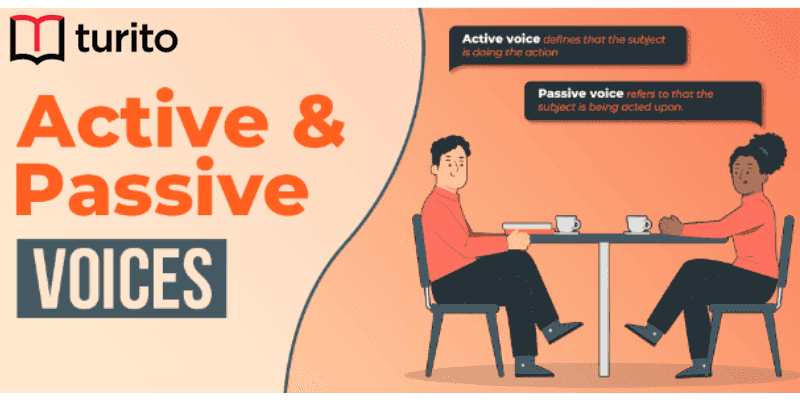
When the subject of a sentence is the doer or actor, the verb is in the active voice. It is so because the subject is active.
- I see the Academy Awards ceremony every year.
- Do you know the winners’ names?
Passive Voice
In passive-voice sentences, the subject is the receiver of the action.
A passive-voice verb is utilized in the past participle form preceded by the auxiliary verb “be.”
- The Academy Awards ceremony is seen by millions.
- The winners’ names are not known until the night of the ceremony.
General rules of Voice Change:
- The object of the action word in the active voice will be the subject of the action word in the aloof voice.
- The subject of the action word in the active voice will be the object in the passive voice. (Generally preceded by the preposition “by”)
- The main verb is transformed into the past participle form, and it is preceded by the correct form of the verb ‘to be ‘in passive voice.
- There are some verbs with the objects. In such cases, either of the objects can be changed into the subject, and other is retained as an object. The objects are called retained objects.
Use of Passive Voice:
- When the receiver of the action is essential: To emphasize the importance of the receiver of the action.
- When articulating a professional, neutral, or objective tone: To articulate a neutral, professional, or objective tone.
- Generally, the receiver of the action functions as the primary topic throughout the text.
- It is used when the agent is unknown, irrelevant, or implied.
- It is used while softening an authoritative tone.

Related topics
Naming Words for Class 2: Simple English Guide
Naming words are names of people, animals, birds, places or things. E.g. Leo, Rat, Crow, London, Book Four types of naming words E.g. Leo, Andrea, Father, Mother E.g. School, London, Park, New york E.g. Tiger, Monkey, Cow, Parrots E.g. Box, Pen, Apples, Car Everything that we can touch, feel, see and talk about is represented by […]
Read More >>Types of Nouns: Definition, Kinds, and Examples
If you’ve developed a nascent interest in the English language already, or your child enjoys reading from the English signboards and alphabet books, it’s time that they were introduced to nouns. Nouns (or naming words, as they are conveyed to kids) are the flat concrete surface on which your child or student’s vocabulary will be […]
Read More >>
Context Clues
What Are Context Clues? Context clues are small hints in a sentence or paragraph that you can see. It helps you understand the meaning of a word you do not know. For this, you will not need to use a dictionary. The sentence itself helps you understand. When you read, the words near can be […]
Read More >>
Speech Writing: Format, Topics, and Examples
What Is Speech Writing? While writing a speech we should concentrate on the three ‘C’s. Your speech should be clear, concise, and consistent. Let’s see the format of speech writing. Speech Writing Format It contains two parts. Title: Give a good title to the topic while writing a speech. Content: The content section is divided […]
Read More >>

Other topics



Comments: