



Adjectives Acting – As Noun, As Verbs

ADJECTIVES ACTS AS NOUN:
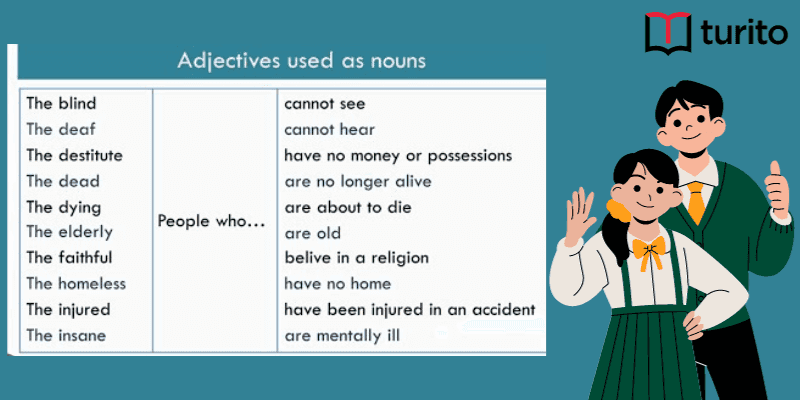
- The common way we use adjectives as nouns is to talk about groups.
- A group is a collection of many things or people that can be described as adjectives.
- Adjectives are used to describe a group of things or people will follow the article.
- Examples: The rich, the poor, the strong, the weak, the old, the young, the willing, the brave, the blessed, the confident, etc.
- Here the young is talking about the young people as a group.
- Some adjectives don’t follow “the”.
- Let’s see an example of an adjective that becomes a noun without following “the”.
‘How does your city government help its homeless?’
- Here “homeless” is a noun that talks about the collection of people who live on the street in the city.
- We learned that these adjectives used as nouns talk about groups of people or things.
- Group is a singular countable noun and singular countable nouns can’t be used by themselves.
- When the noun means a group, it follows the same rule as all singular countable nouns.
- The new noun will usually follow the article “THE”, but it will sometimes follow a possessive form.
ADJECTIVES ACT AS VERBS:
- Verbs are action words used to describe a state or occurrence, and form the main part of the predicate of a sentence, such as hear, become, happen, etc.
- Adjectives are words that describe or alter another person or thing in a sentence.
- One type of adjective procures from and derives its meaning from verbs.
- It is generally called a participle adjective as it is formed from a verb’s participle form.
- Deverbal adjectives are adjectives derived from verbs.
- Facilitative and agentive adjectives are some of the kinds of adjectives derived from verbs.
- The suffix –I’ve is attached to the following verbs to procure adjectives.
Examples
Attract – Attractive
Elude – Elusive
- Sometimes the present participle (verb+ing) form of a verb becomes an adjective.
- Example:
“A rolling rock gathers no algae.”
- In some situations, the past participle form of a verb becomes an adjective.
- Such adjectives are sometimes called participle or verbal adjectives.

Related topics
Naming Words for Class 2: Simple English Guide
Naming words are names of people, animals, birds, places or things. E.g. Leo, Rat, Crow, London, Book Four types of naming words E.g. Leo, Andrea, Father, Mother E.g. School, London, Park, New york E.g. Tiger, Monkey, Cow, Parrots E.g. Box, Pen, Apples, Car Everything that we can touch, feel, see and talk about is represented by […]
Read More >>Types of Nouns: Definition, Kinds, and Examples
If you’ve developed a nascent interest in the English language already, or your child enjoys reading from the English signboards and alphabet books, it’s time that they were introduced to nouns. Nouns (or naming words, as they are conveyed to kids) are the flat concrete surface on which your child or student’s vocabulary will be […]
Read More >>
Context Clues
What Are Context Clues? Context clues are small hints in a sentence or paragraph that you can see. It helps you understand the meaning of a word you do not know. For this, you will not need to use a dictionary. The sentence itself helps you understand. When you read, the words near can be […]
Read More >>
Speech Writing: Format, Topics, and Examples
What Is Speech Writing? While writing a speech we should concentrate on the three ‘C’s. Your speech should be clear, concise, and consistent. Let’s see the format of speech writing. Speech Writing Format It contains two parts. Title: Give a good title to the topic while writing a speech. Content: The content section is divided […]
Read More >>

Other topics





Comments: