



Author’s Purpose and Tone

Author’s Purpose:
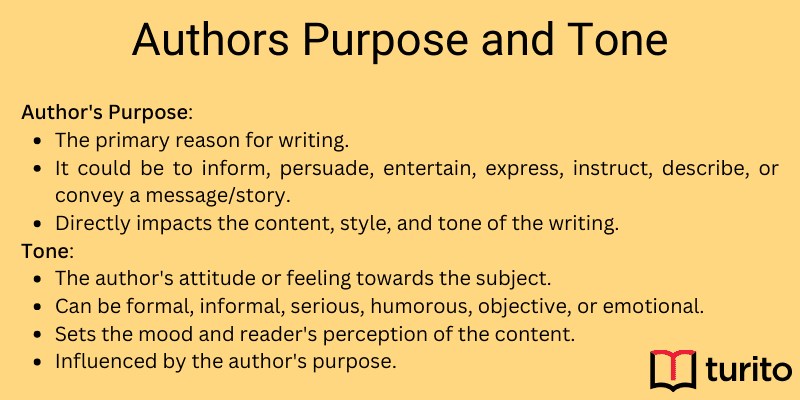
The author’s purpose is the reason why he/she is writing on a topic.
An author writes to communicate the main point about a subject. The core idea of a work is inextricably linked to the author’s goal.
An author’s purpose can be divided into three:
1. To Inform-
To provide information about a topic. Authors with this goal want to present facts that will help readers understand or learn anything.
Example:
Pain is a natural aspect of the human body that alerts us when something is amiss.

2. To Entertain-
To delight and amuse; to appeal to the senses and imagination of the reader. Authors with this goal set out to captivate or pique the audience’s interest.
Example:
“Yes, I have put on some weight. I weighed only seven pounds when I was born.”
3. To Persuade-
To persuade the reader to agree with the author’s viewpoint on a topic. Authors with this intention may include facts, but their primary goal is to persuade or convince readers.
Example:
The death penalty should be abolished as it is deeply flawed.
Author’s Tone:
The author’s tone is his or her attitude toward the subject. The author’s mood is reflected in the words and details he or she chooses.
Textbooks, for example, are typically written in an objective tone with facts and rational explanations. The objective tone is unbiased and matter-of-fact. The majority of the information is factual.
Fiction and personal essays, on the other hand, are frequently written in a subjective tone. Words that describe feelings, judgments, or views are used in a subjective tone. Experiences, sensations, sentiments, and thoughts are likely to be included in the specifics.
The author’s tone is conveyed by the words and details he or she chooses. You must pay attention to how these words and elements are used in the text to identify the author’s tone.
Examples:
- This place may be run-down, yet it holds a particular place in my heart because it is where both of my children were born. – Sentimental tone
- This house does require some repairs, but I’m confident that the landlord will address them shortly. – Optimistic tone
Related topics
Naming Words for Class 2: Simple English Guide
Naming words are names of people, animals, birds, places or things. E.g. Leo, Rat, Crow, London, Book Four types of naming words E.g. Leo, Andrea, Father, Mother E.g. School, London, Park, New york E.g. Tiger, Monkey, Cow, Parrots E.g. Box, Pen, Apples, Car Everything that we can touch, feel, see and talk about is represented by […]
Read More >>Types of Nouns: Definition, Kinds, and Examples
If you’ve developed a nascent interest in the English language already, or your child enjoys reading from the English signboards and alphabet books, it’s time that they were introduced to nouns. Nouns (or naming words, as they are conveyed to kids) are the flat concrete surface on which your child or student’s vocabulary will be […]
Read More >>
Context Clues
What Are Context Clues? Context clues are small hints in a sentence or paragraph that you can see. It helps you understand the meaning of a word you do not know. For this, you will not need to use a dictionary. The sentence itself helps you understand. When you read, the words near can be […]
Read More >>
Speech Writing: Format, Topics, and Examples
What Is Speech Writing? While writing a speech we should concentrate on the three ‘C’s. Your speech should be clear, concise, and consistent. Let’s see the format of speech writing. Speech Writing Format It contains two parts. Title: Give a good title to the topic while writing a speech. Content: The content section is divided […]
Read More >>

Other topics





Comments: