



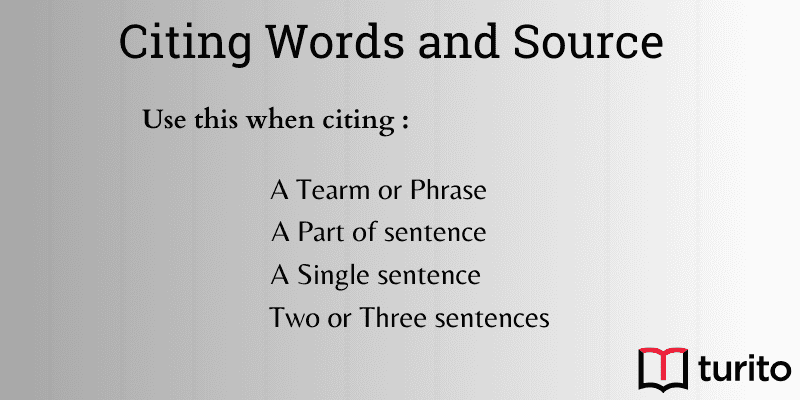
Citing Words and Source

You will most likely use materials such as books, articles, and webpages created by others to support your thesis when writing a research paper, lab report, or any other form of academic project. When using someone else’s information, however, you must provide credit where it is due. Plagiarism occurs when you fail to acknowledge your sources. It is a serious offence that can result in a grade reduction or a failing grade.
Within your research paper, there are a variety of styles for giving credit (also known as bibliographic citation) to external sources.
Other sources of information must be acknowledged both inside the text (in text or parenthetical citations) and at the conclusion of the work (in a Works Cited list). All references listed in the text must also appear in the Works Cited list, and vice versa.
The list of works referenced should begin on a new page and continue the text’s page numbers (e.g., if the text of your paper ends on page 12, the works cited list should begin on page 13). At the top of the page, the words Works Cited should be centered. Double-spacing is required for all entries (most of the handout use single spaced examples throughout due to space limitations). The first line of each item is flat left in MLA, while the succeeding lines are indented 5-7 spaces or one tab in MLA.
The author’s name, title, date of publication, publisher information, and medium type must all be included in a Works Cited citation (print, web, etc.).

Let us take a look through some examples on how to give the right Work Cited list citations.
General format for citing books:
While citing a book, there are four main parts that should be incorporated: the author’s name, the title of the book (italicized), the publisher information and the medium type (print, web, etc).
- Author’s last name, first name. Title of the Book. City: Publisher, year. Medium.
Book with no author or an unknown author:
Use the title if there is no author or if the author is unknown. Shorter titles can be cited in full in the body of the text. Longer titles can be condensed for in-text citations, but the first word (excluding articles like a, an, the, and so on) must remain in order for the title to appear in the alphabetized bibliography at the end of the work. Italicize the titles of whole works (for example, book titles).
Example:
In text: (Encyclopedia of Virginia 212)
Works cited: Encyclopedia of Virginia. New York: Somerset, 1993. Print.
Book with one author:
In text: (Barnet 97)
Works cited: Barnet, Sylvan. The Practical Guide to Writing. Toronto: Longman, 2003. Print.
Book with two or three authors:
In text: (Booth, Colomb, and Williams 190)
Works cited: Booth, Wayne C., Gregory G. Colomb, and Joseph M. Williams. The Craft of Research. 2nd ed. Chicago: U of Chicago P, 2003. Print.
The first author’s name is reversed, with the last name coming before the first. The second and third authors’ names are listed in alphabetical order by first and last name. In the same sequence as they appear on the title page, list the names.
Books with four or more authors:
Either list all writers or just the first one, with the phrase et al (“and others”) after it. For both the in-text citation and the works cited item, use the same format.
Example:
In text: (Barclay et al. 144-145)
Works cited: Barclay, Michael, et al. Have Not Been the Same: The Can Rock Renaissance, 1985-95. Toronto: ECW, 2001. Print.
Edited, translated, or compiled book:
Example:
In text: (Greenspan and Rosenberg 77)
Works cited: Greenspan, Edward, and Marc Rosenberg, eds. Martin’s Annual Criminal Code: Student Edition 2010. Aurora: Canada Law Book, 2009. Print.
Related topics
Naming Words for Class 2: Simple English Guide
Naming words are names of people, animals, birds, places or things. E.g. Leo, Rat, Crow, London, Book Four types of naming words E.g. Leo, Andrea, Father, Mother E.g. School, London, Park, New york E.g. Tiger, Monkey, Cow, Parrots E.g. Box, Pen, Apples, Car Everything that we can touch, feel, see and talk about is represented by […]
Read More >>Types of Nouns: Definition, Kinds, and Examples
If you’ve developed a nascent interest in the English language already, or your child enjoys reading from the English signboards and alphabet books, it’s time that they were introduced to nouns. Nouns (or naming words, as they are conveyed to kids) are the flat concrete surface on which your child or student’s vocabulary will be […]
Read More >>
Context Clues
What Are Context Clues? Context clues are small hints in a sentence or paragraph that you can see. It helps you understand the meaning of a word you do not know. For this, you will not need to use a dictionary. The sentence itself helps you understand. When you read, the words near can be […]
Read More >>
Speech Writing: Format, Topics, and Examples
What Is Speech Writing? While writing a speech we should concentrate on the three ‘C’s. Your speech should be clear, concise, and consistent. Let’s see the format of speech writing. Speech Writing Format It contains two parts. Title: Give a good title to the topic while writing a speech. Content: The content section is divided […]
Read More >>

Other topics



Comments: