



Dashes and Parentheses

Read the following sentences:
- NASA (National Aeronautics and Space Administration)was established in 1958.
- Thomas was extremely talented- the most brilliant of students I have ever met.
In the above sentences, there is an extra layer of information/detailing about the subject that is being talked about. But here, the punctuation mark used in both sentences is not a comma.
In sentence 1, we could have easily done away with the expansion of the acronym NASA. The addition of the National Aeronautics and Space Administration can be seen as a passing comment because its absence wouldn’t have made much difference to the sentence. The brackets in the sentence are called parentheses.
In sentence 2, the main sentence is slightly interrupted so that it makes way for the phrase that follows the punctuation mark used. Here, the additional phrase serves to grab the attention of the reader to the subject Thomas. The punctuation mark used in the sentence is called a dash.
Parentheses:
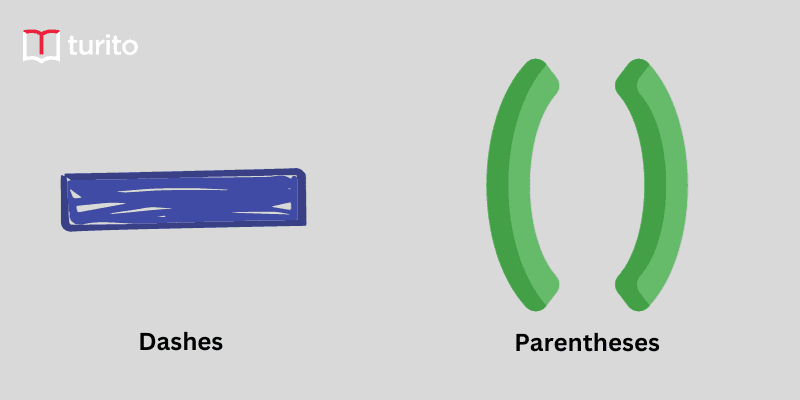
Parentheses are a pair of signs () that can be used to separate a phrase or a clause that does not grammatically belong to the main part of a sentence. They are used to set off information within a sentence and are capable of enclosing a single word, a phrase, or even an entire sentence. The words inside the parentheses usually provide additional information about something else in the sentence.
Examples:
- Some of the committee members (Mr. Swann and Mr. Smith, for example) raised objection to the proposal.
- The lunch that I had (the delicious, healthy salad) cost me $27.
- Max Dillon (the best written character in The Amazing Spiderman 2) gets an underwhelming conclusion in Spiderman: No Way Home.
According to many modern grammarians, the usage of parenthesis has started to dwindle. In fact, the Associated Press style guide would prefer that we stop using parentheses altogether, as it is jarring to the reader.

Dash:
A dash is a small horizontal line that appears in the center of a line of text. It is frequently used to denote an abrupt stop or a change of thought. If the sentence that precedes the interruption is to be continued, a pair of dashes should be used.
Examples:
- Had we prepared well- but let’s focus on the present.
- I met his parents- both of them- who are very disappointed with his exam results.
- Joshua drove the car faster- he wanted to reach the hospital as soon as possible.
PS: Dashes are generally used in casual texts and are more common in fiction writing. They are not used very frequently in formal writing.
Related topics
Naming Words for Class 2: Simple English Guide
Naming words are names of people, animals, birds, places or things. E.g. Leo, Rat, Crow, London, Book Four types of naming words E.g. Leo, Andrea, Father, Mother E.g. School, London, Park, New york E.g. Tiger, Monkey, Cow, Parrots E.g. Box, Pen, Apples, Car Everything that we can touch, feel, see and talk about is represented by […]
Read More >>Types of Nouns: Definition, Kinds, and Examples
If you’ve developed a nascent interest in the English language already, or your child enjoys reading from the English signboards and alphabet books, it’s time that they were introduced to nouns. Nouns (or naming words, as they are conveyed to kids) are the flat concrete surface on which your child or student’s vocabulary will be […]
Read More >>
Context Clues
What Are Context Clues? Context clues are small hints in a sentence or paragraph that you can see. It helps you understand the meaning of a word you do not know. For this, you will not need to use a dictionary. The sentence itself helps you understand. When you read, the words near can be […]
Read More >>
Speech Writing: Format, Topics, and Examples
What Is Speech Writing? While writing a speech we should concentrate on the three ‘C’s. Your speech should be clear, concise, and consistent. Let’s see the format of speech writing. Speech Writing Format It contains two parts. Title: Give a good title to the topic while writing a speech. Content: The content section is divided […]
Read More >>

Other topics


Comments: