



Phrases vs Clauses

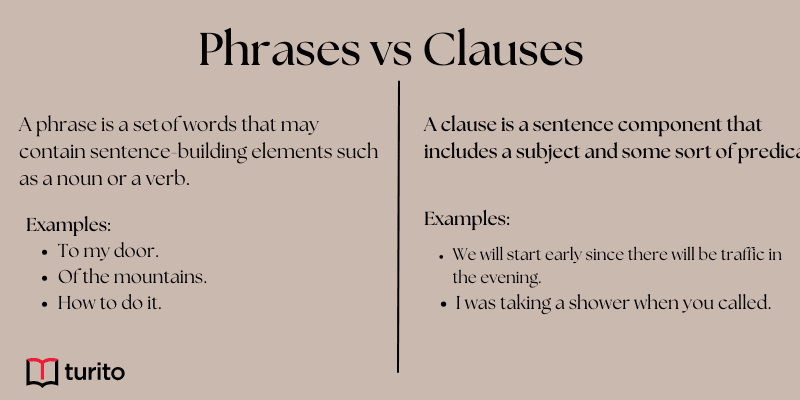
A phrase is a set of words that may contain sentence-building elements such as a noun or a verb.
Examples:
- To my door.
- Of the mountains.
- How to do it.
We know that a sentence is a group of words, which is complete in itself and makes complete sense and that it typically contains a subject and predicate.
But what do we call the group of words that themselves contain a subject and some kind of predicate within a sentence?
They are called clauses.

A clause is a sentence component that includes a subject and some sort of predicate.
Examples:
- We will start early since there will be traffic in the evening.
- I was taking a shower when you called.
Clauses are of two types: Dependent clauses and independent clauses.
Let us take a look at the different types of clauses and see how a clause is different from a phrase:
CLAUSES
1. Independent Clauses
An independent clause, also known as the main clause is a group of words that includes a subject and a predicate that can express a complete thought. An independent clause is capable of standing alone as a sentence.
Examples:
- He came back home in the evening.
- I won’t be able to get this done on time.
- I will be in Germany next week.
2. Dependent Clauses
Read the sentence:
You can call me when you are free.
In this sentence, the main clause is You can call me, which is a complete idea and can also stand to own its own as a sentence. But the group of words that follow-when you are free– acts as a subordinate to the main clause. Though they contain a complete idea within themselves, including a subject and corresponding predicate, the presence of the conjunction when indicates that the clause cannot stand alone as a sentence. It is determined by the main clause.
Now let us define a dependent clause:
A dependent clause is a group of words that has a subject and a predicate but does not express a complete thought. A dependent clause is incapable of standing alone as a sentence as it always needs a main clause to depend upon. Conjunction is frequently used to identify a dependent clause.
In fact, in many cases, the presence of a conjunction is the only thing that distinguishes an independent clause from a dependent clause.
Examples:
- Since the exams is beginning tomorrow, I must sleep earlier tonight.
- The crowd went berserk when their team scored a goal.
- Kelly eats fried food whenever she is away from home.
PHRASES
As explained earlier, a phrase is a set of words that may contain sentence-building elements such as a noun or a verb. It differs from a clause in that it may not include a subject or a predicate. A phrase adds meaning to a sentence by supplying more details regarding the subject, object, verb, or situation. A sentence is also made up of phrases, however, if you isolate a phrase from a sentence, it will not function as a whole sentence. To put it simply, clauses contain phrases, and sentences contain clauses.
Examples of phrases:
- The sun rises in the east.
- Humpty Dumpty sat on a wall.
- Tell me how to do it.
Related topics
Naming Words for Class 2: Simple English Guide
Naming words are names of people, animals, birds, places or things. E.g. Leo, Rat, Crow, London, Book Four types of naming words E.g. Leo, Andrea, Father, Mother E.g. School, London, Park, New york E.g. Tiger, Monkey, Cow, Parrots E.g. Box, Pen, Apples, Car Everything that we can touch, feel, see and talk about is represented by […]
Read More >>Types of Nouns: Definition, Kinds, and Examples
If you’ve developed a nascent interest in the English language already, or your child enjoys reading from the English signboards and alphabet books, it’s time that they were introduced to nouns. Nouns (or naming words, as they are conveyed to kids) are the flat concrete surface on which your child or student’s vocabulary will be […]
Read More >>
Context Clues
What Are Context Clues? Context clues are small hints in a sentence or paragraph that you can see. It helps you understand the meaning of a word you do not know. For this, you will not need to use a dictionary. The sentence itself helps you understand. When you read, the words near can be […]
Read More >>
Speech Writing: Format, Topics, and Examples
What Is Speech Writing? While writing a speech we should concentrate on the three ‘C’s. Your speech should be clear, concise, and consistent. Let’s see the format of speech writing. Speech Writing Format It contains two parts. Title: Give a good title to the topic while writing a speech. Content: The content section is divided […]
Read More >>

Other topics



Comments: