



Elements of Poetry: Meaning, Types & Examples (Grade 8)

Poems are the outcome of poetry. Poets are artists who are responsible for the creative writing of poems. It is difficult to describe poetry, and even specialists in the field frequently dispute on how to define it precisely. A poem is a type of literature that frequently uses rhythm and stylish ways of communicating feelings and ideas, according to a common definition.
A poem is a one-of-a-kind piece of poetry.
Poems don’t have to rhyme; they don’t have to follow any certain format, and they don’t have to use any particular vocabulary or be about any particular subject. But here’s what they must do: employ figurative language to use words artistically. The form of a poem is just as vital as the function, if not more so.
The prose is written in the traditional sentence and paragraph pattern. Prose, while it comes in various forms and tones, closely resembles human speech patterns.
Poetry may communicate emotions and transmit ideas, but it can also do more. Poets use poetry to tell stories, impart lessons, and even express hidden messages. You’re listening to poetry when you listen to music with lyrics.

Now, let us take a look at the different elements of poetry:
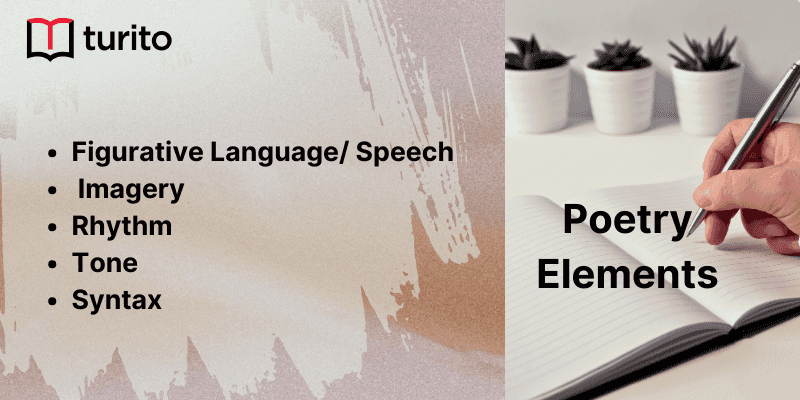
Figurative speech, imagery, rhythm, mood, syntax, etc. are elements of poetry. Each of the following components of poetry will be discussed separately. You should be aware, however, that they function in tandem to achieve the proper message and tone in poetry.
1. Figurative Language in Poetry
There have always been ingredients that made up numerous poems in both modern and traditional poetry. Figurative language is the first of numerous elements of poetry. This is when you utilize different words and language to make a text express a complicated meaning.
Metaphors, similes, and allusions are some examples of figurative speech elements.
A metaphor is a figure of speech that depicts an object or an activity in a way that is not accurate but allows for easy comparison and explanation.
Example: Laughter is the best medicine.
In its literal form, the preceding saying says that laughter is a drug that heals sickness, but its colloquial meaning is to communicate the notion that among many human traits, laughing is necessary for a good mental life.
Another typical figure of speech in poetry is the use of similes in writing. Similes are metaphors that compare two things to explain a concept in a story. The following example might be used to demonstrate that a person is courageous due to a lion’s courageous quality described in any lion narrative.
Examples:
- “As brave as a lion.”
- ‘My love is like a red, red rose.”
2. Imagery in Poetry
Imagery is a poetic element that adds interest and appeal to any piece of poetry. This is how an entire poem is constructed to evoke images in the mind of the reader. In poetry, imagery is utilized to vividly portray a picture of something or a concept in the reader’s mind throughout the creation of stanzas.
Imagery is a literary element that enhances the attractiveness and intrigue of any poem. This is how an entire poem is written to elicit images in the reader’s imagination. Throughout the development of stanzas, imagery is used to powerfully express a picture of something or a notion in the reader’s mind.
The five main types of imagery are:
Visual Imagery: This is a typical literary device for drawing the reader’s attention to a scenario described in the text.
Auditory Imagery: The use of words that relate to the sensation of hearing is what auditory imagery is all about.
Olfactory Imagery: The aroma of inanimate items, a place, an animal, or a person is described using olfactory imagery.
Gustatory Imagery: When a poet utilizes terms that connect to the sensation of taste, this is referred to as “taste poetry.”
Tactile Imagery: Tactile imagery allows a poet to employ certain words to draw the reader’s attention. This is accomplished by employing the appropriate terminology to explain the sensation of touch.
3. Rhythm in Poetry
Even though poems do not have to follow a specific beat, most poets prefer to have a rhythm in their poems to create a recurrent pattern. Rhyming words can be used to archive this. Regular or irregular rhythm can be created by rhyming words.
Rhythm is a poetry element that aids in the creation of a good and creative poem. It is the systematic regularity of a poem’s tempo and rhythm that is archived.
In poetry, we can see five types of rhythms that are used:
Iambic Pentameter: employs the usage of two syllables, stressed and unstressed. The first syllable is unstressed, but the second syllable is.
For example, in the statement –A to Z-, the first syllable has been stressed whereas the second has not.
Trochee: is a form of poetic rhythm that is also widely employed. Because the initial syllable is stressed and the second syllable is not, this is the polar opposite of iamb.
Mouthful numbers – The first syllable in this phrase is stressed, whereas the second one is not.
Spondee: This is when two syllables are stressed, as in the phrase ‘break, break, break.’
Dactyl: This is a different form of poetic rhythm. This is where the first syllable is stressed, followed by the remaining two. Take, for example, the word “wonderful.”
Anapest: The anapest rhythm is the polar opposite of the dactyl rhythm, in which the first two syllables are stressed but the last syllable is not, as in the example below:
“Hit the nail on the head.”- In this phrase, the first two syllables are stressed while the last one is not.
The general structure of a poem is aided by the presence of rhythm in poetry. Rhythm establishes a pattern by which the entire poem moves. Another benefit of having a rhythm is that it aids in the selection of words in a poem.
Initial sounds and final sounds are utilized to create similar sounds in poetry. Throughout the poetry, certain sounds may help to build overall order. This ensures that the poetry has a consistent flow of words.
4. Tone and Mood in Poetry
Another essential aspect of poetry is tone. It’s crucial to know the manner that the speaker will express in any poetry you’re creating. This will be demonstrated by the speaker’s demeanor. The tone of a poem is sometimes referred to as the poem’s mood. Moods can be expressed in a variety of ways in different poetry.
Poems can have a variety of moods, including happy, gloomy, reflective, gloomy, romantic, humorous, and melancholy. The tone and theme of a poem can be used to set the mood of the poem.
Laughter, bright colors, and pleasant smells can be used to depict or portray cheerful and happy moods.
Make your character perform amusing things to create a comic vibe in any poetry scenario. This mood can be utilized to make fun of people or situations.
Melancholy is a depressed state of mind. It’s an emotional tone that makes the reader care about the poem’s character.
If you wish to convey a romantic vibe in your poem, start with a lovely and brilliant theme. Lunch on the beach or a sunset on the horizon are common examples.
The mood in your poetry engages the reader by giving them an emotional insight into what the character is feeling; it also helps them build an emotional link to the poem and understand it on a deeper level. It is difficult for readers to appreciate a poem on a deeper level if it lacks a mood.
5. Syntax in Poetry
Word order is referred to as syntax, yet it is word order that creates specific sounds, images, and attitudes. The way a writer chooses words, arranges them in sentences and longer units of speech, and exploits their meaning is related to his or her style, which expresses more than a writer’s linguistic identity; in reality, syntax reflects the writer’s worldview.
Faulkner’s convoluted, intricate, verbose, and frequently formal style, for example, tells something about the way he sees the South in which he writes. Hemingway, on the other hand, communicates something about his typical obsession, World War I, and its terrible effect on relationships, through his sparse, fragmentary, often interrupted, and staccato style. “Form is content,” as they say. It’s just as essential how something is said as it is what is said.
More Elements of Poetry Explained for Grade 8
Below are some more elements of poetry examples to help 8th graders understand the context and come to the right conclusions.
Structure and Form
Poetry can have different forms, and all these forms have a particular structure. The structure of a poem is the way a poem is organized. The form of a poem refers to its type. For instance, a sonnet has a structure and pattern, whereas a free verse poem does not have a regular meter or rhyme scheme. A blank verse poem, on the other hand, follows a regular rhythmic pattern but does not have a rhyming pattern.
Some structural elements of poetry grade 8 are:
- Stanza: A stanza is a set of lines in a poem that is separated from other sets by a line space or an indentation.
- Verse: Verses refer to stanzas that have no set number of lines that make up units based on sense.
- Canto: Canto is a type of stanza. This is very often found in long poems. It is most easily observed in medieval and modern long poetry.
There are also many different forms of poetry, including:
- Sonnet: A fourteen-line poem with a fixed rhyme scheme, often divided into parts like quatrains and sestets.
- Ode: A formal poem written to praise or celebrate a person, object, or idea.
- Lyric: A short, personal poem that expresses thoughts and feelings in a musical way.
- Elegy: A sad poem written to mourn the death of a person.
- Villanelle: A nineteen-line poem made up of five triplets and a final quatrain.
- Limerick: A humorous poem with five lines and a fixed rhythm.
- Haiku: A traditional Japanese poem with three lines and a syllable pattern of 5-7-5.
Meter
Meter is basically a common pattern found in a verse. It helps create rhythm and gives poetry a musical quality. A meter is formed by combining smaller units called metrical feet.
There are several common feet used in English poetry. These include:
- Iamb: One unstressed syllable followed by a stressed syllable, as in des-pair.
- Trochee: One stressed syllable followed by an unstressed syllable, as in sis-ter.
- Dactyl: One stressed syllable followed by two unstressed syllables, as in si-mi-lar.
- Anapest: Two unstressed syllables followed by a stressed syllable, as in com-pre-hend.
- Spondee: Two stressed syllables, such as drum beat.
- Pyrrhic: Two unstressed syllables.
Rhyme and Rhyme Scheme
Rhyme is the replication of similar sounds in poetry that often come at the end of lines. Rhymes are used to create poetic patterns, add a musical quality, and make poems easier to remember. Many poetic structures, such as sonnets and ballads, are dominated by rhyming patterns.
Some common types of rhyme are:
- End Rhyme: Comes when the final words of lines rhyme.
- Imperfect Rhyme: Words sound similar but do not match exactly.
- Internal Rhyme: Rhyming words appear within the same line.
- Masculine Rhyme: Rhymes come on stressed syllables at the end of lines.
- Feminine Rhyme: Rhymes come on unstressed syllables at the end of lines.
A rhyme scheme shows the pattern of rhymes in a poem using letters. Common rhyme schemes include:
- AAA: All lines rhyme.
- AAB: First two lines rhyme; the third does not.
- AABB: Rhyming pairs of lines.
- ABA: First and third lines rhyme.
- ABBA: Enclosed rhyme pattern.
- AABA: Three lines rhyme, one stands apart.
- ABAB: Alternate rhyme pattern.
Subject
The subject of a poem is what the poem is all about. Different types of poetry have different subject matters. A sonnet, for example, can be about love, admiration, or separation. A divine sonnet can be concerned with adoration of God, enlightenment, and salvation. An elegy is composed as a tribute to the deceased, and its subject can be lost.
Speaker
The voice that delivers or narrates the poem is called the speaker. The speaker and the poet are not necessarily the same person. The poet always has a voice imagined for the poem. Poems can be written from either the first, second, or third person point of view.
It is important to understand who the speaker is, as it helps readers to appreciate their tone and mood. Some of these famous poetic voices include Prufrock in T.S. Eliot’s poem, Porphyria’s Lover’s speaker, and the Ancient Mariner in Coleridge’s poem.
Theme
A theme in a poem refers to the central idea conveyed by the poem. It is an idea that is repeated throughout a poem. Themes in poetry include love, nature, beauty, death, and immortality, among others.
The understanding of the theme allows the reader to understand the purpose behind the poet’s writing of the poem. For instance, in the poem A Red, Red Rose by Robert Burns, the theme revolves around admiration and love.
Key Points to Remember About Poetry Elements for Grade 8
Here are a few things to remember when exploring the basic elements of poetry:
- All These Different Elements Work Together: Structure, meter, rhyme, subject, speaker, theme, and such elements combine to convey the meaning of the poem.
- Structure and Form Create the Shape: The stanzas, lines, forms, and similar structural elements influence the readers’ understanding of the poem.
- Sound and Rhythm are Important: Patterns of stressed and unstressed syllables and repeated sounds, or rhyme and rhyme schemes, help create the melody, pace, and musical quality in a poem.
- Subject and Theme are Not the Same: The subject is what the poem is about, but the theme is the deeper message or the idea the poet wants to convey.
FAQ
What are the elements of poetry?
Elements are the different parts that make up a poem. They help the poet convey ideas and emotions in the intended way.
What are the different elements of poetry?
Figurative language, imagery, rhythm, tone and mood, syntax, structure and form, meter, rhyme and rhyme scheme, subject, speaker, and theme are the important elements of poetry.
What are the basic elements of poetry for Grade 8?
Figurative Language, rhyme, imagery, theme, tone, and speaker are the basic elements of poetry for Grade 8.
Why are the elements of poetry important?
The elements of poetry help readers understand how the poem is written and what the poet intends to convey. They explain the ideas and emotions, and set the tone and mood of the poem.
What are some elements of poetry examples?
Rhyme, meter, imagery, figurative language, theme, speaker, and structure are some elements of poetry. For example, rhyme produces similar sounds at the end of the lines. Imagery, on the other hand, helps paint a picture in the reader’s mind.
Related topics
Naming Words for Class 2: Simple English Guide
Naming words are names of people, animals, birds, places or things. E.g. Leo, Rat, Crow, London, Book Four types of naming words E.g. Leo, Andrea, Father, Mother E.g. School, London, Park, New york E.g. Tiger, Monkey, Cow, Parrots E.g. Box, Pen, Apples, Car Everything that we can touch, feel, see and talk about is represented by […]
Read More >>Types of Nouns: Definition, Kinds, and Examples
If you’ve developed a nascent interest in the English language already, or your child enjoys reading from the English signboards and alphabet books, it’s time that they were introduced to nouns. Nouns (or naming words, as they are conveyed to kids) are the flat concrete surface on which your child or student’s vocabulary will be […]
Read More >>
Context Clues
What Are Context Clues? Context clues are small hints in a sentence or paragraph that you can see. It helps you understand the meaning of a word you do not know. For this, you will not need to use a dictionary. The sentence itself helps you understand. When you read, the words near can be […]
Read More >>
Speech Writing: Format, Topics, and Examples
What Is Speech Writing? While writing a speech we should concentrate on the three ‘C’s. Your speech should be clear, concise, and consistent. Let’s see the format of speech writing. Speech Writing Format It contains two parts. Title: Give a good title to the topic while writing a speech. Content: The content section is divided […]
Read More >>

Other topics





Comments: