



Point of View

The narrator’s perspective about the events of the story is referred to as a point of view. It is the “eye” or narrative voice through which you tell a story. When the writer writes a story, he/she must decide who will tell it and to whom it will be told. The story could be told from the perspective of a character who is involved in the story or from the perspective of someone who sees and knows all of the characters but is not one of them.
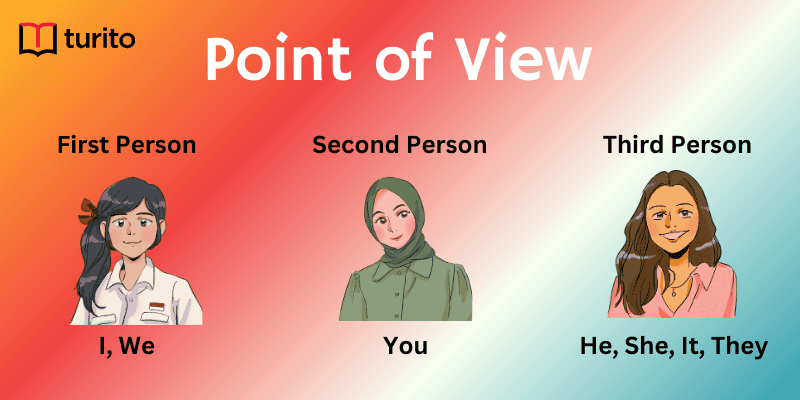
Primarily, there are three modes of point of view:
- First person point of view
- Second person point of view
- Third person point of view
Let us take a look at them:
1. First Person Point of View
In first person point of view mode, one of the characters is narrating the story. The I sentence construction, which relies on first-person pronouns, generally reveals this (“I arrived at work.”). The reader assumes that this character is closely related to the story’s action—either the protagonist or someone close to him. First-person narrative can provide intimacy and a deeper look into a character’s mind, but it is also limited by the character’s perceptual abilities. They are limited to reporting only what they would reasonably know about the story, and they are further limited by their point of view.
The author can use the first person to give the reader direct access to a specific character’s emotions, thoughts, voice, and way of seeing the world—their point of view on the main events of the story. The decision of which character gets first person’s point of view can drastically alter the course of a story.
F. Scott Fitzgerald’s Nick Carraway in The Great Gatsby (1925) and Herman Melville’s Ishmael in Moby Dick (1851) are two of the most well-known first-person narrators in literature and excellent examples of this point of view.

Example:
“I lay down on the grass, which was very short and soft, where I slept sounder than ever I remember to have done in my life, and, as I reckoned, above nine hours; for when I awoke, it was just daylight. I attempted to rise, but was not able to stir: for as I happened to lie on my back, I found my arms and legs were strongly fastened on each side to the ground; and my hair, which was long and thick, tied down in the same manner.”
–Gulliver’s Travels by Jonathan Swift
2. Second Person Point of View
The second person point of view uses the pronoun you to structure its sentences and is less common in novel-length work. (“You believed you could do it.”) Because the narrator is speaking directly to the reader in the second person, you can draw them into the story and make them feel like they’re a part of it. It’s important to remember that writing in the second person differs from simply addressing the reader. Rather, the second-person point of view puts the reader “on the field” by putting them in the shoes of the protagonist—the one to whom the action happens.
Writing in the second person for an extended period is difficult and will stretch your writing abilities. Few stories are appropriate for such a viewpoint, but it can work, as in Jay McInerney’s Bright Lights, Big City, a novel that takes the reader on a wild night through Manhattan.
Another writer who is well-known for her innovative use of second-person narrative in her work is Lorrie Moore in her short story collection Self-Help (1985).
Example:
“Eventually you ascend the stairs to the street. You think of Plato’s pilgrims climbing out of the cave, from the shadow world of appearances toward things as they are, and you wonder if it is possible to change in this life. Being with a philosopher makes you think.”
-Bright Lights, Big City by Jay McInerney
3. Third Person Point of View
In the third person point of view, the narrator is someone (or something) who is not a character in the story that is being told. In the third person, the pronouns he, she, and they are used to refer to all of the characters. It is the most common point of view in writing because it allows the writer to focus on different people, events, and places without being constrained by the consciousness of a single character.
The third person point of view is further subdivided into third person omniscient point of view and third person limiter point of view.
Third Person Omniscient Point of View:
The term third person omniscient refers to the narrator’s knowledge of all the thoughts and feelings of each character and the ability to jump in and out of anyone’s internal life as needed. The term omniscient simply means all-knowing. In the sense that their perspective is limitless, this type of narrator is more god-like than human.
Example:
“Occupied in observing Mr. Bingley’s attentions to her sister, Elizabeth was far from suspecting that she was herself becoming an object of some interest in the eyes of his friend. Mr. Darcy had at first scarcely allowed her to be pretty: he had looked at her without admiration at the ball; and when they next met, he looked at her only to criticize.”
–Pride and Prejudice, by Jane Austen
Third Person Limited Point of View:
When an author uses a third-person limited point of view (also known as a “close third”), he or she stays close to one character while remaining in the third person. This style allows you to be inside a character’s thoughts, feelings, and sensations, which can provide readers with a more in-depth understanding of the character and scene.
Example:
“Winston stopped writing, partly because he was suffering from cramps. He did not know what had made him pour out this stream of rubbish. But the curious thing was that while he was doing so a different memory had clarified itself in his mind…”
–1984 by George Orwell
Related topics
Naming Words for Class 2: Simple English Guide
Naming words are names of people, animals, birds, places or things. E.g. Leo, Rat, Crow, London, Book Four types of naming words E.g. Leo, Andrea, Father, Mother E.g. School, London, Park, New york E.g. Tiger, Monkey, Cow, Parrots E.g. Box, Pen, Apples, Car Everything that we can touch, feel, see and talk about is represented by […]
Read More >>Types of Nouns: Definition, Kinds, and Examples
If you’ve developed a nascent interest in the English language already, or your child enjoys reading from the English signboards and alphabet books, it’s time that they were introduced to nouns. Nouns (or naming words, as they are conveyed to kids) are the flat concrete surface on which your child or student’s vocabulary will be […]
Read More >>
Context Clues
What Are Context Clues? Context clues are small hints in a sentence or paragraph that you can see. It helps you understand the meaning of a word you do not know. For this, you will not need to use a dictionary. The sentence itself helps you understand. When you read, the words near can be […]
Read More >>
Speech Writing: Format, Topics, and Examples
What Is Speech Writing? While writing a speech we should concentrate on the three ‘C’s. Your speech should be clear, concise, and consistent. Let’s see the format of speech writing. Speech Writing Format It contains two parts. Title: Give a good title to the topic while writing a speech. Content: The content section is divided […]
Read More >>

Other topics





Comments: