



Possessive Noun

What is a Possessive Noun?
- It is used to show ownership of something.
- We usually add an apostrophe and a ‘s’ at the end of a noun.
Example:
- This is Sara’s bag.
- Here, we understand that Sara is the owner of the bag. Thus, the noun ‘Sara’ becomes possessive by adding an apostrophe and a ‘s’.
How do you know if a noun is possessive?
- Look out for the apostrophe and the ‘s’ to check if a noun is possessive or not.
Singular and Plural Possessive Nouns
Just like there are possessive nouns in singular form, there are also possessive nouns in plural form.
When plural nouns end in an ‘s’, add an apostrophe at the end to form a possessive noun.
- Those are my cat’s food. (Here, it is singular. Only one cat)
- Those are my cats’ food. (Here, it is plural. More than one cat)
The car’s window is broken.
All the cars’ windows are broken.

This egg’s color is weird.
The eggs’ colors are so different from each other.
The windows’ glass was broken.
The houses’ doors are all painted red.
Avoid the Confusion
An apostrophe and an ‘s’ together on some nouns can mean something else too.
They can represent a contraction, i.e., two words joined together to make one word.
- Can’t – can not
- Don’t – do not
But how do we know if ‘girl’s’ is possessive or if it is contraction?
- ‘The girl’s’ – The girl’s bag (possessive noun)
- The girl’s bag is stolen.
- ‘The girl’s’ – ‘The girl is’. (contraction)
- The girl’s smart! (The girl is smart)
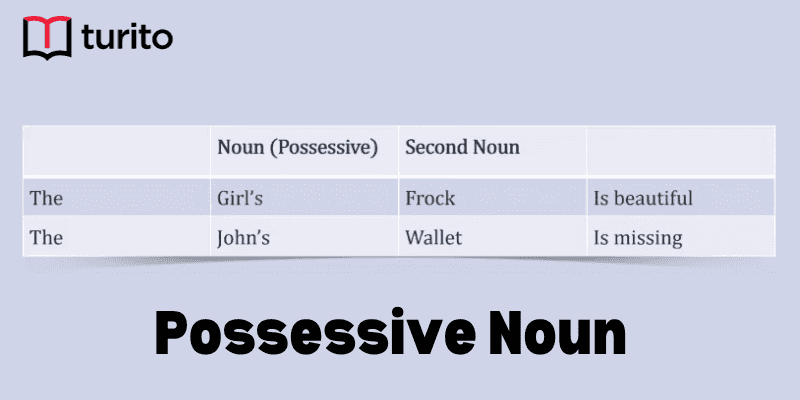
If the noun is followed by a second noun, then it is possessive.
- The girl’s frock was beautiful.
- John’s wallet is missing.
If the noun is followed by a verb, then it is contraction.
- The girl’s tired.
- John’s a great leader!
Possession

Contraction

Frequently Asked Questions (FAQ’s):
- What is a possessive noun?
A possessive noun is a noun that is used to show ownership of something.
- What are examples of possessive noun?
This is Vrinda’s car.
My brother’s friend is coming home.
My mother’s bag is red.
- How to check possessive noun?
The word that ends with an apostrophe and “s” at the end are possessive nouns.
- What is a singular possessive noun?
If the noun is singular then it is singular possessive noun.
- What is a plural possessive noun?
If the noun is plural then it is plural possessive noun.
Related topics
Naming Words for Class 2: Simple English Guide
Naming words are names of people, animals, birds, places or things. E.g. Leo, Rat, Crow, London, Book Four types of naming words E.g. Leo, Andrea, Father, Mother E.g. School, London, Park, New york E.g. Tiger, Monkey, Cow, Parrots E.g. Box, Pen, Apples, Car Everything that we can touch, feel, see and talk about is represented by […]
Read More >>Types of Nouns: Definition, Kinds, and Examples
If you’ve developed a nascent interest in the English language already, or your child enjoys reading from the English signboards and alphabet books, it’s time that they were introduced to nouns. Nouns (or naming words, as they are conveyed to kids) are the flat concrete surface on which your child or student’s vocabulary will be […]
Read More >>
Context Clues
What Are Context Clues? Context clues are small hints in a sentence or paragraph that you can see. It helps you understand the meaning of a word you do not know. For this, you will not need to use a dictionary. The sentence itself helps you understand. When you read, the words near can be […]
Read More >>
Speech Writing: Format, Topics, and Examples
What Is Speech Writing? While writing a speech we should concentrate on the three ‘C’s. Your speech should be clear, concise, and consistent. Let’s see the format of speech writing. Speech Writing Format It contains two parts. Title: Give a good title to the topic while writing a speech. Content: The content section is divided […]
Read More >>

Other topics



Comments: