



Possessive Pronouns – Concept and Its Uses

Possessive pronouns are used to show ownership or possession.
They say that something belongs to someone.
For example: Peter asked, “Is that bag yours?”
Here, yours is the possessive pronoun.
Possessive pronouns are used in place of a noun or a noun phrase.

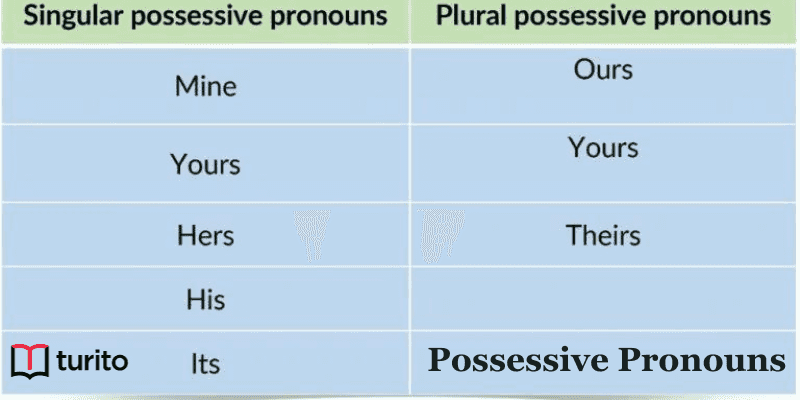
Mine, yours, his, hers, its, ours and theirs are possessive pronouns.
These are also known as strong or absolute possessive pronouns.
For example: Tia said that the pen is hers.
Possessive adjectives are used as determiners in front of a noun to show someone who owns something.
My, your, his, her, its, our, and there are possessive adjectives.
These are also known as weak possessive pronouns.
For example: Tia said that it is her pen.
Singular possessive pronouns
If a possessive pronoun refers to only one person or thing, it is known as a singular possessive pronoun.
For example: My friend is taller than your friend.
My friend is taller than yours.
Plural possessive pronouns
If a possessive pronoun refers to more than one person or thing, it is known as a plural possessive pronoun.
For example: Our teachers are talking to their teachers.
Our teachers are talking to theirs.

Possessive pronouns do not have apostrophe.
For example: Yours, hers
Pronouns like his and hers denote gender. If you want to use a gender neutral singular pronoun, theirs can be used.
For example: Each student should bring his lunch.
This sentence is correct if all the students are males. When we are not sure about that, we can say:
Each student should bring their lunch.
Another way of saying this is to make the sentence plural. For instance:
All students should bring their lunch.
Possessive pronouns can be used as both subject and object.
For example:
Have a look at these dresses. Mine is the pink one. (Subject = Mine, i.e., my dress)
I went to the tailor to get my dress, but I didn’t get mine. (Object = Mine, i.e., my dress)
Related topics
Naming Words for Class 2: Simple English Guide
Naming words are names of people, animals, birds, places or things. E.g. Leo, Rat, Crow, London, Book Four types of naming words E.g. Leo, Andrea, Father, Mother E.g. School, London, Park, New york E.g. Tiger, Monkey, Cow, Parrots E.g. Box, Pen, Apples, Car Everything that we can touch, feel, see and talk about is represented by […]
Read More >>Types of Nouns: Definition, Kinds, and Examples
If you’ve developed a nascent interest in the English language already, or your child enjoys reading from the English signboards and alphabet books, it’s time that they were introduced to nouns. Nouns (or naming words, as they are conveyed to kids) are the flat concrete surface on which your child or student’s vocabulary will be […]
Read More >>
Context Clues
What Are Context Clues? Context clues are small hints in a sentence or paragraph that you can see. It helps you understand the meaning of a word you do not know. For this, you will not need to use a dictionary. The sentence itself helps you understand. When you read, the words near can be […]
Read More >>
Speech Writing: Format, Topics, and Examples
What Is Speech Writing? While writing a speech we should concentrate on the three ‘C’s. Your speech should be clear, concise, and consistent. Let’s see the format of speech writing. Speech Writing Format It contains two parts. Title: Give a good title to the topic while writing a speech. Content: The content section is divided […]
Read More >>

Other topics





Comments: