



Proper Noun – Concept and Its Uses

Proper nouns
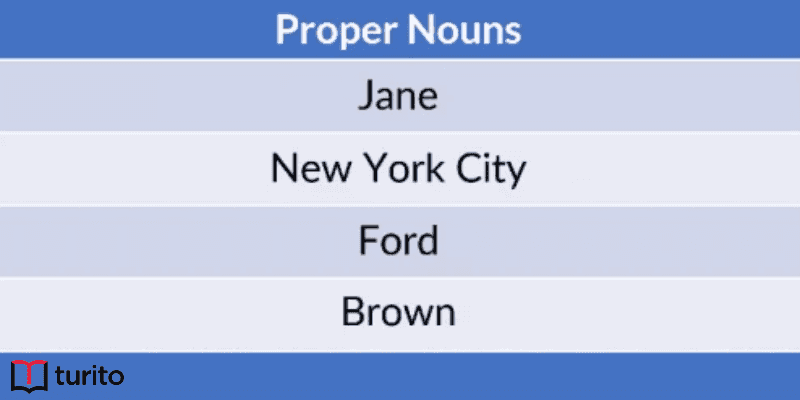
The specific names of persons, places, animals and things are proper nouns.
Jane, New York City, Blackie, Ford
While common nouns are the generic names of people, places, animals and things; proper nouns are specific.
Proper nouns are always capitalized.
For example:


Proper nouns are specific nouns. They are capitalized, no matter where they appear in a sentence.
Proper nouns are used to refer to:
Names of people and animals
The names of particular people and animals are proper nouns.
For example: Barack Obama, Donald Duck
- Titles of people
Certain names have titles attached to them. Titles are given to people who are in specific positions. When they are used as part of names, they can be capitalized.
For example: Doctor John is our family doctor.
I heard that President Biden will address the nation today.
Names of places
The names of specific streets, cities, states, countries, geographical regions, zoos, parks, etc., come under proper nouns.
For example: Canada, San Francisco, Miami Beach, the Rocky Mountains
Articles or unimportant words in the names of places are not capitalized.
For example: the Atlantic Ocean, the United States of America
Names of things
The names of specific or unique things are proper nouns.
For example: Mars (planet), Harry Potter (book), Toyota (car)
- Days, months, and holidays
Months of the year, days of the week, and holidays are proper nouns and they are capitalized.
For example: Friday (day), November (month), Christmas (holiday)
Brand names
Brands describe a specific product. The names of brands or companies are proper nouns.
For example: Google, Reebok, Disney, Turito
- Titles of works
The titles of movies, TV shows, plays, books, newspapers, magazines and songs are proper nouns.
For example: Frozen, the New York Times
Seasons and directions are not proper nouns. They are capitalized only if they are parts of names.
For example:
I am driving south.
I am going to visit South Africa.
I’m planning to visit my grandparents this summer.
Tina’s best friend’s name is Summer.
Related topics
Naming Words for Class 2: Simple English Guide
Naming words are names of people, animals, birds, places or things. E.g. Leo, Rat, Crow, London, Book Four types of naming words E.g. Leo, Andrea, Father, Mother E.g. School, London, Park, New york E.g. Tiger, Monkey, Cow, Parrots E.g. Box, Pen, Apples, Car Everything that we can touch, feel, see and talk about is represented by […]
Read More >>Types of Nouns: Definition, Kinds, and Examples
If you’ve developed a nascent interest in the English language already, or your child enjoys reading from the English signboards and alphabet books, it’s time that they were introduced to nouns. Nouns (or naming words, as they are conveyed to kids) are the flat concrete surface on which your child or student’s vocabulary will be […]
Read More >>
Context Clues
What Are Context Clues? Context clues are small hints in a sentence or paragraph that you can see. It helps you understand the meaning of a word you do not know. For this, you will not need to use a dictionary. The sentence itself helps you understand. When you read, the words near can be […]
Read More >>
Speech Writing: Format, Topics, and Examples
What Is Speech Writing? While writing a speech we should concentrate on the three ‘C’s. Your speech should be clear, concise, and consistent. Let’s see the format of speech writing. Speech Writing Format It contains two parts. Title: Give a good title to the topic while writing a speech. Content: The content section is divided […]
Read More >>

Other topics




Comments: