



Recalling Adverbs: Memorizing the Difference Between Verb and Adverb

Recalling Adverbs
Let’s memorize the difference between verbs and adverbs.
The primary distinction between verbs and adverbs is that verbs are action words, whereas adverbs are descriptive terms. Verbs describe the activity that a noun does, whereas adverbs describe how that action is carried out.
Verb: Adverb
Ex: Henry is writing a lovely novel about the history of nature.
Q) What is an Adverb?
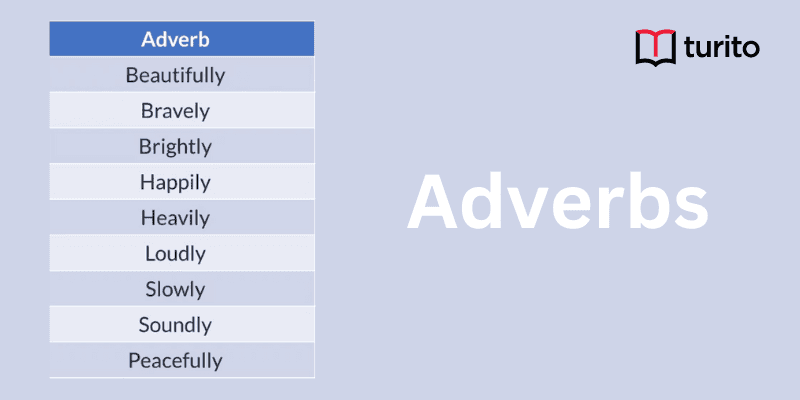
A term that describes a verb is called an adverb. It describes an action or the manner in which something is carried out. Many adverbs end in -ly.

Examples:

Now Let’s study at the various categories of Adverb.
Adverb:
It is a word that modifies a verb, an adjective, or a sentence as a whole. In other words, they are employed to demonstrate the properties of a verb or an adjective. Adverbs can modify another adverb in a sentence, which is a fascinating truth about them.
Adverbs appear in several different forms, and they serve a variety of functions in sentence constructions. These include:

Adverbs of Time:
A time adverb adds context to a verb. Time adverbs are typically used at the start or finish of a phrase. We’ll put it at the beginning of a phrase when it’s really important to describe the instant something happened.
Adverbs of time include:
Never, lately, just, always, recently, during, yet, soon, sometimes, usually, so far, annually, daily, monthly, recently, regularly, yet, soon, etc.
Examples:
- We recently brought a new car.
- I finish all my works during my free time.
- He hasn’t reached at the home yet.
- You will recover from this infection soon.
Adverbs of Manner:
Adverbs of manner add context to a verb’s action. The most common adverbs are adverbs of manner. They’re also very visible. They’ll all end in –ly, for the most part.
Adverbs of manner include:
Neatly, slowly, quickly, sadly, calmly, politely, loudly, kindly, lazily
Examples:
- She neatly cleaned up her circumstance.
- Let us quickly finish our homework.
- She is walking slowly.
- Drive the car fast if you want to catch the train.
Adverbs of Place:
Adverbs of location describe the location of the verb. It’s typically used after the primary verb or object, or at the end of the phrase.
Adverbs of place include:
Here, nowhere, there, everywhere, out, in, above, below, inside, outside, into etc.
Examples:
- The cat is sitting below the chair.
- She comes to my school every day.
- The thief who has stolen my car was found nowhere.
- In my university plants are everywhere in the garden.
Adverbs of Degree:
The intensity of the verb in the phrase is described by an adverb of degree. They’re usually utilized before a sentence’s primary verb.
Adverbs of Degree include:
Almost, quiet, nearly, too, enough, just, hardly, simply, so
Examples:
- I almost finished my packing.
- Michael is so excited to go for a cookout.
- You hardly know about Jessy.
- Henry’s grandmother is in extremely critical condition.
Adverbs of Frequency:
The frequency of the verb is indicated by an adverb of frequency. The majority of the time, they are employed to modify verbs. They usually come before the primary verb.
Adverbs of Frequency include:
Never, always, rarely, sometimes, normally, seldom, usually, again.
Examples:
- She will never accept your mistakes again.
- We usually go for weekends with teammates.
- I feel sometimes that you have scolded her more than she deserves.
- My sister rarely uses her shoe while going for a walk.
Now let’s revise adverbs.
- An adverb is a word that modifies an adjective, verb , determiner, clause, preposition, or sentence is referred to as an adverb.
- Adverbs can describe how something is done, such as speaking courteously or working diligently. Adverbs can also be used to express how much or how many of something you own.
Let’s practice with few examples
Identify the adverbs in the following sentences and write in the space provided.
- She sadly talked to her friends.
A._____________________________________
- I always use a black pen to write diary.
A._____________________________________
- Ethan comes very late to the school.
A._____________________________________
- The group discussion was very good to learn something new.
A._____________________________________
- I recently went to Alaska.
A._____________________________________
- We will try to solve this problem later.
A._____________________________________
- She rarely goes out for a picnic.
A._____________________________________
- Students warmly welcomed the Director on the annual day celebration.
A._____________________________________
- He runs very fast.
A._____________________________________
- Sebastian is much faster than Samuel.
A._____________________________________
Answers:
- Sadly
- Always
- Very
- Very
- Recently
- Later
- Rarely
- Warmly
- Very
- Much
Related topics
Naming Words for Class 2: Simple English Guide
Naming words are names of people, animals, birds, places or things. E.g. Leo, Rat, Crow, London, Book Four types of naming words E.g. Leo, Andrea, Father, Mother E.g. School, London, Park, New york E.g. Tiger, Monkey, Cow, Parrots E.g. Box, Pen, Apples, Car Everything that we can touch, feel, see and talk about is represented by […]
Read More >>Types of Nouns: Definition, Kinds, and Examples
If you’ve developed a nascent interest in the English language already, or your child enjoys reading from the English signboards and alphabet books, it’s time that they were introduced to nouns. Nouns (or naming words, as they are conveyed to kids) are the flat concrete surface on which your child or student’s vocabulary will be […]
Read More >>
Context Clues
What Are Context Clues? Context clues are small hints in a sentence or paragraph that you can see. It helps you understand the meaning of a word you do not know. For this, you will not need to use a dictionary. The sentence itself helps you understand. When you read, the words near can be […]
Read More >>
Speech Writing: Format, Topics, and Examples
What Is Speech Writing? While writing a speech we should concentrate on the three ‘C’s. Your speech should be clear, concise, and consistent. Let’s see the format of speech writing. Speech Writing Format It contains two parts. Title: Give a good title to the topic while writing a speech. Content: The content section is divided […]
Read More >>

Other topics




Comments: