



Area of Irregular Shapes for Grade 3 – Simple Methods & Examples

What Is the Area of an Irregular Shape?
The area of an irregular shape is the space that it occupies, although it does not follow a clean formula. In contrast to the squares or perfect rectangles, irregular shapes have sides that are uneven or their angles don’t line up evenly. That is what makes them tricky in the beginning.
You see irregular shapes everywhere. This can include floor plans, garden plots, or playground markings. Even simple drawings in math books. When students ask, “How do you find the area of an irregular shape?” The answer is rarely one step. It’s about breaking the shape down into parts you already understand.
Once you do that, the problem stops feeling confusing and starts feeling manageable.
Understanding Irregular Shapes with Rectangles and Squares
Irregular shapes become easier once you imagine them as groups of rectangles and squares. This works especially well when you’re dealing with the area of irregular rectangle problems or the area of uneven rectangle layouts.
This is why teachers often introduce the area of irregular rectangle problems using grids. Grids turn strange outlines into familiar blocks. Each block has a clear length and width. That makes the calculation easier.

For example, an uneven rectangle might look confusing as a whole. But split it into two or three regular rectangles, and suddenly you’re just finding simple areas and adding them together. This is also how students slowly understand the area of unequal rectangle shapes without panic.
Key Concepts to Find the Area of Irregular Shapes
- How to break larger area into smaller areas
- Divide the irregular shape into squares and rectangles
- Find the area of each individual squares and rectangles
- Find the area of any irregular shapes
1.1 Area of Square
- All sides are of equal length in a square.
- Area of a square = Side x Side
- Side = 6 inches
- Area = 6 in x 6 in. = 36 square inches

1.2 Area of Rectangle
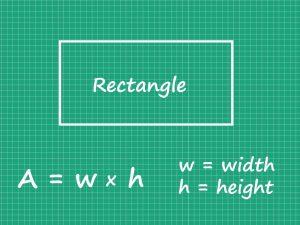
As the opposite sides are the same in a rectangle area
Area of the rectangle = Length * Width
Length = 8 inches, Width = 5 inches
Area = 8 in x 5 in = 40 square inches

Jack wants to lay artificial grass for playing golf in the ground. Let us help Jack find the area of the ground to be covered by grass.

Method 1
Draw the figure on the grid paper and count the unit squares covered to find the area.
Total number of squares = 56
Area to be covered by grass = 56 square feet

Method 2
- Break the larger area into smaller parts.
- Look for the possibilities in which the smaller shapes are part of a larger shape.
- Divide the larger area into smaller rectangles and find the area.
The golf area to be covered by grass is divided into rectangles A, B and C
Find individual areas
Area of rectangle A = 4 ft x 3 ft = 12 square feet
Area of rectangle B = 4 ft x 3 ft = 12 square feet
Area of rectangle C = 4 ft x 8 ft = 32 square feet
Total area = 12 + 12 + 32 = 56 square feet

How to Find the Area of an Irregular Shape?
If you’re wondering how to find the area of an irregular shape, follow this process.
- First, divide the shape into smaller rectangles or squares. These should have straight sides and right angles whenever possible.
- Second, measure the length and width of each smaller shape. This step matters. Guessing leads to wrong answers.
- Third, calculate the area of each part using the rectangle formula: Area = length × width.
- Finally, add all the smaller areas together. That total is the area of the full shape.
This method works whether you’re finding the area of uneven rectangle layouts or figuring out how to work out the area of an irregular shape on paper.
Area of Uneven or Unequal Rectangles
Let us understand how to calculate area of uneven rectangle. An uneven or unequal rectangle doesn’t have matching sides. One length may be longer. One width may be shorter. That’s why students often ask how do you calculate the area of an irregular shape.
The rule stays the same. You don’t change the formula. You change how you apply it.
If a rectangle has different lengths on different sides, split it. Treat each section as its own rectangle with clear dimensions. Then calculate each area separately.
This method also explains how to find the area of a rectangle with different lengths. You’re not forcing one formula onto a messy shape. You’re adapting the shape to the formula you already know.
Steps to Find the Area of an Irregular Shape
- Find all the unknown sides.
- Divide the irregular shape into squares and rectangles
- Find the area of each individual squares and rectangles
- Add all the individual areas to find the total area of the irregular shape.
Total area = sum of all individual areas

Steps to Find the Area of an Irregular Shape
1. Find all the unknown sides.
In this example, find the values of side a and side b
Side a = 10 – 3 = 7 cm
Side b = 5 – 3 = 2 cm

2. Divide the irregular shape into squares and rectangles
In the example, the figure is divided into one rectangle-A and one square-B
Total area = Area of Rectangle A + Area of Square B

Steps to find the area of an irregular shape
3. Find the area of each individual squares and rectangles
Area of rectangle A = length x width
= 10 x 2 = 20 square cm
Area of square B = side x side
= 3 x 3 = 9 square cm

4. Add all the individual areas to find the total area of the irregular shape
Total area = Area of rectangle A + Area of rectangle B
= 20 sq. cm + 9 sq. cm
= 29 sq. cm
Solved Examples of Area of Irregular Shapes
Total area of the shaded part = Area of the outer rectangle – Area of the inner rectangle
Area of outer rectangle = 10 cm x 8 cm
= 80 square cm
Area of inner rectangle = 4 cm x 6 cm
= 24 square cm
Total area of shaded part = 80 sq. cm – 24 sq. cm
= 56 square cm

Practice Questions: Find the Area of Irregular Shapes
Find the area of the irregular shapes

Exercise:
Find the area of the shapes shown below.
1.

2.

3.

4.

5.

What We Have Learned About Area
- The area of a surface or a plane figure is the number of square units needed to cover the surface or the figure
- Area of the square = S x S
- Area of the rectangle = Length x Width
- Area is measured using standard units
- To find area of irregular shape
- Break the larger area into smaller parts.
- Look for the possibilities in which smaller shapes are part of the larger shape.
- Divide the larger area into smaller rectangles and find the area.
Summary: Area of Irregular Shapes
To find the area of irregular shapes, the first thing to do is to divid the irregular shape into regular shapes that you can recognize such as triangles, rectangles, circles, squares and so forth.
Then, find the area of these individual shapes and add them up.
FAQ
What is the area of an uneven rectangle?
The area of an uneven rectangle is found by dividing it into smaller rectangles, calculating each area, and adding them together.
How do you calculate the area of an irregular rectangle?
You split the irregular rectangle into regular rectangles or squares, find each area, then combine the results.
What is an unequal rectangle?
An unequal rectangle has sides of different lengths, making it harder to calculate as one shape without dividing it.
How do Grade 3 students find the area of irregular shapes?
Grade 3 students start by turning irregular shapes into even shapes they already understand. They split the shape into simple rectangles or squares first. Once the shape feels familiar, they apply the area formulas they know.
Why do we divide shapes to find their area?
Area formulas work best on regular shapes, and dividing makes irregular shapes easier to solve.
Related topics

Obtuse Angle: Definition, Degree Measure, and Examples
What is an Obtuse Angle? In geometry, an angle that is greater than 90 degrees but lesser than 180 degrees is called an obtuse angle. We can easily recognize an obtuse angle because it extends past a right angle. Obtuse angle explained in detail with examples but first learn about angles. Type of Angles Geometry […]
Read More >>
Line Segment in Geometry: Definition, Symbol, Formula, and Examples
A line is a straight, one-dimensional figure that extends endlessly in both directions in geometry. It has no starting and ending points. When we define a starting point but not an ending point of a line, it is called a ray. Another important term associated with the line is a line segment. Line Segment Definition […]
Read More >>
Addition and Multiplication Using Counters & Bar-Diagrams
Introduction: We can find the solution to the word problem by solving it. Here, in this topic, we can use 3 methods to find the solution. 1. Add using counters 2. Use factors to get the product 3. Write equations to find the unknown. Addition Equation: 8+8+8 =? Multiplication equation: 3×8=? Example 1: Andrew has […]
Read More >>

Other topics



Comments: