



Line Segment in Geometry: Definition, Symbol, Formula, and Examples

A line is a straight, one-dimensional figure that extends endlessly in both directions in geometry. It has no starting and ending points. When we define a starting point but not an ending point of a line, it is called a ray. Another important term associated with the line is a line segment.
Line Segment Definition Geometry
Line segment definition: A line segment is a one-dimensional figure which describes a path between two points. Unlike a line, a line segment has a definite starting point and a definite endpoint. Thus, we can measure it. Moreover, it has a defined length, and it can form the sides of any polygon.
A line segment is represented by a bar (-) on the top of its notation, say AB.
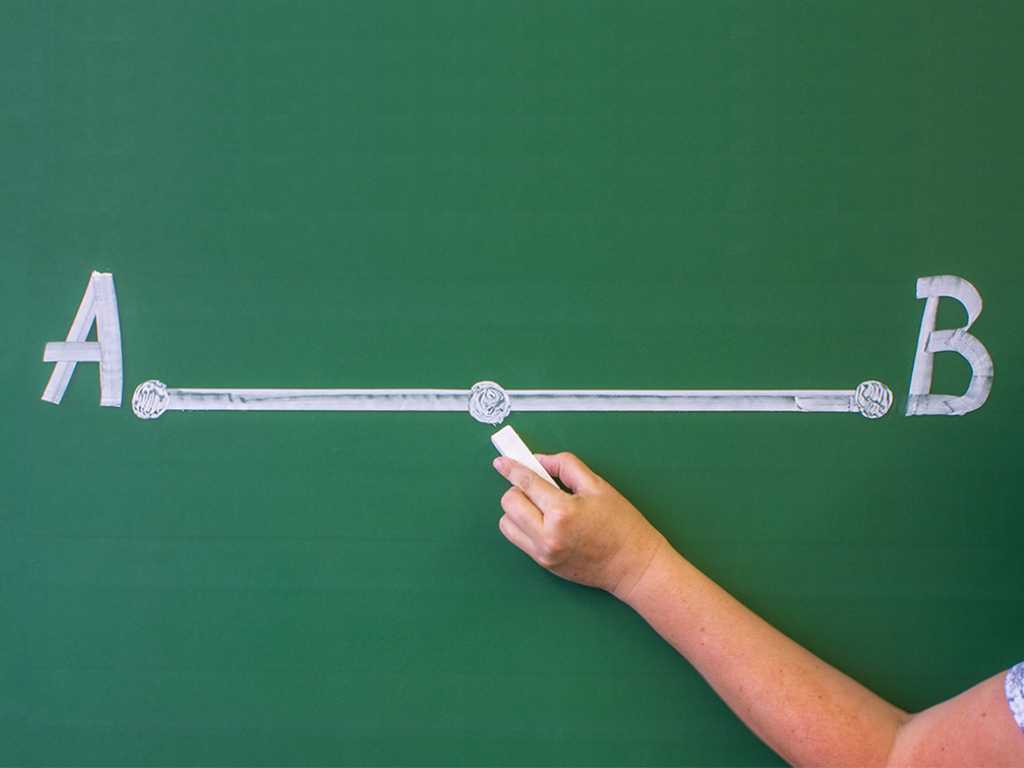
The following figure shows a line segment AB. The distance between points A and B gives the length of the line segment. You can understand line segment geometry from the following figure.
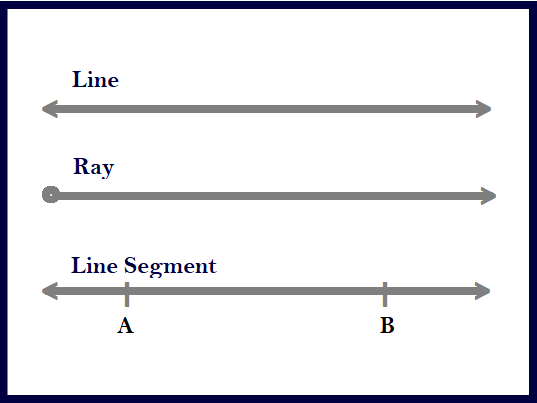
Difference Between Line, Line Segment, and Ray
The following table states the differences between line, line segment, and ray.

| Line | Line Segment | Ray |
| A line is a straight figure that extends in two directions indefinitely. | A segment is part of a line with a definite starting point and a definite endpoint. | A ray has a definite starting point, but no endpoint. |
| A line is represented by arrows on both ends. | A line segment is represented by endpoints. | A ray is represented by a point at one end, which is the starting point, and an arrow at the other end. This arrow represents that the line goes on forever. |
| It is written as ↔ AB | It is written as AB | It is written as → EF |
| Example: a line that you see without initial and endpoints. | A ruler, a pencil, and a stick are examples of a line segment in real life. | An example of a ray is the sun’s rays. The starting point of the sun’s rays is the sun but there is no endpoint. |
Line Segment Formula
Since a line segment is a distance between two points, we can use the distance formula to calculate the length of the line segment. Thus, the formula is:
d =√(x2– x1)2+(y2 – y1)2
Line Segment Calculation Example
| Example 1: What is the distance between two coordinates A (5, -13) and B (-3, 4)? Solution: We can Calculate the distance between the coordinates using the distance formula. d = √(x2– x1)2+(y2 – y1)2 =√(-3 -5)2+(4 -(-13))2 = √(-8)2+(17)2 = √64+289 = 18.78 |
How to Find the Length of a Line Segment?
There are several methods to find the length of a line segment. Here we will learn three different methods.
Measuring a Line Segment
Here’s how you can measure a line segment properly.
Observation
The most trivial strategy to find the length of a line segment is to compare two line segments by simple observation. On observing, you can easily predict which one is long or short compared to the other. However, this method has several constraints, and we cannot rely completely on observation to compare two line segments.
Using Trace Paper
We can compare two line segments using the support of a tracing paper. Firstly, we will trace one line segment. Next, we will compare it with the other segment. To do this precisely, we will place the tracing paper on the other line segment. Now, notice which one is longer compared with the other.
If we have to compare more than two line segments, then we can follow the same steps again and again. It is crucial to trace the lien segments precisely for an exact comparison of the line segments. Consequently, failure to do so puts a limitation on this procedure.
Using A Ruler
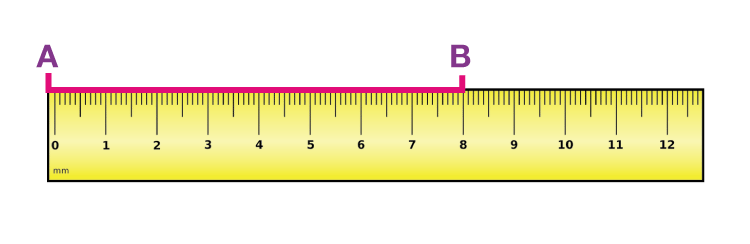
We can measure the length of a line segment with the help of a ruler (scale). Follow the steps to measure a given line segment and name it AB.
Step 1: Place the ruler along the line segment in a way that zero is placed at the starting point A of the given line segment.
Step 2: Read the values on the ruler and locate the number that comes on the other endpoint B.
Step 3: Thus, the length of the line segment is 8 inches.
We can write it as AB = 8cm.
Construction of Line Segment
The following steps describe how to draw a line segment of 10 cm with the help of a measuring ruler or scale.
Step 1: We will draw a line of any length ( keeping the length of the line segment, i.e., 10 cm, into consideration)
Step 2: Mark a point A on the line, which is the starting point of the line segment.
Step 3: Now, we will align a scale or ruler such that mark A coincides with 0 on the ruler.
Step 4: Locate the 10 cm on the line drawn with the help of a ruler and mark a point B.
Step 5: Join A and B to get the required line segment of the length of 10cm.
Steps to constructing a line segment PQ of length 8 cm with the help of a ruler and compass.
Step 1: Firstly, we will draw a line of any length. This can be without any measurement, although we must consider the length of the line segment.
Step 2: Mark a point P on the line. This will be the starting point of the line segment.
Step 3: Now place the ruler and find the pointer of the compass 8cm apart from the tip of the pencil’s lead.
Step 4: Now, place the pointer of the compass at point P on the line. Mark an arc with the same measurement using a pencil.
Step 5: Now, mark this point as point Q. So, PQ is the required line segment of length 8 cm.
What Does a Line Segment Look Like?
Students and children encounter line segments when learning the fundamentals of geometry. A line segment can be understood as one of the most basic components in the subject, which, as the student grows and progresses, will be applied widely.
A line segment can be identified as a vertical or horizontal path that has clear, defined starting and ending points. Think of a tightrope. It has two endpoints on each side and is drawn on each side to be perfectly taut. That’s how a line segment looks as well.
Some of the common examples of a line segment in the real world are:
- A pen or pencil
- The edges of a regular ruler
- A stick or baton
- A straw
- A tube light
- The edge of the paper
- A piece of chalk
- Side of a polygon
You’ll find it easy to understand what a line segment ought to be when you look at these objects.
Conclusion
There are infinite lines that keep moving in one direction, while there are lines that possess clearly defined starting and end points. Line segments in geometry are understood as the latter. Serving as one of the primary concepts in the subject, they are a crucial geometrical tool for drawing up graphs and diagrams. Line segments are a common design element and are used by mathematicians, economists, artists, designers, and architects alike. They form a simple principle, and yet pervade every part of a student’s journey academically as well as in life!
Examples of Line Segments
The most prevalent examples are seen in 2D geometry, where each polygon is constructed of a series of line segments.
- A hexagon is made up of six-line segments joined end-to-end
- A rectangle is made up of four-line segments
- A pentagon is made up of five-line segments
Therefore, line segments perform a crucial function in geometry.
Understanding Line Segment Examples with Solutions
Example 1: How would you know if the given two line segments are perpendicular to each other?
Answer: If two line segments intersect each other at 90 degrees, then the two line segments are perpendicular to each other. Also, if two lines are perpendicular, their slope is -1.
Example 2: In the following figure, mention all the line segments.

Answer: The line segments in the figure are: PQ, RS, AB, CD, MN, GH, EG, FH, NH, MG, GB, NF, ME, AM, CN, PE, RG, PF, RH, CF, CH, HD, SG, QE, MB, ND, AG, CH, FD, EB.
Example 3: Find the distance between two coordinates, A (10, -12) and B (-5, 4)?
Solution: Using the distance formula, we can calculate the distance between the coordinates using the distance formula.
d = √(x2– x1)2+(y2 – y1)2
= √(-5-10)2+(4 -(-12))2
= √((-15)2+(16)2
= √(225+256)
=√481 = 21.93
Example 4: Name all the line segments in the following figures:
Answer: In Fig 1, there are 5 line segments. The line segments are AB, BE, DE, CD, and AC.
In Fig 2, there are 12 line segments. The line segments are AB, BC, CD, DE, EF, FG, GH, HI, IJ, JK, KL, and LA.
Example 5: How many line segments do the following shapes have:
- Hexagon
- Triangle
- Pentagon
- Circle
Answer: 1. A hexagon has six line segments.
2. A triangle has three line segments.
3. A pentagon has 5 line segments.
4. A circle has one line segment. It is known as the curved line segment. This curved line segment is the one that is creating the circle itself.
Frequently Asked Questions
What is a Line Segment?
A line segment is a one-dimensional figure which describes a path between two points.
What is the definition of a line segment?
A fixed path with clearly defined starting and ending points, line segments are one of the foundational concepts in geometry. They resemble a tightrope, and the distance between the two points (Point A and Point B) is measured to solve a large number of problems in mathematics.
What is the symbol of a line segment?
Line segments in geometry and mathematical usage can be identified with a symbol consisting of AB with a bar on top.
How is a line segment different from a line?
The major difference between a line and a line segment is the ending point. Line segments begin at Point A and end at Point B. This factor makes them important geometrical concepts for application in a variety of real-life tasks. In contrast, a line does not have defined ending points and, as a result, cannot be used for measuring distances or in mathematical problems. Line segments are finite, while lines are infinite.
How is a line segment different from a ray?
A segment is part of a line with a definite starting point and a definite endpoint. A ray has a definite starting point, but no endpoint.
What are some examples of line segments?
The edges of the table, the side of a square or triangle, Matchstick all are examples of line segments.
What does a line segment look like?
A line segment can be easily recognized and better understood through real-world examples. Some of them include a tightrope, the edges of a ruler, a piece of chalk, and the sides of a polygon.
Related topics

Obtuse Angle: Definition, Degree Measure, and Examples
What is an Obtuse Angle? In geometry, an angle that is greater than 90 degrees but lesser than 180 degrees is called an obtuse angle. We can easily recognize an obtuse angle because it extends past a right angle. Obtuse angle explained in detail with examples but first learn about angles. Type of Angles Geometry […]
Read More >>Area of Irregular Shapes for Grade 3 – Simple Methods & Examples
What Is the Area of an Irregular Shape? The area of an irregular shape is the space that it occupies, although it does not follow a clean formula. In contrast to the squares or perfect rectangles, irregular shapes have sides that are uneven or their angles don’t line up evenly. That is what makes them […]
Read More >>
Addition and Multiplication Using Counters & Bar-Diagrams
Introduction: We can find the solution to the word problem by solving it. Here, in this topic, we can use 3 methods to find the solution. 1. Add using counters 2. Use factors to get the product 3. Write equations to find the unknown. Addition Equation: 8+8+8 =? Multiplication equation: 3×8=? Example 1: Andrew has […]
Read More >>

Other topics



Comments: