



Cause of Motion

Key Concepts
- Force
- Effects of force
- Force: A Vector
- Combining Vector
Introduction:
There are several questions that might come to our mind, having learned about motion in detail, such as,
- Why does a body move in the first place?
- Why does a body change its speed and/or direction of motion (non-uniform motion)?
- Why does a body not change its speed and/or direction of motion (uniform motion)?
We are going to answer all such questions in this section.
Explanation:
Force
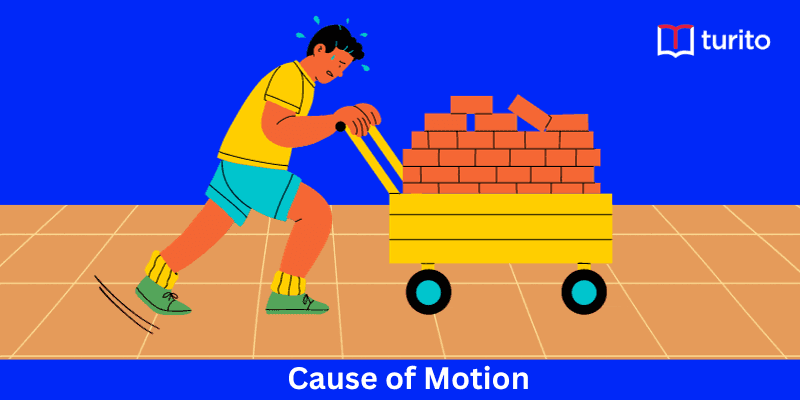
As shown in the figure below, we all perform several activities in our daily lives, such as pushing a trolley full of groceries, playing football, pushing, and pulling the door to open or close it, etc.

All these activities lead to the motion of an object. This happens because we apply force on another object, such as a trolley, football, door, etc.
“A force is a push or a pull on an object.”

A force can be applied to a body by hitting, kicking, pushing, pulling, and punching it. All these activities move the body on which the force has been applied. Force changes speed.
When a football is hit, it moves. However, when it is hit harder, it moves faster than before. If a moving football is left on its own, it slows down gradually and stops after moving for some time. This indicates that a force can speed up or slow down a moving body.
Force changes direction of motion.
When a batsman hits a cricket ball, that changes its direction of motion completely. Also, when a moving striker hits an edge of a carom board, its direction of motion changes. These observations indicate that a force can change the direction of motion of a moving body.
Force stops a motion.
When a fielder catches a cricket ball, it stops. Similarly, when a goalkeeper catches a football approaching the goal post, the football stops moving. Here, both the fielder and the goalkeeper apply force on the cricket ball and the football, respectively. As a result, they stop moving. Thus, a force can stop a moving body.
Force: A Vector
We know when a football is hit, it starts moving. However, when we intend to move it faster, we hit it harder. Thus, a larger force needs to be applied to see a greater impact. Hence, a force has a size (magnitude). The size of the force is measured in the SI units of “Newton.”

Moreover, force is always applied in a specific direction. For example, the activities shown in figure 5.1 includes force applied in certain directions, as shown in figure 5.2 below.
Thus, the force has both size and direction, which makes it a vector quantity.
Example 1: What is the direction of the gravitational force on a body near the earth’s surface?
Answer: The gravitational force on the stone near the surface is directed towards the center of the earth, as shown in the figure below.

Combining Forces
Most objects are under the effect of multiple forces at a time. For example, a stone undergoing free fall is under the influence of gravity and air resistance forces.A combined effect of all the forces that a body is subjected to determines its motion. In other words, the motion of a body subjected to multiple forces depends on how these forces combine.
For example, it is easier to push a heavy object, such as a wooden dresser, when two people push it together rather than just one person trying harder to push it. Figure 5.4 below depicts the same situation.

Here, the forces exerted on the dresser by the two persons are shown to be 30 N and 65 N in the same direction. The motion of the dresser would depend upon the combined effect of the two forces.
“The total force resulting from the combination of all the forces on an object is called the net force on it.”
It is generally the sum of all the forces acting on the body, taking directions of all the forces into account.
Thus, the net force on the dresser = 30 N + 65 N = 95 N
The net force of 95 N is directed in the same direction as the other two forces.
Direction of force
To work with vector quantities, we always need to consider their direction along with their numerical value. To assign a sign to a force vector, we first choose a particular direction as our reference direction and consider it to be the positive direction. Now, if any force is in the reference direction, a positive sign is assigned to it. If any vector is in the opposite direction to the reference, a negative sign is assigned to it.

When these forces are combined, they are added along with their sign. After the addition, the sign on the net force determines its direction. Suppose the sign of the net force is positive. In that case, the net force is directed along the reference direction. If the sign is negative, the net force is directed opposite to the reference direction.
Suppose a heavy object, such as a dresser, is pushed by two people from the opposite sides instead of the same side. The situation is depicted in figure 5.6 below.

The two forces are now in opposite directions. Suppose the reference, positive direction is towards the right. In that case, the 30 N force is positive. On the other hand, the 65 N force is negative, as it is directed opposite to the reference, positive direction.
Thus, the net force here = 30 N + (–65 N) = –35 N
Now, the net force is negative, which means it is directed towards the left, opposite to the reference, positive direction.
Example 2: A book lying on a table exerts a force of 16 N on the table due to its weight in the downward direction. The table also exerts a force of 16 N in the upward direction. What is the net force (with direction) on the book?

Solution:
Let the downward direction be the reference direction. Then the downward force of gravity will be 16 N, whereas the force exerted by the table on the book is –16 N.
Therefore, the net force = 16 + (–16) = 0
Thus, there is no net force exerted on the book.
Example 3: Two teams, team 1 and team 2, were playing a game of tug of war. The forces of pull exerted by all the players are shown in the figure below. Which team will win the game? Why?

Solution:
Let us choose the reference direction to be towards the right. So, all the forces towards the right will be taken as positive, and all the forces towards the left will be taken as negative.
Team 2 has all its players exerting force towards the right, and team 1 has all its players exerting force towards the left.
Therefore, the forces exerted by the players of team 1 are –63 N, –32 N, –26 N, and the force exerted by the players of team 2 are 46 N, 35 N, and 29 N.
Therefore, the net force = 46 + 35 + 29 + (–63) + (–32) + (–26) = –11 N
Thus, the net force on the rope is directed towards the left, as it is negative. Hence, team 2 will win the game. It is because the net force is directed towards them.
Summary
- A push or a pull is called a force.
- Forces are always exerted by one body on another.
- Force can start or stop a motion.
- Force can speed up or slow down a moving body.
- Force can change the direction of a moving body.
- Force has both magnitude and direction. It is a vector quantity.
- The combination of all the forces on an object is called the net force on that object.
- A positive or negative sign on a force is used to show the direction of a force to be in the reference direction or opposite to the reference direction, respectively.
Related topics
Effects of Force: Types, Examples, and Applications
Effects of Force Key Concepts What Is Force? A force comes into play when two or more objects interact with each other. This force when applied to an object by another, gives rise to some kind of change in the state of motion of an object. In this section we will be looking at these […]
Read More >>
Electrical Components and Symbols Explained with Diagrams
What Are Electrical Components? Consider the electrical components as the building blocks of any circuit. These are the actual components that cause electricity to do what you want it to do. Every switch you flip, every fan that spins, every charger that doesn’t overheat relies on these small parts doing their job quietly. You rarely […]
Read More >>Friction: Advantages and Disadvantages Explained
Friction is one of the most important concepts of friction, and today we will learn what friction is and everything there is to know about it. What Is Friction? According to Britannica, Friction is the force that stops one solid item from sliding or rolling over another. Frictional forces, like the traction needed to walk […]
Read More >>
Different Types of Waves and Their Examples
Introduction: We can’t directly observe many waves like light waves and sound waves. The mechanical waves on a rope, waves on the surface of the water, and a slinky are visible to us. So, these mechanical waves can serve as a model to understand the wave phenomenon. Explanation: Types of Waves: Fig:1 Types of waves […]
Read More >>

Other topics


Comments: