



Centripetal Force- Introduction, Explanation & Application

Key Concepts
- Centripetal force
- Tangential velocity
- Centripetal acceleration
Introduction:
In this session we are going to read more about centripetal force, which is one of the forces of uniform circular motion and deduce the relation between centripetal force and acceleration.
Explanation:
Centripetal force:
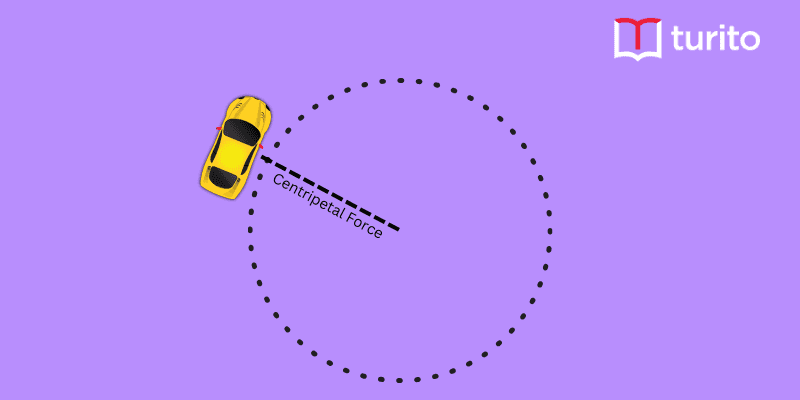
A force is required to maintain circular motion. Any force that causes an object to follow a circular path is called a centripetal force. Centripetal means “center-seeking.”
Newton’s Second Law says that if an object is accelerating, there must be a net force on it. For an object moving in a circle, this is called the centripetal force. The centripetal force points toward the center of the circular path.
Its unit is Newton (N).

Velocity vector is tangential to the direction of the motion of the object and the centripetal force is directed inwards as it is a “center-seeking” force.


Centripetal force:
It depends on the:
- Object’s mass
- Object’s speed
- Distance between the object and the axis point
Such that:

Centripetal Acceleration
It depends on the:
- Radius of the circle.
- The speed of the object.
It is denoted by ‘ac’ and its unit is m/s2.
The relation between acceleration, radius and speed are:

Application of Centripetal force:
A few of the application of centripetal force are:
- Gravitational force that holds the moon in its orbit is a centripetal force.

b. Electrical forces holding the electrons in orbit around the nucleus are centripetal forces.

c. When a car takes a turn, the force that keeps it in its curved path is centripetal force.

d. When a ball is swirled around a string, the force that keeps it swirling in the circular path is called a centripetal force.

e. When going through a loop on a giant wheel the force experienced is called as a centripetal force.

Questions and answers
Question 1: Draw the direction of motion if the object is released from its orbit at point 1 and 2.

Answer:
For object 1 it will go in horizontal direction towards the right.
For object 2 it will go vertically down.

Question 2: The motion of a boy of weight 40 Kg in a merry-go-round of the radius 20 m and the speed of the boy around the merry go round is 40 m/s. What is the centripetal force and centripetal acceleration experienced by the system?
Answer:
Velocity = 40m/s
Radius = 20m
ac =
v2rv2r
=
4022040220 =
40 × 402040 × 4020 = 80m/s2
Mass of boy = 40kg
Fc =
mv2rmv2r
= 40(80)
= 3200N
Summary
- Any force that causes an object to follow a circular path is called a centripetal force.
- It is pointed inwards.
- Centripetal force depends upon mass, velocity and radius.
Fc = Mv2/R
- Centripetal acceleration depends upon velocity and radius.
ac=v2/r
- A few of the applications where this is used is:
- When a car takes a turn on a curved path
- Gravitational force that holds the celestial bodies in its orbit ·
- When a ball is swirled around a string
- Electrical forces holding the electrons in its path
Related topics
Effects of Force: Types, Examples, and Applications
Effects of Force Key Concepts What Is Force? A force comes into play when two or more objects interact with each other. This force when applied to an object by another, gives rise to some kind of change in the state of motion of an object. In this section we will be looking at these […]
Read More >>
Electrical Components and Symbols Explained with Diagrams
What Are Electrical Components? Consider the electrical components as the building blocks of any circuit. These are the actual components that cause electricity to do what you want it to do. Every switch you flip, every fan that spins, every charger that doesn’t overheat relies on these small parts doing their job quietly. You rarely […]
Read More >>Friction: Advantages and Disadvantages Explained
Friction is one of the most important concepts of friction, and today we will learn what friction is and everything there is to know about it. What Is Friction? According to Britannica, Friction is the force that stops one solid item from sliding or rolling over another. Frictional forces, like the traction needed to walk […]
Read More >>
Different Types of Waves and Their Examples
Introduction: We can’t directly observe many waves like light waves and sound waves. The mechanical waves on a rope, waves on the surface of the water, and a slinky are visible to us. So, these mechanical waves can serve as a model to understand the wave phenomenon. Explanation: Types of Waves: Fig:1 Types of waves […]
Read More >>

Other topics





Comments: