



Difference between Series and Parallel Circuits

Key Concepts
- Series connection of load
- Series connection of battery
- Parallel connection of battery
- Parallel connection of load
Introduction:
We have parallel connections at home. When one electrical appliance short circuits, the others work fine. On the other hand, in Diwali decoration lights, if one bulb goes off, all the bulbs stop working. In this section, we are going to find the answer to these problems and know a lot more.
Explanation:
Series connection:
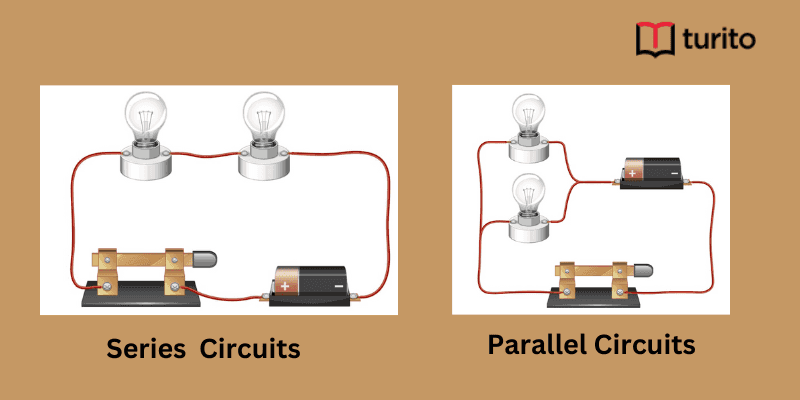
In series connection, there is only one direction for the current to flow— clockwise or anticlockwise.


When load is connected in series
- Current:
- Current is same throughout the circuit.
- Current depends on the total resistance in the circuit.
- Voltage:
- Voltage varies across each component.
- The sum of the voltages across each load in the entire circuit equals the total voltage supplied by the battery.
- Resistance:
- Total resistance increases when loads are connected in series.
- As the total resistance increases, the overall current decreases.
When electric cells are connected in series
- Effective voltage is the sum of the voltage of each cell.
- A large current is given out because of increased voltage, thus increasing the efficiency of the appliance.
- Maximum overall lifespan of the battery is the same as the lifespan of each of individual cell,

Parallel connection:
In parallel connection, there is more than one direction for the flow of current. Multiple components are connected through the same set of electrical common point.
Junction point:
Location where a circuit divides into multiple paths or multiple paths combine is called a junction point.
No current is created or destroyed by parallel paths, rather the current is split!



When load is connected in parallel
- Current:
- Current varies across each component.
- The sum of the current passing through each load in the entire circuit equals the total current supplied by the battery.
- Current depends on the total resistance in the circuit.
- Voltage:
- Voltage is same throughout the circuit.
- Resistance:
- Total resistance decreases when load is connected in parallel.
- As the total resistance decreases, the overall current increases.
When electric cells are connected in parallel
- Effective voltage is the same as the voltage of each cell.
- As the voltage is the same so efficiency will be normal.
- Maximum overall lifespan of the battery is the sum of the lifespans of each of cell..

Questions and answers
Question 1: What is the difference between series connection and parallel connection of load?
Answer:

Question 2: What is the difference between series connection and parallel connection of electric cells?
Answer:

Summary
1. In series connection of load:
- One path for electron flow
- When load is removed electrons cannot flow.
- Total voltage equals the sum of the voltage across each load.
- Current is the same throughout the circuit.
- Voltage varies for all the loads
- In series connection, the total resistance of all load increases
- Overall current is less as the total resistance increases.
2. In series connection of electric cells:
- Effective voltage is the sum of the voltage of each cell.
- Large current is given out.
- Maximum overall lifespan of the battery is the same as the lifespan of each of the individual cell.
3. In parallel connection of load:
- Multiple paths for electron flow.
- When the load is removed electrons can still flow.
- Total current equals sum of the current across each load.
- voltage is same throughout the circuit.
- current varies for all the loads
- In parallel connection, total resistance due to all load decreases
- Overall current is more as the total resistance increases.
4. In parallel connection of electric cell:
- Effective voltage is the same as the voltage of each cell.
- Maximum overall lifespan of the battery is the sum of the lifespan of each of the individual cell
Related topics
Effects of Force: Types, Examples, and Applications
Effects of Force Key Concepts What Is Force? A force comes into play when two or more objects interact with each other. This force when applied to an object by another, gives rise to some kind of change in the state of motion of an object. In this section we will be looking at these […]
Read More >>
Electrical Components and Symbols Explained with Diagrams
What Are Electrical Components? Consider the electrical components as the building blocks of any circuit. These are the actual components that cause electricity to do what you want it to do. Every switch you flip, every fan that spins, every charger that doesn’t overheat relies on these small parts doing their job quietly. You rarely […]
Read More >>Friction: Advantages and Disadvantages Explained
Friction is one of the most important concepts of friction, and today we will learn what friction is and everything there is to know about it. What Is Friction? According to Britannica, Friction is the force that stops one solid item from sliding or rolling over another. Frictional forces, like the traction needed to walk […]
Read More >>
Different Types of Waves and Their Examples
Introduction: We can’t directly observe many waves like light waves and sound waves. The mechanical waves on a rope, waves on the surface of the water, and a slinky are visible to us. So, these mechanical waves can serve as a model to understand the wave phenomenon. Explanation: Types of Waves: Fig:1 Types of waves […]
Read More >>

Other topics


Comments: