



Equations of Motion- Definition, Method, Formula

Deriving Equations of Motion

Explanation:
Introduction:
Equation of motion is mostly derived from the definition of the quantity which describes the motion and the time related to motion.
The equations to be derived are:
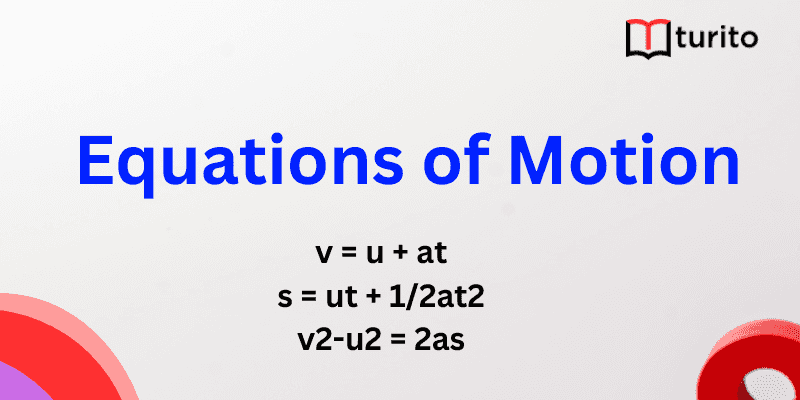
v = u + at
s = ut + 1/2at2
v2-u2 = 2as

Deriving the equation in two types:
- Algebraic method
- Graphical method
Deriving the equation v = u + at using the algebraic method:
we know that acceleration is the ratio of change of velocity with time; hence, we have

Deriving the equation v= u + at using the graphical method:

Important points:
- In the above graph, the y-axis represents velocity, and the x-axis represents time.
- We can see initial velocity u is in the y-axis and also some points on v in the graph.
- Therefore, the graph represents v-t graph, and the slope of the graph is acceleration.
- The slope and the equation are derived as follows:

Deriving the equation s = ut + 1/2 at2 using the algebraic method:
we know that displacement = velocity x time

From the first derivation, we know v = u + at

Deriving the equation s = ut + 1/2 at2 using graphical method

Important motion:
In the above graph, the total distance traveled in the graph is given by the area of RPQS
The area under RPQS is further divided into the area of triangle RQS and the area of the rectangle RTOS.
Hence, the distance traveled is,
S = area of RQS + area RTOS
S = ½ (RS x SQ) + RT x TO
S=1/2 (t x at) + u x t
S = ut +1/2 at2
Deriving the equation v2 – u2 = 2as using the algebraic method:

Deriving the equation v2 – u2 = 2as using the graphical method:

Important points:
S =1/2(sum of opposite sides) x height
S = (RS + PQ) x TO
The above equation becomes
S = 1/2(u + v) x (v – u)/a
Rearranging the equation, we get
S = 1/2(v + u) x (v – u) x a
S = (v2 – u2)/2a
Therefore,
v2 – u2 = 2as

Related topics
Effects of Force: Types, Examples, and Applications
Effects of Force Key Concepts What Is Force? A force comes into play when two or more objects interact with each other. This force when applied to an object by another, gives rise to some kind of change in the state of motion of an object. In this section we will be looking at these […]
Read More >>
Electrical Components and Symbols Explained with Diagrams
What Are Electrical Components? Consider the electrical components as the building blocks of any circuit. These are the actual components that cause electricity to do what you want it to do. Every switch you flip, every fan that spins, every charger that doesn’t overheat relies on these small parts doing their job quietly. You rarely […]
Read More >>Friction: Advantages and Disadvantages Explained
Friction is one of the most important concepts of friction, and today we will learn what friction is and everything there is to know about it. What Is Friction? According to Britannica, Friction is the force that stops one solid item from sliding or rolling over another. Frictional forces, like the traction needed to walk […]
Read More >>
Different Types of Waves and Their Examples
Introduction: We can’t directly observe many waves like light waves and sound waves. The mechanical waves on a rope, waves on the surface of the water, and a slinky are visible to us. So, these mechanical waves can serve as a model to understand the wave phenomenon. Explanation: Types of Waves: Fig:1 Types of waves […]
Read More >>

Other topics


Comments: