



Faraday’s Law of Electromagnetic Induction


Introduction:
Electromagnetic Induction:
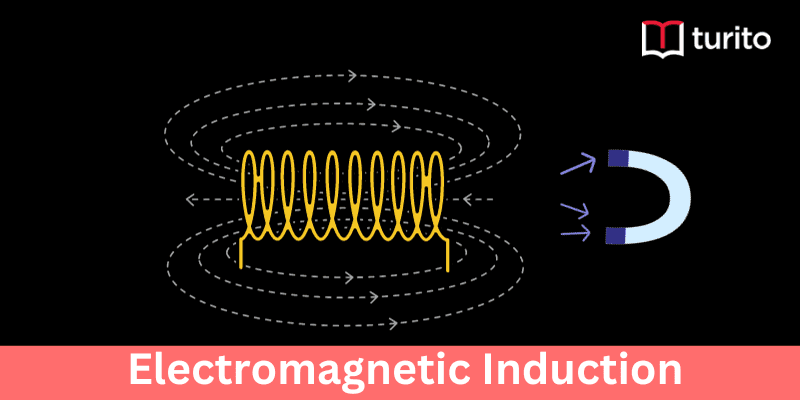
Michael Faraday established that Oersted’s experiment had the opposite effect. When the magnetic flux linked to the conductor changes, he explained how emf can be produced across the ends of the conductor. Electromagnetic induction was the name given to this phenomenon. This phenomenon’s discovery ushered in a revolution in the world of electric power generation.
Explanation:
Faraday’s Experiments:
A circular insulated wire of one (or) more turn connected to a sensitive galvanometer G. Here N-S is a bar magnet that can be moved with respect to the coil.

Faraday Observed That:
- The galvanometer shows a sudden deflection whenever there is relative motion between the coil and the magnet. This means that the coil is induced with current.
- The deflection is temporary. It lasts as long as relative motion between the coil and the magnet continues.
- The deflection is more when the magnet moves fast and less when the magnet moves slow.
- The direction of deflection is reversed when the same pole (north or south) is moved away from the coil instead of moving towards the coil.
- The motion of the magnet implies that the number of magnetic lines of force threading the coil is changing.
- The maximum current is observed when the magnet is moved in and out of the coil with the greatest number of turns. Minimum current is observed when the magnet is moved in and out of the coil with the least number of turns.
Conclusions:
An electromotive force (e.m.f.) is induced in the coil whenever there is a relative motion between the source of the magnetic field (magnet) and the coil.
When the magnet and coil approach each other, the flux associated with the coil increases, causing an emf. The magnetic flux linked to the coil drops as the magnet and coil move away from each other, causing an emf to be induced once again. This emf would only be present for as long as the flux changes.
An electric current begins to flow as a result of this emf, and the galvanometer deflects. The deflection in the galvanometer will be there as long as the magnet and coil are in relative motion.

Induced emf is produced in the coil whenever relative motion between the coil and the magnet occurs. Current and charge are induced in the circuit if the coil is in a closed circuit. This phenomenon is called electromagnetic induction.
Faraday’s Law Of E.M.I:
1. First Law:
Whenever the amount of magnetic flux linked with the coil changes an emf is induced in the coil.
2. Second Law:
The magnitude of induced emf in a circuit is directly proportional to the rate of change of magnetic flux linked with the circuit.
ε = – N dΦB / dt
Where,
ε is the induced voltage
N is the number of turns in the coil
ΦB is the magnetic flux
t is the time
The negative sign indicates emf always opposes any change in magnetic flux linked with the circuit.
Summary
- Electromagnetic induction is the phenomenon where a current is induced in a circuit due to a change in the magnetic flux linked to it.
- An emf is produced when there is a change in the magnetic flux linked to a closed circuit. This emf is called induced emf and the current produced is known as induced current.
- Faraday’s First Law: Whenever there is a change in the magnetic flux linked with a circuit, an emf and hence a current is induced in the circuit. However, it lasts only as long as the magnetic flux changes.
- Faraday’s Second Law: The magnitude of induced e.m.f in a circuit is directly proportional to the rate of change of magnetic flux linked with the circuit.
E = – NdΦB / dt
Where, E is the induced voltage
N is the number of turns in the coil
Os is the magnetic flux
t is the time
Related topics
Effects of Force: Types, Examples, and Applications
Effects of Force Key Concepts What Is Force? A force comes into play when two or more objects interact with each other. This force when applied to an object by another, gives rise to some kind of change in the state of motion of an object. In this section we will be looking at these […]
Read More >>
Electrical Components and Symbols Explained with Diagrams
What Are Electrical Components? Consider the electrical components as the building blocks of any circuit. These are the actual components that cause electricity to do what you want it to do. Every switch you flip, every fan that spins, every charger that doesn’t overheat relies on these small parts doing their job quietly. You rarely […]
Read More >>Friction: Advantages and Disadvantages Explained
Friction is one of the most important concepts of friction, and today we will learn what friction is and everything there is to know about it. What Is Friction? According to Britannica, Friction is the force that stops one solid item from sliding or rolling over another. Frictional forces, like the traction needed to walk […]
Read More >>
Different Types of Waves and Their Examples
Introduction: We can’t directly observe many waves like light waves and sound waves. The mechanical waves on a rope, waves on the surface of the water, and a slinky are visible to us. So, these mechanical waves can serve as a model to understand the wave phenomenon. Explanation: Types of Waves: Fig:1 Types of waves […]
Read More >>

Other topics





Comments: