



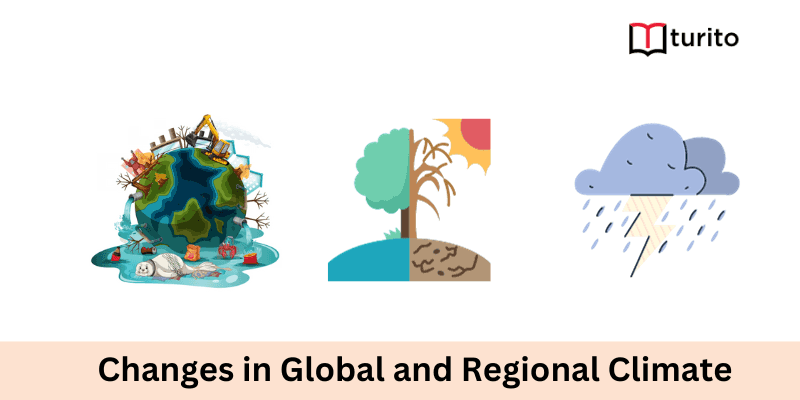
Changes in Global and Regional Climate

Geological Record: Changes in Global and Regional Climate

 Introduction
The long-term pattern of weather in a certain area is called climate. Changes in weather can be seen from hour to hour, day to day, month to month or even from year to year. For periods of 30 years or more, different patterns of weather can be seen.
Generally, climates are consistent, hence living things can adjust to them. For example: Polar bears have adjusted to remain warm in polar climates, whereas cacti have adapted to store water that help them to survive in dry climates.
Climates change very slowly, over hundreds or even thousands of years. As climates change, living organisms in that particular area must adapt, relocate, or sometimes risk becoming extinct.

Changing Climate of Earth
Many times Earth’s climate has changed. For example, fossils dating back to 144 to 65 million years ago, i.e., Cretaceous period, show that the Earth was much warmer as compared to today’s time. Fossilized plants and animals that generally live in warm environments have been seen at higher latitudes than they could survived today. For example, the breadfruit trees, now found in tropical islands, grew in the far north regions of Greenland.

In the past 500,000 years, at least four ice ages have been experienced on Earth. During these times, temperature on the Earth decreased which caused expansion of ice sheets and glaciers. The ice age startedbout 2 million years ago. The last ice age occurred around. The ice caps started disappearing around 18,000 years ago. But they have not vanished completely. The presence of ice caps in Antarctica and Greenland shows that even now the Earth is in a type of ice age. Many scientists think that we are in an interglacial period, i.e., the time between ice ages when global temperatures rise and ice caps melt due to warmer temperatures, which causes the sea levels to rise. This warming is called El Niño.
Climatologists look for evidence of past climate change in several places, such as glaciers.
Glaciers scrape and scrub rocks as they go. They accumulate sediment known as glacial till. This accumulated sediment sometimes create hills or ridges called moraines. Glaciers also produce drumlines, an elongated oval hill. All of these geographic structures on land that at present have no glaciers, indicate that once there were glaciers.
Natural Sources of Climate Change
Wind and Ocean current
Climate changes happen due to Earth’s atmosphere. The change in climate brought by El Niño, which depends on winds and ocean currents, is an example of natural atmospheric changes.
Forces outside Earth’s atmosphere is also one of the cause of natural climate change. For example, the 100,000-year cycles of ice ages are most likely associated with changes in the tilt of Earth’s axis and the shape of Earth’s orbit around the sun. Slowly these planetary factors change over time and causes change in movement of the sun’s energy to different parts of the world in different seasons.

Meteorite
The influence of large meteorites on Earth can also affect climate change. The effect of a meteor can send lots of waste into the atmosphere. This waste can block some of the sun rays, making it cold and dark. This climate change affect the survival of organisms. Many paleontologists think that the effect of a meteor or comet resulted in the extinction of the dinosaurs. Dinosaurs cannot survive in a cool, dark climate. Their bodies cannot adapt to the cold, and the dark that limits the growth of plants on which they survive.

Plate tectonics
Climate change can also be caused by plate tectonics. Over a period of time, there is a great change in Earth’s continental plates. Almost more than 200 million years ago, the merging of continents resulted in the formation of one big landmass called Pangaea. When the continents broke and moved away from each other, their locations on Earth changed, and eventually the movements of ocean currents also changed. So, both of these changes had effects on climate.

Greenhouse gases
Changes in the percentage of greenhouse gases in the atmosphere also have an effect on climate change. Greenhouse gases such as carbon dioxide trap the sun’s heat within Earth’s atmosphere. This causes rise in temperatures of the Earth’s surface. Volcanoes on land and under the ocean—release greenhouse gases, hence if the volcanic eruption reaches the troposphere the additional gases also add to warming.

Summary
- The long-term pattern of weather in a certain area is called climate.
- Climates change very slowly, over hundreds or even thousands of years.
- Climate changes happen due to Earth’s atmosphere. . The influence of large meteorites on Earth can also affect climate change.
- Climate change can also be caused by plate tectonics.
- Changes in the percentage of greenhouse gases in the atmosphere also have an effect on
climate change.
Related topics
Effects of Force: Types, Examples, and Applications
Effects of Force Key Concepts What Is Force? A force comes into play when two or more objects interact with each other. This force when applied to an object by another, gives rise to some kind of change in the state of motion of an object. In this section we will be looking at these […]
Read More >>
Electrical Components and Symbols Explained with Diagrams
What Are Electrical Components? Consider the electrical components as the building blocks of any circuit. These are the actual components that cause electricity to do what you want it to do. Every switch you flip, every fan that spins, every charger that doesn’t overheat relies on these small parts doing their job quietly. You rarely […]
Read More >>Friction: Advantages and Disadvantages Explained
Friction is one of the most important concepts of friction, and today we will learn what friction is and everything there is to know about it. What Is Friction? According to Britannica, Friction is the force that stops one solid item from sliding or rolling over another. Frictional forces, like the traction needed to walk […]
Read More >>
Different Types of Waves and Their Examples
Introduction: We can’t directly observe many waves like light waves and sound waves. The mechanical waves on a rope, waves on the surface of the water, and a slinky are visible to us. So, these mechanical waves can serve as a model to understand the wave phenomenon. Explanation: Types of Waves: Fig:1 Types of waves […]
Read More >>

Other topics





Comments: