



Plane Mirror and Properties – Types of Images Formed

Plane Mirror and Properties
 Key Concepts
- Characteristics of the image formed by a plane mirror
- Lateral inversion
- Virtual and real images
- Ray diagram of the image formation by a plane mirror
 Introduction
It is known that when light falls on a smooth and polished surface, like that of a mirror, it undergoes a regular reflection to produce a sharp and clear image of the object lying in front of it. This image is a result of the regular reflection of the light that comes from or reflects from the object and falls on the mirror. In this section, we will be looking at the way the mirrors produce the image of everything lying in front of them by understanding the required concepts.
 Explanation
Characteristics of the image formed by a plane mirror:
The following are the characteristics of the image formed by a plane mirror.
- The image is always upright.
- The image is of the same size as the object.
- The distance of the image from the mirror is exactly equal to the distance of the object from the mirror.
- The image cannot be formed on the screen, i.e., it is a virtual image.
- The image is laterally inverted.
Lateral inversion:
It is the phenomenon of reversal of the mirror image of an object wherein the left side of the object appears to be on the right side of the image and vice versa. This is why when a person standing in front of the mirror raises his left hand, the image in the mirror seems to raise his right hand. The text ‘AMBULANCE’ is written in a laterally inverted way on an ambulance so that it appears to a person driving ahead of it in the right manner on their rear-view mirror.

Ray diagram of the image formation by a plane mirror:
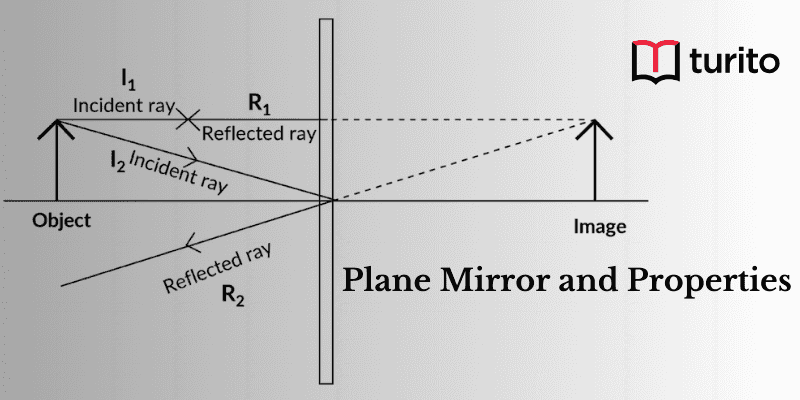
Let us take two incident rays, I1 and I2, emerging from the head of an object placed in front of the mirror. I1 incidents normally whereas I2 incidents at an angle to the surface of the mirror. After reflection, they give rise to the corresponding reflected rays R1 and R2. These reflected rays appear to diverge from a point behind the mirror, where the image of the head of the object is formed. Similarly, if we consider each and every point on the body and draw ray diagrams, we will be able to get the image of the whole body behind the mirror.


Virtual Image:
- The images which are not formed by the actual meeting of the reflected rays at a point but are formed at a point from where the reflected rays appear to diverge are called virtual images.
- A virtual image cannot be obtained on a screen.
- A virtual image is always upright.
Real image:
- A real image is formed at a point where the reflected rays actually meet.
- For example, the projection formed by a projector on a screen is a real image.
- Real images are always obtained on a screen.
- Real images are always inverted (upside down).
- For example, a real image of a person is seen on the inner surface of a stainless-steel spoon. It is also inverted.

Summary
- The image formed by a plane mirror is of the same size and at the same distance
as that of the object. - The image formed by a plane mirror is virtual, upright and laterally inverted.
- A virtual image is obtained at a point from where the reflected rays seem to
diverge. It cannot be obtained on a screen. - A real image is obtained at a point at which the reflected rays actually meet. It is
obtained on a screen. - The projection of a projector formed on a screen is a real image.
- Virtual images are always upright and real images are always inverted.
- An incident ray of light undergoing a normal incidence on a reflecting surface
gets reflected along the same line in the opposite direction.
Related topics
Effects of Force: Types, Examples, and Applications
Effects of Force Key Concepts What Is Force? A force comes into play when two or more objects interact with each other. This force when applied to an object by another, gives rise to some kind of change in the state of motion of an object. In this section we will be looking at these […]
Read More >>
Electrical Components and Symbols Explained with Diagrams
What Are Electrical Components? Consider the electrical components as the building blocks of any circuit. These are the actual components that cause electricity to do what you want it to do. Every switch you flip, every fan that spins, every charger that doesn’t overheat relies on these small parts doing their job quietly. You rarely […]
Read More >>Friction: Advantages and Disadvantages Explained
Friction is one of the most important concepts of friction, and today we will learn what friction is and everything there is to know about it. What Is Friction? According to Britannica, Friction is the force that stops one solid item from sliding or rolling over another. Frictional forces, like the traction needed to walk […]
Read More >>
Different Types of Waves and Their Examples
Introduction: We can’t directly observe many waves like light waves and sound waves. The mechanical waves on a rope, waves on the surface of the water, and a slinky are visible to us. So, these mechanical waves can serve as a model to understand the wave phenomenon. Explanation: Types of Waves: Fig:1 Types of waves […]
Read More >>

Other topics


Comments: