



Production of Sound

Key Concepts
- Sound
- Production of sound
- Production of sound by non-living and living things
Introduction: Production of Sound
We hear a lot of sounds at various places that we visit during the day and the night. At every place we hear sounds from different sources. For example, at school we hear the voices of teachers, friends and other students, the sound of the bell and the announcements over a mike. Whereas, on a busy road we hear sounds of various vehicles, traffic and sirens. We will be learning about sound in this section.
Explanation:
Sound:
We humans make sound by the following activities,
- Speaking and screaming
- Burping and hiccupping
- Clapping hands
- Cracking knuckles
- Walking
- Sneezing and coughing
- Hitting and kicking
All these activities result in some kind of sound and also these activities require energy to be performed. This energy comes from the muscles which contain stored chemical energy. From the law of conservation of energy, energy can neither be created nor destroyed. It can only change its form. Here, chemical energy stored in the muscles is converted to sound. Thus, sound is a form of energy which produces a sensation of hearing in our ears.
Production of Sound:
When a steel plate is hit by a steel spoon multiple times, it would be observed that the steel plate vibrates and also produces a sound. It can be concluded that a sound is produced when an object vibrates. Vibration means rapid to and from motion of an object. A vibrating object produces sound.

Production of sound by non-living and living things:
Non-living things:

The noise produced by vehicles originate from the vibration of their engines. The sound produced by home appliances originate from the vibration of their internal parts such as motors.
Musical instruments produce many different sounds. Instruments such as guitar have strings which need to be plucked to produce sound. Instruments such as drums and gongs need to be hit to produce sound. Instruments such as flutes and trumpets need to be blown to produce sound.
When these instruments are plucked, scratched, hit or blown, a part of them vibrates and produces sound. In a guitar the strings vibrate on plucking to produce sound. When a drum is hit, its membrane vibrates to produce sound. A gong vibrates to produce sound. In flutes and trumpets, it is the air column that vibrates to produce sound.
Thus, sound can be produced by plucking, scratching, blowing, hitting, rubbing and shaking objects. This is because all these actions lead to the vibration of the body. A body produces sound when it vibrates.
Living things:
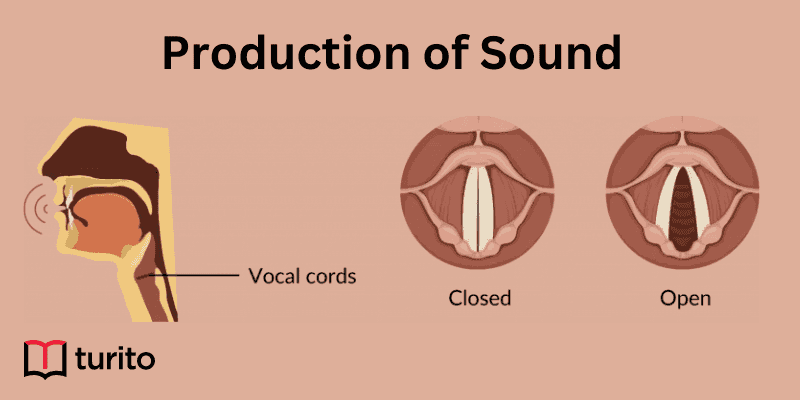
Human voice is produced by using the vocal cords of the larynx, which is a part of the throat.
The sound is produced when the vocal cords vibrate.
While vibrating the vocal cords open and close as shown in the picture.

Most mammals, birds and frogs have vocal cords or similar structures to produce sounds of their own.

We hear bees and mosquitoes buzzing. Are these sounds produced by their vocal cords?
The buzzing sound heard when bees and mosquitoes fly is produced from rapid movement of their wings, which makes the air around vibrate.
When the birds flap their wings while flying, a sound is produced.
A cricket produces a singing type sound when it scrapes parts of its front wings together.

Summary:
- We hear and make various kinds of sounds in our daily lives.
- Sound is a form of energy which produces a sensation of hearing in our ears.
- The chemical energy stored in our body is converted into sound energy when sound.
- Vibrating objects produce sound. Vibration refers to a rapid to and fro motion object.
- Sound is produced by vehicles and various appliances because of the vibration of their internal parts such as the engine and motors respectively.
- Various musical instruments produce sound due to vibration of a membrane, a string or an air column.
- Human beings voice is produced by the vibration of the vocal cord in the larynx in the throat.
- Most mammals, birds and frogs have vocal cord or similar organs to vibrate and produce their respective sounds. 9. Mosquitoes and bees make a buzzing sound because of rapid movement of their wings.
Related topics
Effects of Force: Types, Examples, and Applications
Effects of Force Key Concepts What Is Force? A force comes into play when two or more objects interact with each other. This force when applied to an object by another, gives rise to some kind of change in the state of motion of an object. In this section we will be looking at these […]
Read More >>
Electrical Components and Symbols Explained with Diagrams
What Are Electrical Components? Consider the electrical components as the building blocks of any circuit. These are the actual components that cause electricity to do what you want it to do. Every switch you flip, every fan that spins, every charger that doesn’t overheat relies on these small parts doing their job quietly. You rarely […]
Read More >>Friction: Advantages and Disadvantages Explained
Friction is one of the most important concepts of friction, and today we will learn what friction is and everything there is to know about it. What Is Friction? According to Britannica, Friction is the force that stops one solid item from sliding or rolling over another. Frictional forces, like the traction needed to walk […]
Read More >>
Different Types of Waves and Their Examples
Introduction: We can’t directly observe many waves like light waves and sound waves. The mechanical waves on a rope, waves on the surface of the water, and a slinky are visible to us. So, these mechanical waves can serve as a model to understand the wave phenomenon. Explanation: Types of Waves: Fig:1 Types of waves […]
Read More >>

Other topics





Comments: