



Propagation of Sound

Key Concepts
- Propagation of sound
- Compression and rarefaction
Introduction:
Sound starts from a vibrating object, propagates through a material medium and then reaches the listeners ears. While propagating through a medium the sound waves disturb the particles of the medium. In this section we will be looking at the way in which the particles are disturbed by the propagation of sound through them.
Explanation:
Propagation of Sound:
Sound is generated when an object vibrates. These vibrations set the neighboring particles of the medium to vibration. These vibrating particles set their neighboring particles to vibration. This process continues till the vibrations are carried to the ears of the listener. The following points refer to the way in which the sound propagates through a medium.
- The particles of the medium which is in contact with the vibrating object is first displaced from its equilibrium position.
- This vibrating particle hits the adjacent particle, which gets displaced from its equilibrium position and starts vibrating. After displacing the adjacent particle, the first particle comes back to its original position.
- This particle in turn sets the next particle to vibration and then comes to rest.
- This process repeats itself until it reaches the particle near the ear of the listener.
- This disturbance created by a source of sound in the medium travels through the medium and not the particles of the medium.
- The particles of the medium do not themselves move forward, but the disturbance is carried forward.

Activity:
The following activity may be conducted to visualize the way in which the sound propagates through a medium by disturbing the particles.
- For this we need a slinky and fix one of its ends to a rigid object such as a wall and its body rests on a table.
- Now, hold the free end of the slinky and push it forward.
- It will be observed that some of the turns of the slinky come closer together and form a group.
- This group of turns then moves forward towards the fixed end of the slinky.
- The movement of the sound wave in the air takes place in a similar fashion.
Propagation of sound:
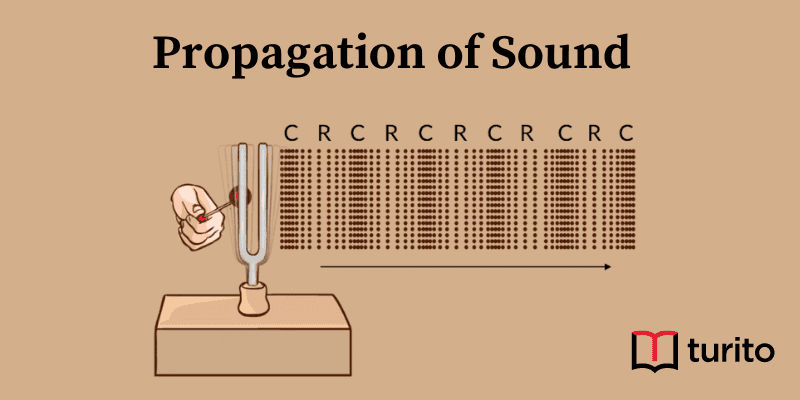
- When an object vibrates in the air medium, it pushes the nearby air particles and compresses them while moving forward.
- This creates a high-pressure or high-density region called compression (C).
- This compression then starts to move away from the vibrating object.
- Now when the vibrating object moves backward it creates a region of low pressure or low density called the rarefaction (R).
- As the object vibrates it moves back and forth multiple times.
- Every time it vibrates it creates one region each of compression (C) and rarefaction (R).
- As a result of multiple vibrations, a series of Cs and Rs are generated in the air.
- These Cs and Rs form the sound wave which moves through the medium.
- Compressions are the regions of high pressure and has a high density of particles.
- Rarefactions are the regions of low pressure and has a low density of particles.
- The sound wave is propagated through the medium in terms of the propagation of the compressions and rarefactions.
- Thus, propagation of sound can be visualized as the propagation of density or pressure variations in the medium.

Summary:
- The process of sound traveling from one place to the other is called the propagation of sound.
- When an object vibrates in a medium the particles of the medium which are in contact with the it first get displaced from their equilibrium positions.
- These particles disturb their neighboring particles in a similar way, after which they come to rest.
- This disturbance created by a source of sound in the medium travels through the medium and not the particles of the medium.
- The sound wave is propagated through the medium in terms of the propagation of the compressions and rarefactions.
- The propagation of sound can be visualized as the propagation of density or pressure variations in the medium.

Related topics
Effects of Force: Types, Examples, and Applications
Effects of Force Key Concepts What Is Force? A force comes into play when two or more objects interact with each other. This force when applied to an object by another, gives rise to some kind of change in the state of motion of an object. In this section we will be looking at these […]
Read More >>
Electrical Components and Symbols Explained with Diagrams
What Are Electrical Components? Consider the electrical components as the building blocks of any circuit. These are the actual components that cause electricity to do what you want it to do. Every switch you flip, every fan that spins, every charger that doesn’t overheat relies on these small parts doing their job quietly. You rarely […]
Read More >>Friction: Advantages and Disadvantages Explained
Friction is one of the most important concepts of friction, and today we will learn what friction is and everything there is to know about it. What Is Friction? According to Britannica, Friction is the force that stops one solid item from sliding or rolling over another. Frictional forces, like the traction needed to walk […]
Read More >>
Different Types of Waves and Their Examples
Introduction: We can’t directly observe many waves like light waves and sound waves. The mechanical waves on a rope, waves on the surface of the water, and a slinky are visible to us. So, these mechanical waves can serve as a model to understand the wave phenomenon. Explanation: Types of Waves: Fig:1 Types of waves […]
Read More >>

Other topics



Comments: