



Properties of Electric Charges

Key Concepts
- The law of conservation of charge
- The additive nature of charge
- Quantization of charge
Introduction: Properties of Electric Charges
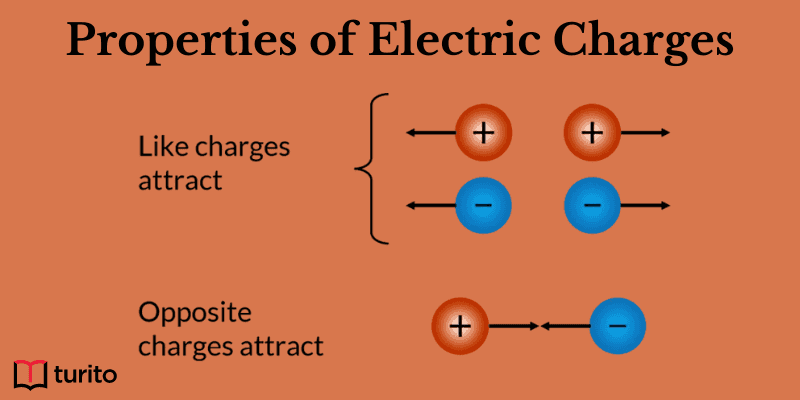
When two materials are rubbed against one another, electrons can move from one material to the other. This causes one material to become more negatively charged than the other. Objects get charged on rubbing or by conduction. When they are brought close to each other we see that:
The objects with the same electric charge repel each other.
The objects with opposite charges attract each other.

Law of conservation of charge:
The law of conservation of charge states that a charge can neither be created nor destroyed. However, it can be transferred from one body to another.
Explanation:
Charging by rubbing:
When two objects are rubbed against each other, negative charges (electrons) from one object gets transferred to another object. The object which loses electrons become positively charged and the object which gains electrons becomes negatively charged.


Conclusion:
When two objects are rubbed against each other, the transfer of charges takes place, but the total charge of the isolated system remains constant.

Charging by induction:
When a charged body is brought near an uncharged conductor, the charged body will attract the opposite charges and repel similar charges present in the uncharged body. As a result of this one side of the neutral body (close to the charged body) becomes oppositely charged while the other is similarly charged.
![Conservation of charge during charging by induction-1]](https://www.turito.com/learn-internal/wp-content/uploads/2022/08/image-2313.png)
Conclusion:
In the method of charging by induction, the inducing body neither gains nor loses charge. The total charge of the isolated system remains constant.

Charging by conduction:
In the case of conduction, electrons flow from one object to the other.

Conclusion:
In the case of conduction, electrons flow from one object to the other. However, the total charge of an isolated system remains constant.

Additive nature of charges:
Charges given to a system add up like real numbers. If a system contains three charges Q1, Q2, and Q3 then the total charge of the system is Q.

Total charge = Q = (Q1 + Q2 + Q3)
If the system has n number of charges, then the total charge Q:
Q = (Q1 + Q2 + Q3 + ……. + Qn)
A charge is a scalar quantity. It has magnitude but no direction.
A charge can be positive or negative.
The SI unit of charge is the Coulomb.
Example:
A system contains four charges Q1 = +2C, Q2 = +3C, Q3 = -4C and Q4 = -5C, then find the total charge of the system.

Solution:
Total charge = Q = (Q1 + Q2 + Q3 + Q4)
Total charge = Q = (2C) + (3C) + (-4C) + (-5C)
Total charge = Q = (-4C)
Quantization of charge:
- In the 20th century, Robert Millikan performed an experiment to determine the smallest possible charge in nature.
- By his famous oil-drop experiment Millikan found that the smallest possible charge in nature is 1.6 x 10⁻¹⁹ Coulomb.
- Later it was found that the charge on an electron or a proton is 1.6 x 10⁻¹⁹ Coulomb.
- Experimentally it has been observed that the charge on a body either positive or negative is always an integer multiple of 1.6 x 10⁻¹⁹ Coulomb.
Electric charges are quantized. They come in packets that cannot be divided.
The charge of a system is the integer multiple of the basic electric charge on an electron or proton (e).
Charge on an electron or proton = e = 1.6 x 10⁻¹⁹ C
The general formula for quantization of charge is:
Q = ± ne
Here Q = charge
n = an integer that gives the number of electrons or protons
n = …-2, -1,0,1,2,3………. etc.
e = charge on an electron or proton

Summary
Properties of charges:
Law of conservation of charge:
The law of conservation of charge states that a charge can neither be created nor destroyed. However, it can be transferred from one body to another.
Additive nature of charge:
Charges given to a system add up like real numbers. If the system has n number of charges,
then:
the total charge Q (Q1 + Q₂+Q3+…….+Qa)
A charge is a scalar quantity. It has magnitude but no direction. The SI unit of charge is
Coulomb (C)
Quantization of charge:
The charge of a system is the integer multiple of the basic electric charge on an electron or proton (e).
Charge on an electron or proton e = 1.6 x 10⁻¹⁹ C The general formula for quantization of charge is Q = ne Here n is an integer that gives the number of electrons or protons.
n=-2,-1,0,1,2,3………..etc.
Related topics
Effects of Force: Types, Examples, and Applications
Effects of Force Key Concepts What Is Force? A force comes into play when two or more objects interact with each other. This force when applied to an object by another, gives rise to some kind of change in the state of motion of an object. In this section we will be looking at these […]
Read More >>
Electrical Components and Symbols Explained with Diagrams
What Are Electrical Components? Consider the electrical components as the building blocks of any circuit. These are the actual components that cause electricity to do what you want it to do. Every switch you flip, every fan that spins, every charger that doesn’t overheat relies on these small parts doing their job quietly. You rarely […]
Read More >>Friction: Advantages and Disadvantages Explained
Friction is one of the most important concepts of friction, and today we will learn what friction is and everything there is to know about it. What Is Friction? According to Britannica, Friction is the force that stops one solid item from sliding or rolling over another. Frictional forces, like the traction needed to walk […]
Read More >>
Different Types of Waves and Their Examples
Introduction: We can’t directly observe many waves like light waves and sound waves. The mechanical waves on a rope, waves on the surface of the water, and a slinky are visible to us. So, these mechanical waves can serve as a model to understand the wave phenomenon. Explanation: Types of Waves: Fig:1 Types of waves […]
Read More >>

Other topics





Comments: