



Properties of Sound

Key Concepts
- Amplification
- SONAR
- Sound and noise
- Pitch
Explanation: Properties of Sound
Amplification:
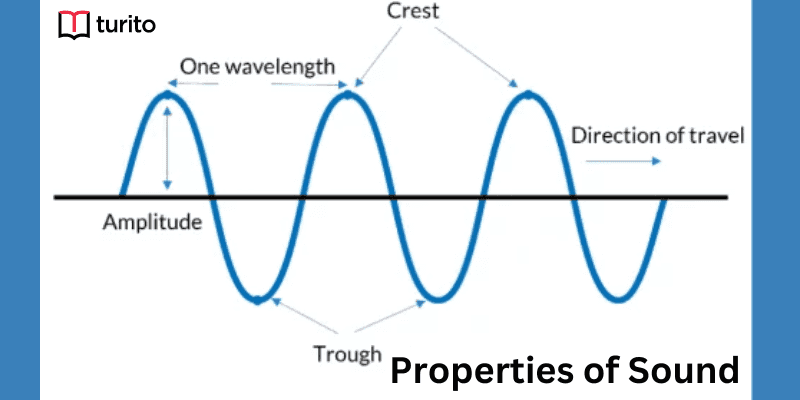
Consider a transverse wave with the amplitude A. After the amplification, the wave’s amplitude changes to A’ . Here, there is an increase in the sound. The sound wave gets louder as the amplitude of the sound increases; amplification increases the sound and alters the wave. If the amplitude decrease or increase is uneven it makes the wave irregular.
Working of SONAR:
SONAR has three parts:
- Transmitter
- Obstacle or absorber
- Receiver
Transmitter:
The transmitter is a device that acts as the source of the ultrasound waves; transmitting the ultrasound waves.
Obstacle:
The obstacle is not part of the SONAR. Still, if the sound waves are faced by any obstacles in the transmission, the obstacle or absorber is the main source of the reflection of the sound as sound waves cannot pass through the obstacle; therefore, the sound waves are reflected.
Receiver:
The sound waves which are reflected by the obstacle are then transmitted back, which in turn are received by the receiver thus, reading the type of obstacle in the radar.

Music:
Sound which is pleasing to hear is called music.
All the string instruments and the musical instruments produce sound in the form of music which is pleasant to hear, hence called music.
Noise:
Noise is the sound that is unpleasant to hear.
The vehicle horn and the other environmental sound which are unpleasant to hear are called noise.
Effects of noise pollution:
Too much production of noise with high decibel intensity is called noise pollution.
- Health issues for the pregnant woman.
- Heart issues among the elderly people.
- Blood pressure related issues.
- Hearing damage.
Pitch:
The highness and the lowness of a sound wave is called its pitch.
If the pitch is high, it is called a steep pitch. If the pitch is low, it is called a base.
Summary:
- Amplification: The sound gets louder as its amplitude increases.
- Working of SONAR:
- SONAR has three parts:
- Transmitter
- Obstacle or absorber
- Receiver
- Music: Sound which is pleasant to hear are called music.
- Noise: Noise is the sound that is unpleasant to hear.
- Pitch: The highness and the lowness of a sound is called pitch. If the pitch is high, it is called a steep pitch. If the pitch is low, it is called a base.
Related topics
Effects of Force: Types, Examples, and Applications
Effects of Force Key Concepts What Is Force? A force comes into play when two or more objects interact with each other. This force when applied to an object by another, gives rise to some kind of change in the state of motion of an object. In this section we will be looking at these […]
Read More >>
Electrical Components and Symbols Explained with Diagrams
What Are Electrical Components? Consider the electrical components as the building blocks of any circuit. These are the actual components that cause electricity to do what you want it to do. Every switch you flip, every fan that spins, every charger that doesn’t overheat relies on these small parts doing their job quietly. You rarely […]
Read More >>Friction: Advantages and Disadvantages Explained
Friction is one of the most important concepts of friction, and today we will learn what friction is and everything there is to know about it. What Is Friction? According to Britannica, Friction is the force that stops one solid item from sliding or rolling over another. Frictional forces, like the traction needed to walk […]
Read More >>
Different Types of Waves and Their Examples
Introduction: We can’t directly observe many waves like light waves and sound waves. The mechanical waves on a rope, waves on the surface of the water, and a slinky are visible to us. So, these mechanical waves can serve as a model to understand the wave phenomenon. Explanation: Types of Waves: Fig:1 Types of waves […]
Read More >>

Other topics



Comments: