



Learn Area of Rectangle – Grade 5 Maths | Length × Breadth

Key Concepts
- Find the area of a rectangle.
- Apply and extend previous understandings of multiplication to multiply a fraction or whole number by a fraction.
- Find the area of a rectangle with fractional side lengths by tiling it with unit squares of the appropriate unit fraction side lengths, and show that the area is the same as would be found by multiplying the side lengths.
- Multiply fractional side lengths to find areas of rectangles, and represent fraction products as rectangular areas.
Use fractional measurements and find the area
- Multiplying fractions may look difficult but it is actually quite easy to do!
- Unlike addition and subtraction, where the denominators have to match before performing the same, in multiplication the initial values of fractions are not required to be changed.
- To understand how to multiply fractions you should already have a basic understanding of what a fraction looks like.
- You need to know that the top number is called the numerator while the bottom number is called the denominator.
- When you go to multiply the fractions together you will be multiplying the numerators together and the denominators together to get the correct answer.
The steps to multiplying fractions are as follows:
- Multiply the numerators.
- Multiply the denominators.
- Check to make sure the fraction is in lowest terms.
Find the area of rectangle
- If you do not remember the formula for finding the area of a rectangle, how can you find its area?
Count no. of square units in the rectangle.
There are 40 square units in given rectangle.

∴ Area of rectangle = 40 Sq. uts
- How could you define area?
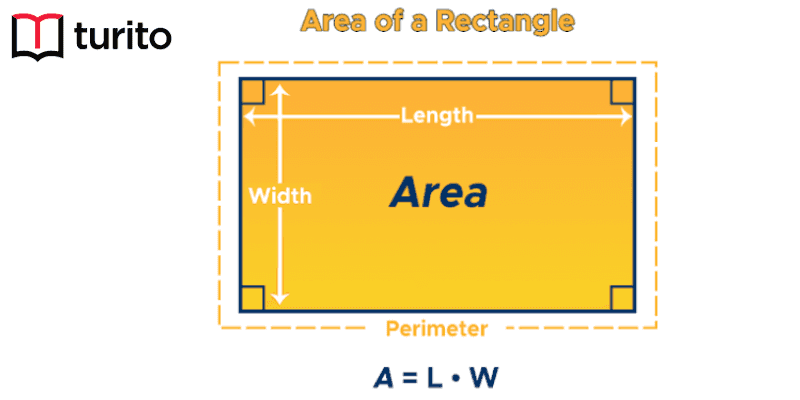
The area of any shape is the number of unit squares that can fit into it. Here ‘unit’ refers to one (1) and a unit square is a square with a side of 1 unit. So, the area of a rectangle is the number of unit squares within the boundary of the rectangle. Alternatively, the space occupied within the perimeter of a rectangle is called the area of the rectangle.

Area of rectangle = 10 × 4 = 40 Sq. units
= length of rectangle × width of rectangle
∴Area of rectangle = l × w Sq. units
- A rectangular poster is 𝟏/𝟒 yard wide and 𝟑/𝟒 yard tall. What is its area? Solve this problem by the method of your choice.
Solution:
Area of rectangular poster = l × w Sq.units
= 1/4 × 3/4
= 1× 3/4 × 4

∴ Area of rectangular poster = 3/16 Sq. Yards

- Jenny has a rectangular garden. What is the area of her garden?
Solution:
The area of a rectangle is found by multiplying the length with the width.
Step 1.

Length of rectangle = 5/4
Yards = 5 × 1/4
Width of rectangle = 1/3 Yards

First take unit fractions of the measurements of rectangle, then multiply 1/4 × 1/3 = 1/12
Because 12 rectangles each 1/4 wide and 1/3 high fit in a unit square.
Step 2.
A rectangle of width 5/4 yards and height 2/3 yards is tiled with 5 X 2 rectangles of area 1/12

So, 5/4 × 2/3 = 5×2/4×2 (Multiply numerator’s and multiply denominator’s)
= 10/12 square yards
= 5/6 square yards
∴ Area of rectangle garden = 5/6 yd2
Reasoning:
- Mason has a rectangular garden that is 𝟐/𝟑 yard wide by 𝟕/𝟒 yards long. What is the area of Mason’s garden? Use a drawing to show your work.
Solution:
Explanation
Remember that the entire square represents 1 square unit.
The length of the square is split into 4 equal parts. Each part is 1/4 of a unit long.
4 parts are shaded, so the length of the shaded rectangle is 1 whole part and ¾ i.e., 1 ¾ is 7/4 of a unit.
Step 2
Remember that the entire square represents 1 square unit.
The width of the square is split into 3 equal parts.
Each part is 1/3 of a unit wide. 2 parts are shaded so the width of the shaded rectangle is 2/3 of a unit.

- Mason has a rectangular garden that is 𝟐/𝟑 yard wide by 𝟕/𝟒 yards long. What is the area of Mason’s garden? Use a drawing to show your work.
Solution:

To find the area of the shaded rectangle, we multiply the rectangle’s length X width
The Length of shaded rectangular garden l = 7/4 yards

The Breadth of shaded rectangular garden w = 2/3 yards
Area of rectangular garden = l × w Sq. uts
= 7/4 × 2/3
or
= 7/4 × 2/3
= 7×2/4×3
= 14/12
= 7×1/2×3
∴The area of rectangular garden = 7/6
Sq. yards = 7/6 sq. yards
- Find the area of this figure.

Solution:
Given that,
Length = 3/4 inch
Breadth = 3/4 inch
Area of the shaded figure = 3/4 × 3/4
= 3×3/4×4
= 9/16
∴Area of the given figure is 9/16 in2
- Margaret purchased a doormat measuring 𝟏/𝟐 yard by 𝟐/𝟑 yard for her back door step. If the step is 𝟏/𝟒 square yard, will the mat fit? Explain.
Solution:

Given that ,
Length of the door mat = 1/2 yard
Width of the door mat = 2/3 yard
Area of the door mat = 1/2 × 2/3
= 1×2/2×3
= 2/6
Area of the door mat = 1/3 square yards
Area of the back door step = 1/4 square yards
1/3 × 4/4 = 4/12
1/4 × 3/3 = 3/12 (Equivalent Fraction of both areas)
4/12 > 3/12 Doormat area is greater than backdoor step area
Then,
∴The doormat will not fit to back door step.
Practice
- Find the area of a rectangle with side lengths 𝟓/𝟑 feet and 𝟑/𝟒 feet?
Solution:
Given that,
Length of the rectangle= 5/3 feet
Width of the triangle= 3/4 feet
Area of the triangle = 5/3 × 3/4
= 5×3/3×4
= 15/12
Area of the triangle = 5/4 square feet.
- Find the area of the square with side lengths of 38 𝟑𝟖 inch.
Solution:

Given that,
Length of the square = 3/8 inch
Area of the square = 3/8 × 3/8
= 3×3/8×8
= 9/64
Area of the square = 9/64 square inches.
- Find the area of the rectangle with side lengths 𝟕/𝟑 centimeters and 𝟓/𝟒 centimeters?

Solution:
Given that,
Length of the rectangle = 7/3 cm
Width of the rectangle = 5/4 cm
Area of the rectangle = 7/3 × 5/4
= 7×5/3×7
= 35/12
∴Area of the rectangle = 35/12 square centimeters
Remember
- You can’t always draw pictures to figure out a problem, so you can multiply fractions using a few simple steps.
- To multiply two fractions, multiply the numerator by the numerator and the denominator by the denominator.
a/b × c/d = a×c/b×d
Here is an example
1/2 × 3/5 = ________
Multiply the first numerator by the second numerator and multiply the first denominator by the second denominator.
7/10 × 3/4 = 7×3/10×4 = 21/40
- Let’s look at another example. 3/4 × 2/9 =_____
First, multiply the numerator by the numerator and the denominator by the denominator.
3/4 × 2/9 = 3×2/4×9 = 6/36
Next, simplify the fraction 6/36 by dividing by the greatest common factor (GCF). The G.C.F. of 6 and 36 is 6.
6÷6/36 = 1/6
3/4 × 2/9 = 1/6
or
3/4 × 2/9 = 3/4 × 2/9 = 1/2 × 1/3 = 1×1/2×3 = 1/6
- Cross simplify the fractions.
To cross-simplify, simplify on the diagonals by using greatest common factors to simplify a numerator and an opposite denominator.
3/4 × 2/9 = 3/4 × 2/9
= 1/2 × 1/3
= 1×1/2×3
= 3/4 × 2/9 = 1/6
Related topics

Obtuse Angle: Definition, Degree Measure, and Examples
What is an Obtuse Angle? In geometry, an angle that is greater than 90 degrees but lesser than 180 degrees is called an obtuse angle. We can easily recognize an obtuse angle because it extends past a right angle. Obtuse angle explained in detail with examples but first learn about angles. Type of Angles Geometry […]
Read More >>
Line Segment in Geometry: Definition, Symbol, Formula, and Examples
A line is a straight, one-dimensional figure that extends endlessly in both directions in geometry. It has no starting and ending points. When we define a starting point but not an ending point of a line, it is called a ray. Another important term associated with the line is a line segment. Line Segment Definition […]
Read More >>Area of Irregular Shapes for Grade 3 – Simple Methods & Examples
What Is the Area of an Irregular Shape? The area of an irregular shape is the space that it occupies, although it does not follow a clean formula. In contrast to the squares or perfect rectangles, irregular shapes have sides that are uneven or their angles don’t line up evenly. That is what makes them […]
Read More >>
Addition and Multiplication Using Counters & Bar-Diagrams
Introduction: We can find the solution to the word problem by solving it. Here, in this topic, we can use 3 methods to find the solution. 1. Add using counters 2. Use factors to get the product 3. Write equations to find the unknown. Addition Equation: 8+8+8 =? Multiplication equation: 3×8=? Example 1: Andrew has […]
Read More >>

Other topics





Comments: