



How to Find the Area of Square?

The area of a square can be understood by how much space a square covers inside it. In simple terms, the space present within the boundary of a square is known as the area of the square. In this article, you shall learn the fundamental parameters of a square. Also, you will study how to find the area of the square, the area of the square formula, and the surface area of a square pyramid.
Are we all familiar with what a square is? A square is a closed quadrilateral. Quadrilaterals are figures having 4 sides. Thus square is a four-sided figure that has all four sides equal. If one side of a square is 10 cm, then the other sides are also equal to 10 cm. Let us learn some of the mathematical terms and concepts related to a square first:
- A square has all sides equal. This implies that the opposite and the adjacent sides of a square are equal to each other.
- The opposite sides of a square are parallel, making it a parallelogram.
- The adjacent sides of a square are perpendicular to each other. This means that any two adjacent sides have an angle of 90 degrees between them.
- A square is divided into two right-angled congruent triangles.
- A square is a special case of a rectangle.
- The perimeter of a square: The distance covered by the boundaries of a square is known as the perimeter of a square. It is formulated as:
Perimeter (square) = s + s + s + s = 4 x s = 4s {where ‘s’ represents the side of a square}
In our day-to-day life, we can find squares everywhere. From our homes to our schools, squares are present at each corner. The tiles in your kitchen are square. The chessboard is a square containing 64 black and white smaller squares. The most common example is a Rubik’s cube. Each surface of a Rubik’s cube is square.
Other dimensions, such as the diagonal and the perimeter of the square, can also be used to compute the area of a square. In this article, we’ll try to learn more about the area of the square.

Area of Square
The area of the square is defined as the number of square units required to fill this shape. In other words, when calculating the area of a square, we consider the length of its side. Because all of the sides of the shape are equal, its area is the product of its two sides. The most common units for measuring the area of a square are square meters, square feet, square inches, and square cm.
The area of a square can also be calculated using other dimensions, such as the diagonal and the perimeter of the square. On this page, we’ll try to learn more about the area of a square.
What is the Area of the Square?
A square is a two-dimensional closed shape that has four equal sides and four equal angles. The four angles at the vertices are formed by the square’s four sides. The perimeter of a square is the sum of the total lengths of its sides, and the area of the square is the total space occupied by the shape. It has the following properties a quadrilateral.
The two sides are parallel.
- All four sides are the same.
- All angles are 90o.
Squares can be found everywhere. Here are some examples of commonly seen square-shaped objects. A square is represented by the chessboard, the clock, a blackboard, and a tile.
Illustration: Let us consider a square of length 4 units. Now consider smaller squares of length 1 unit each. As we can see in the figure below, 4 squares of 1 unit fill the first row of the larger square. Similarly, 4 squares of 1 unit fill the second, third and fourth row. Now the larger square is filled. If we count the number of smaller squares, we get that 16 squares of 1 unit fill the square of 4 units. Hence 16 units are the area of the square.
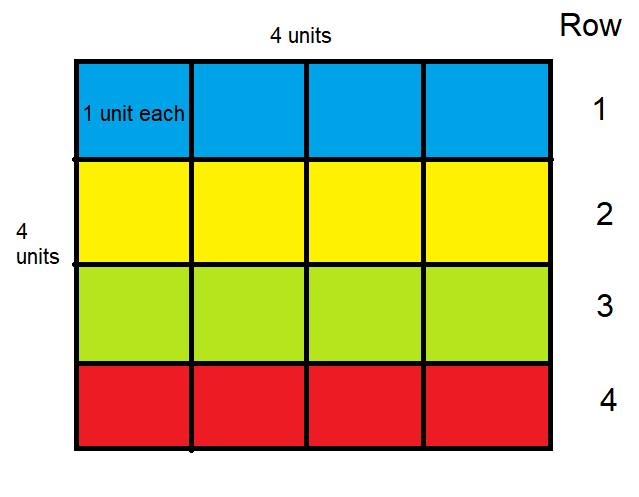
From this, we can deduce that the area of the square is equal to the product of its two sides. As we know, 16 = 4 x 4, and 4 units form one side of the square. In the next section, we will learn and derive the area of the square formula.
Area of Square Formula
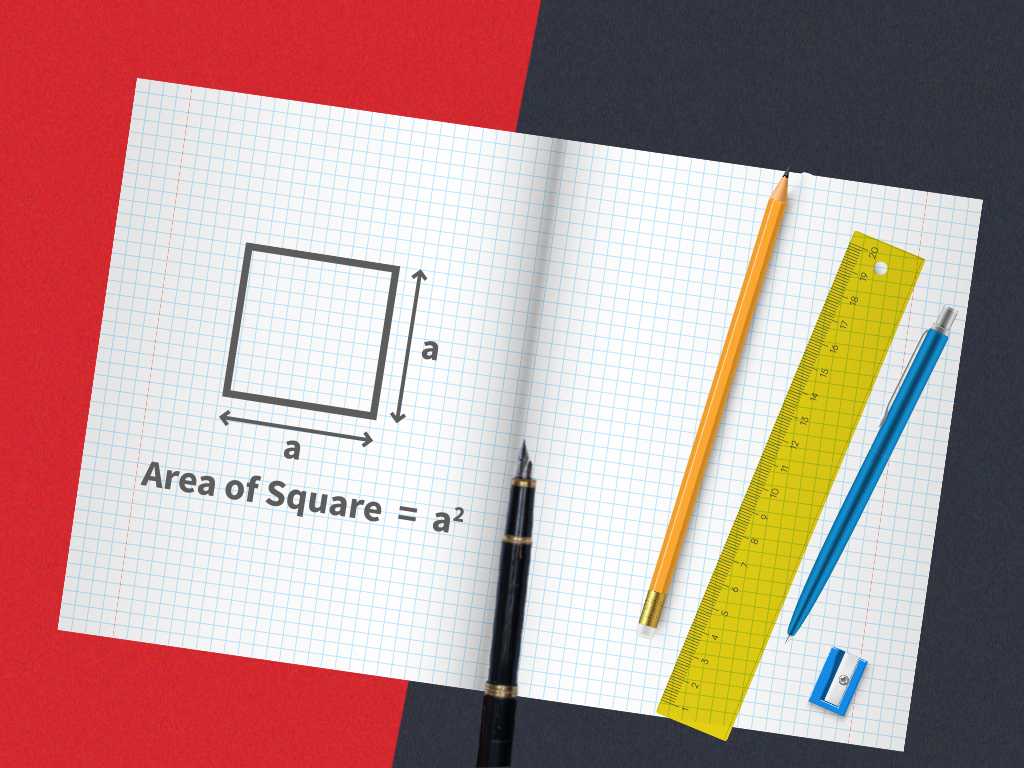
From the above illustration, we learn that the area of a square is equal to the product of the sides. This can be written as ‘side x side’. Hence the formula for any square with any length of a side is given as
Area = (Side)2
Let us Look at an Example to Understand this Formula:
Example: Find the area of a square with sides of a length of 13 cm.
Solution: Given the length of the side = 13 cm
The area of square = (Side)2 = (13)2 = 169 cm2.
The area of a square is always in square units ( square cm, square m, square inches, etc.)
What if we are not provided with the sides of a square but rather we are given the diagonal length? How do we find the area of the square in this case?
Don’t worry! The area of the square can be evaluated even if the length of the diagonal is given. You can find the area using the formula written below:
Area of square ( using diagonals) = (D)2/2, where D represents the diagonal length.
Note: Remember that the square’s diagonals are equal, so the area remains the same if any of the diagonals are given.
Example: Find the area of a square when the diagonal length is 13 cm.
Solution: We are given, diagonal = 13 cm
Area of the square = D2/2
= (13)2/2
= 169/2 cm2
How do you Find the Area Of Square
Hitherto, we have learned 2 formulas related to finding the area of a square. Let us learn how you will approach the questions related to the area of any square.
1. When Anyone’s Side is Given:
- Step 1: Note down the value of the side, say ‘a’.
- Step 2: Substitute the value of an in the formula -> Area (with side) = (Side)2 = (a)2
- Step 3: Write the answer in square units.
Example: Find the area of plastic required to cover a square table of length 8 m.
Solution: Given that length of the table = 8 m
Therefore the area of plastic required to cover the table = area of the table.
Area of table = (side)2 = 82 = 64 m2
2. When Anyone Diagonal is Given:
- Step 1: Write down the value of the diagonal length, say ‘d’.
- Step 2: Substitute the value of d in the formula -> Area (with diagonal) = (d)2/2 =
- Step 3: Write the result in square units.
Example: Find the area of a square with a diagonal length of 4 cm
Solution: Given that length of the diagonal = 4 cm
Area of the square = (4)2/2 = 16/2 = 8 cm2
Find Area of Square When the Perimeter of a Square is Given
In the above sections, we learned how to calculate the area of a square when either the side or diagonal is given. But, suppose you are not provided with any of these parameters, but the perimeter of the square is given. How will you find the area when the perimeter of square is given? Let us find out:
- Step 1: Note the perimeter of the given square.
- Step 2: We know the value of the perimeter of a square is 4s. Therefore 4s = Perimeter.
- Step 3: Substitute the value of perimeter and find the side using the formula s = Perimeter/4
- Step 4: Now that we know the side of the square. Find the area using s2.
- Step 5: Write the answer in square units.
Example: A square garden has a perimeter of 64 cm. Max wants to plant flowers and find the area of this garden but doesn’t know how to do it? Help him figure out the area of the garden.
Solution: We know: Perimeter of the garden = 64 cm
First, we will figure out the length of the sides of the garden.
Using the formula in step 3
Side (s) = perimeter/4
= 64/4
= 16 cm
Now,
Area of the garden = (s)2
= 162
= 256 cm2
Some Tips from Our Side:
Take note of the following factors to keep in mind when you calculate the area of a square.
While evaluating the area of square, we often mistake doubling the number. This is not the case! Keep in mind that the area of a square is not 2 x side. It is always either ‘side x side’ or side2.
We must remember to write the area’s unit when representing it. The area of a square is always two-dimensional; hence we use square units. For example cm2, m2, inch2, etc.
Frequently Asked Questions
1. What is Area of Square in Geometry?
Area of the square in geometry is the measurement of a surface. It is calculated by multiplying the length by the width.
2. What is the Area of Square Formula?
Area of square formula is a way to calculate the area of a square. The formula for the area of a square is A = s2, where s represents the length of each side of the square.
3. How Do You Calculate the Area of Square?
To calculate the area of a square, you need to multiply the length of one side by itself. So if you have a square with sides that are each 10 centimetres long, you’d do: 10 * 10 = 100.
4. What are the Units of the Area of Square?
The units for the area of a square are squared units. The most common unit for measuring area is square metres, but sometimes you might see square feet or acres as well.
5. What is the Perimeter and Area of Square Formulas?
The formula for the perimeter of a square is: p = 4s
The formula for the area of a square is: A = s2
Related topics

Obtuse Angle: Definition, Degree Measure, and Examples
What is an Obtuse Angle? In geometry, an angle that is greater than 90 degrees but lesser than 180 degrees is called an obtuse angle. We can easily recognize an obtuse angle because it extends past a right angle. Obtuse angle explained in detail with examples but first learn about angles. Type of Angles Geometry […]
Read More >>
Line Segment in Geometry: Definition, Symbol, Formula, and Examples
A line is a straight, one-dimensional figure that extends endlessly in both directions in geometry. It has no starting and ending points. When we define a starting point but not an ending point of a line, it is called a ray. Another important term associated with the line is a line segment. Line Segment Definition […]
Read More >>Area of Irregular Shapes for Grade 3 – Simple Methods & Examples
What Is the Area of an Irregular Shape? The area of an irregular shape is the space that it occupies, although it does not follow a clean formula. In contrast to the squares or perfect rectangles, irregular shapes have sides that are uneven or their angles don’t line up evenly. That is what makes them […]
Read More >>
Addition and Multiplication Using Counters & Bar-Diagrams
Introduction: We can find the solution to the word problem by solving it. Here, in this topic, we can use 3 methods to find the solution. 1. Add using counters 2. Use factors to get the product 3. Write equations to find the unknown. Addition Equation: 8+8+8 =? Multiplication equation: 3×8=? Example 1: Andrew has […]
Read More >>

Other topics



Comments: