



ASA and AAS Congruence

Key Concepts
- Identify congruent triangles
Introduction
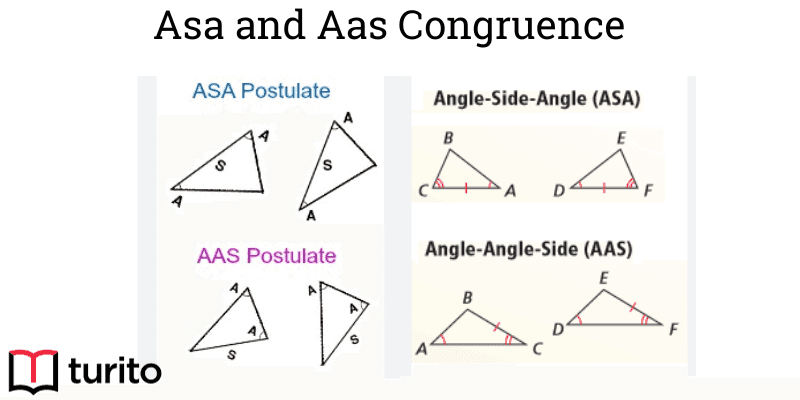
Angle-Side-Angle (ASA) Congruence Postulate:
If two angles and the included side of one triangle are congruent to two angles and the included side of a second triangle, then the two triangles are congruent.


If Angle ∠A≅∠D,
Side AC-≅DF, and
Angle ∠C≅∠F,
then ∆ABC≅∆DEF

Prove Triangles Congruent by ASA and AAS
Angle-Angle-Side (AAS) Congruence Theorem:
If two angles and a non-included side of one triangle are congruent to two angles and the corresponding non-included side of a second triangle, then the two triangles are congruent.

Given: ∠B=∠E, ∠C=∠F and AC=DF
To prove: ΔABC ≅ ΔDEF
Proof:
In ∆ABC
∠A+∠B+∠C=180° _____________ (1) (By angle sum property)
In ∆DEF ∠D+∠E+∠F=180°_____________ (2) (By angle sum property)
From (1) and (2),
∠A+∠B+∠C= ∠D+∠E+∠F
∠A+∠E+∠F=∠D+∠E+∠F (Given ∠B=∠E and ∠C=∠F)
⇒∠A=∠D _____________________ (3)
Now, in ΔABC and ΔDEF
∠A=∠D (from (3))
AC = DF (Given)
∠C=∠F (Given)
∴ΔABC≅ΔDEF (AAS congruency)
Hence proved.
What is a flow proof?
A flow proof is a step of proof to be written for a theorem. A flow proof uses arrows to show the flow of a logical argument.
Example 1: Prove the Angle-Angle-Side congruence theorem for the given figures.

Solution:
Given: ∠A≅∠D, ∠C≅∠F and BC≅EF
To prove: ΔABC≅ΔDEF

Example 2: In the diagram,CE ⊥ BD and ∠CAB≅∠CAD.
Write a flow proof to show that ΔABE≅ΔADE.

Solution:
Given: CE−⊥BD− and ∠CAB≅∠CAD
To prove: ΔABE≅ΔADE
Proof:

Example 3: OB is the bisector of ∠AOC, PM
⊥ OA and PN ⊥ OC. Show that ∆MPO ≅ ∆NPO.

Solution:
In ∆MPO and ∆NPO
PM ⊥ OM and PN ⊥ ON
⇒∠PMO = ∠PNO = 90°
Also, OB is the bisector of ∠AOC
Then ∠MOP = ∠NOP
OP = OP common
∴ ∆MPO ≅ ∆NPO (By AAS congruence postulate)
Example 4: Prove that △CBD ≅ △ABD from the given figure.

Solution:
Given: BD- is an angle bisector of ∠CDA, ∠C ≅ ∠A
To prove: △CBD ≅ △ABD
Proof:
BD- is an angle bisector of ∠CDA, ∠C ≅ ∠A (Given)
∠CDB ≅ ∠ADB (By angle bisector)
DB ≅ DB (Reflexive property)
△CBD ≅ △ABD (Definition of AAS)
Hence proved.
Example 5: Prove that △ABD ≅ △EBC in the given figure.

Solution:
Given: AD∥EC, BD≅BC
To prove: △ABD ≅ △EBC
Proof:

Exercise
- In the diagram, AB ⊥ AD, DE ⊥ AD, and AC ≅ DC. Prove that △ABC ≅ △DEC.

- Use the AAS congruence theorem, prove that △HFG ≅ △GKH.

- In the diagram, ∠S ≅ ∠U and ≅ . Prove that △RST ≅ △VUT.

- Use the ASA congruence theorem to prove that △NQM ≅ △MPL.

- Use the ASA congruence theorem to prove that △ABK ≅ △CBJ.

- Use the AAS congruence theorem to prove that △XWV ≅ △ZWU.

- Use the AAS congruence theorem to prove that △NMK ≅ △LKM.

- Prove that △FDE ≅ △BCD ≅ △ABF from the given figure.

- If m∥n, find the value of x.

- Prove that △HJK ≅ △LKJ from the given figure.

Concept Summary
We have learned five methods for proving that the triangles are congruent.

What have we learned
- Understand and apply Angle-Side-Angle (ASA) congruence postulate.
- Understand and apply Angle-Angle-Side (AAS) congruence postulate.
- Understand the definition of a flow proof.
- Prove theorems on Angle-Side-Angle (ASA) and Angle-Angle-Side (AAS).
- Solve problems on Angle-Side-Angle (ASA) and Angle-Angle-Side (AAS) postulates.
Related topics

Obtuse Angle: Definition, Degree Measure, and Examples
What is an Obtuse Angle? In geometry, an angle that is greater than 90 degrees but lesser than 180 degrees is called an obtuse angle. We can easily recognize an obtuse angle because it extends past a right angle. Obtuse angle explained in detail with examples but first learn about angles. Type of Angles Geometry […]
Read More >>
Line Segment in Geometry: Definition, Symbol, Formula, and Examples
A line is a straight, one-dimensional figure that extends endlessly in both directions in geometry. It has no starting and ending points. When we define a starting point but not an ending point of a line, it is called a ray. Another important term associated with the line is a line segment. Line Segment Definition […]
Read More >>Area of Irregular Shapes for Grade 3 – Simple Methods & Examples
What Is the Area of an Irregular Shape? The area of an irregular shape is the space that it occupies, although it does not follow a clean formula. In contrast to the squares or perfect rectangles, irregular shapes have sides that are uneven or their angles don’t line up evenly. That is what makes them […]
Read More >>
Addition and Multiplication Using Counters & Bar-Diagrams
Introduction: We can find the solution to the word problem by solving it. Here, in this topic, we can use 3 methods to find the solution. 1. Add using counters 2. Use factors to get the product 3. Write equations to find the unknown. Addition Equation: 8+8+8 =? Multiplication equation: 3×8=? Example 1: Andrew has […]
Read More >>

Other topics



Comments: