



Composite Figures – Area and Perimeter

Key Concepts
- Composite Figures
- Area and perimeter of composite figures
Prior Knowledge:
Find the missing sides a and b of the given figure and calculate its perimeter.

Answer:
We get the length of side a by adding together the ones opposite it: 3 and 6.
a = 3 cm + 6 cm = 9 cm
Now, we need to subtract 7 from 10 to get side b.

b = 10 cm – 7 cm = 3 cm
Perimeter = 10 + 3 + 3 + 6 + 7 + 9 = 38 cm.
13.2 Composite Figures
Definition:
A composite shape or a composite figure is a shape that is made up of two or more common shapes.
The area of the composite shapes is the area of combined shapes of one, or more simple polygons and circles.

There are two general methods for finding the area of a composite shape.
Method 1: Find the individual areas of each piece of the composite shape. The area of the composite shape will be the sum of the individual areas.

Method 2: Find the area of a shape larger than the composite shape and the areas of the pieces of the larger shape that is not included in the composite shape. The area of the composite shape will be the difference between the area of the larger shape, and the areas of the pieces of the larger shape not included in the composite shape.

Example 1:
Calculate the area and the perimeter of the following shape.

The composite shape is made up of a rectangle and a triangle.
Area = area of a rectangle + area of a triangle
= length × breadth +
12
× base × height
For the rectangle:
Length = 16 cm, width = 12 cm
For triangle:
Base = 12 cm (same as width of rectangle)
Height = (24 – 16) = 8 cm
So, area = 16 × 12 +
12
× 12 × 8
= 192 + 48
= 240 cm2
Perimeter = sum of the lengths of 5 sides
= 16 + 10 + 10 + 16 + 12
= 64 cm
Exercise:
- A rectangular window has a length of 7 centimeters and a width of 4 centimeters. Find
the perimeter of the rectangular window. - What is the area of the given shape?

- A rectangular balcony has an area of 45 square feet and a perimeter of 28 feet. What are
the dimensions of the balcony? - A rectangular deck has an area of 192 square feet. Its perimeter is 56 feet. What are the
dimensions of the deck? - A photograph is 6 inches wide and 10 inches tall with each opposite side being
congruent. A frame shop charges $1.00 per inch for a silver frame. How much would it
cost to buy a silver frame for the photograph? - The sides of a square-shaped room measures 9 feet. Stephanie wants to buy carpet to
cover the floor of the room. If the carpet costs $3.00 per square foot, how much will it
costto buy carpet for the room? - Emily wants to purchase new carpet for her rectangular living room. The room is 14 feet
wide and 18 feet long. There is also a rectangular fireplace that is 3 feet wide and 5 long
that takes up a portion of the room, Carpet costs $3.00 per square foot. How much would
it cost Emily to carpet the room? - Deanna’s backyard needs a new fence. The backyard is 10 yards long and 8 yards wide
with each opposite side being congruent. It costs $3.50 per yard to install a fence. How
much would it cost Deanna to install a new fence? - The area of rectangular envelope is 60 square inches. Its perimeter is 34 inches. What
are the dimensions of the envelope? - Daniel needs to paint the base area of his L-shaped pool. Dimensions of the pool are
given in the figure below. What is the total area of Daniel’s pool that will be painted?

What have we learnt :
Understand the meaning of composite figures
Solve composite figures by dividing them into two figures
Solve word problems involving estimating area of figures
Solve word problems involving area and perimeter of composite figures
Concept Map:
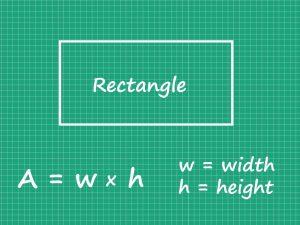
Perimeter of different shapes formulas:


Related topics

Obtuse Angle: Definition, Degree Measure, and Examples
What is an Obtuse Angle? In geometry, an angle that is greater than 90 degrees but lesser than 180 degrees is called an obtuse angle. We can easily recognize an obtuse angle because it extends past a right angle. Obtuse angle explained in detail with examples but first learn about angles. Type of Angles Geometry […]
Read More >>
Line Segment in Geometry: Definition, Symbol, Formula, and Examples
A line is a straight, one-dimensional figure that extends endlessly in both directions in geometry. It has no starting and ending points. When we define a starting point but not an ending point of a line, it is called a ray. Another important term associated with the line is a line segment. Line Segment Definition […]
Read More >>Area of Irregular Shapes for Grade 3 – Simple Methods & Examples
What Is the Area of an Irregular Shape? The area of an irregular shape is the space that it occupies, although it does not follow a clean formula. In contrast to the squares or perfect rectangles, irregular shapes have sides that are uneven or their angles don’t line up evenly. That is what makes them […]
Read More >>
Addition and Multiplication Using Counters & Bar-Diagrams
Introduction: We can find the solution to the word problem by solving it. Here, in this topic, we can use 3 methods to find the solution. 1. Add using counters 2. Use factors to get the product 3. Write equations to find the unknown. Addition Equation: 8+8+8 =? Multiplication equation: 3×8=? Example 1: Andrew has […]
Read More >>

Other topics


Comments: