



Convert Metric Units of Length

What is length?
Length is the term used for identifying the size of an object or distance from one endpoint to another end object.
OR
Length is a measure of how long an object is or the distance between two points.
Metric Unit of Length: In the metric system, the basic unit of length is meter.
Vocabulary:

The most common metric units of length are:
- Kilometer
- Meter
- Centimeter
- Millimeter
Note: – All of the other metric units of length are defined in terms of the meter.
Let us understand the metric units of length, what they are in actual.
Kilometer
Kilometer is the biggest metric unit of measurement.
The abbreviation for kilometer is ‘km’
1 kilometer is equal to 1000 meter
1 kilometer length is the same which is about 2 ½ times around the track.

Meter
It is the base unit of measurement.
The abbreviation for meter is ‘m’
1 meter length is the same as the length of a guitar, the height of a chair.

Centimeter
The abbreviation for centimeter is ‘cm’.
1 clength is same like length of an ant, the length of a dice.

Millimeter
The abbreviation for millimeter is ‘mm’.
1 millimeter length is the same like the thickness of a paper.
We can also understand 1 mm by thickness of a dot.

Some basic customary unit of length and relation between

Distance of Metric Units of Length (Approximate)
- 1 kilometer length is the same that is about 2 ½ times around the track.
- 1 meter length is the same as the length of a guitar, the height of a chair.
- 1 centimeter length is the same as the length of an ant, the length of a dice.
- 1 mm by thickness of a dot.


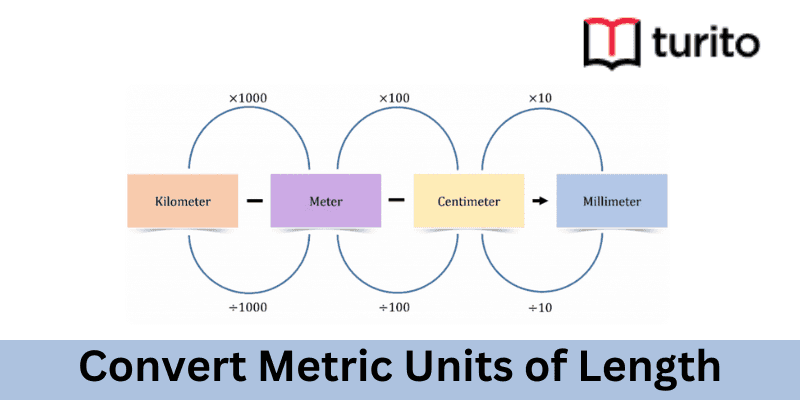
Conversion between the metric units
To convert larger unit to a smaller unit, we need to multiply.
To convert a smaller unit to a larger unit, we need to divide.

1. 7 m = _____ cm.
2. 6600 cm = _____m.
3. 37 m = _____cm.
4. 66 cm = ____mm.
5. 5 ½ km = ___m.
Solution:
1. 1 m = 100 cm
So, 7 m = 7 × 100 = 700 cm
2. 1 m = 100 cm or 100 cm = 1m
So, 1 cm = 1 ÷ 100 m Now, for 6600 cm = 6600 ÷ 100 m = 66 m
3. 1 m = 100 cm
Now, 37 m = 37 × 100 = 3700 cm
4. 1 cm= 10 mm
66 cm = 66 × 10 = 660 mm.
5. Since 1 km = 1000m
So, 5 ½ km = 5 ½ × 1000 m
= 5 × 1000 + ½ × 1000
= 5500 m
Examples
Example 1: Five books of height 7 cm 5 mm each are stacked over one another. What is the total height so obtained?
Solution:
Height of one book = 7 cm 5 mm
So, the total height obtained for such 5 books = (7cm 5 mm) × 5
= 35 cm 25 mm (But 10 mm = 1 cm)
= (35 cm + 2 cm) and 5 mm
= 37 cm 5 mm
Example 2: Mr. John bought a cloth of length 3890 cm. How much is the length in m and cm?
Solution:
Since, 1 m = 100 cm or 100 cm = 1 m
So, 1 cm = 1/100 m
Now, 3890 cm = 3890 ÷ 100
= 38 m 9 cm
Concept Map

What have we learned
- Identify metric units of length.
- Use multiplication and division to determine metric units equivalencies
- Perform arithmetic calculations on metric units of length.
- Solve application problems involving units of length.
Related topics

Obtuse Angle: Definition, Degree Measure, and Examples
What is an Obtuse Angle? In geometry, an angle that is greater than 90 degrees but lesser than 180 degrees is called an obtuse angle. We can easily recognize an obtuse angle because it extends past a right angle. Obtuse angle explained in detail with examples but first learn about angles. Type of Angles Geometry […]
Read More >>
Line Segment in Geometry: Definition, Symbol, Formula, and Examples
A line is a straight, one-dimensional figure that extends endlessly in both directions in geometry. It has no starting and ending points. When we define a starting point but not an ending point of a line, it is called a ray. Another important term associated with the line is a line segment. Line Segment Definition […]
Read More >>Area of Irregular Shapes for Grade 3 – Simple Methods & Examples
What Is the Area of an Irregular Shape? The area of an irregular shape is the space that it occupies, although it does not follow a clean formula. In contrast to the squares or perfect rectangles, irregular shapes have sides that are uneven or their angles don’t line up evenly. That is what makes them […]
Read More >>
Addition and Multiplication Using Counters & Bar-Diagrams
Introduction: We can find the solution to the word problem by solving it. Here, in this topic, we can use 3 methods to find the solution. 1. Add using counters 2. Use factors to get the product 3. Write equations to find the unknown. Addition Equation: 8+8+8 =? Multiplication equation: 3×8=? Example 1: Andrew has […]
Read More >>

Other topics


Comments: