



Convert Metric Units of Mass

What is Mass?
Mass is used to measure the weight of an object.
For example, you are measuring the mass of your body when you step on to a scale.
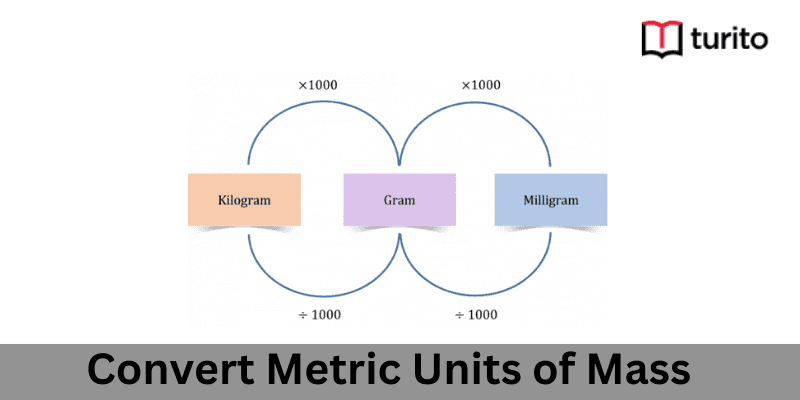
Metric Unit of Mass: In the metric system of measurement, the most common units of mass are the gram and kilogram.
Note: All of the other metric units of mass are defined in terms of the gram.
Let’s understand the metric units of mass, what they are in actuality.
Kilogram
The abbreviation for kilogram is ‘Kg.’

1 kilogram is equal to 1000 grams.
1 kilogram mass is the same as a Cuban Solenodon, a pineapple. (Approx.)

Gram
The measurement of a gram is one of the most widely used measurements.
The abbreviation for gram is ‘’g.”
1 gram quantity is the same as the weight of a paper clip or the weight of a dollar note.

Milligram
A milligram is a very small unit of measurement in the metric system,
It also requires very precise scales to weigh out a milligram accurately.
The abbreviation for milligram is ‘’mg.”
1 milligram quantity is the same as a small feather or half the weight of a small mosquito.

Some basic metric units of capacity and relation between

Conversion between the metric units of capacity
To convert from one unit of mass to another unit, we need to multiply or divide.

Examples:

1. Convert 8 kg into gram and milligram.
Solution: 8 kg = 8 × 1000 g = 8000 g
= 8 kg = 8 × 1000 × 1000 mg = 8,000,000 mg
2. Convert 35 g into kilograms.
Solution: 35 g = 35/1000 kg
= 0.035 kg
3. Convert 310 mg into grams.
Solution: 310 mg = 310/1000 g
= 0.31 g
4. Convert 12 kg 3 g into kilograms.
Solution: 12 kg 3 g = 12 kg + 3/1000 g
= 12 kg + 0.003 g
= 12.003 kg
Example: Which has the greater mass: 7 kilograms or 6,123,000 milligrams? Explain how you made your comparison.
Solution: 7 kg = 7 × 1000 g
= 7000 g = 7000 × 1000 mg
= 7,000,000 mg
Now it is obvious that 7 kg is greater mass.
Example: There are two boxes of cereal in the kitchen. One contains 350 g of cereal, and the other one contains 2.67 kg of cereal. How much cereal (measured in kg) is there in total?
Solution: 350 g = 0.35 kg
= 2.67 + 0.35 = 3.02
There are 3.02 kg of cereal in total.
Concept Map

Related topics

Obtuse Angle: Definition, Degree Measure, and Examples
What is an Obtuse Angle? In geometry, an angle that is greater than 90 degrees but lesser than 180 degrees is called an obtuse angle. We can easily recognize an obtuse angle because it extends past a right angle. Obtuse angle explained in detail with examples but first learn about angles. Type of Angles Geometry […]
Read More >>
Line Segment in Geometry: Definition, Symbol, Formula, and Examples
A line is a straight, one-dimensional figure that extends endlessly in both directions in geometry. It has no starting and ending points. When we define a starting point but not an ending point of a line, it is called a ray. Another important term associated with the line is a line segment. Line Segment Definition […]
Read More >>Area of Irregular Shapes for Grade 3 – Simple Methods & Examples
What Is the Area of an Irregular Shape? The area of an irregular shape is the space that it occupies, although it does not follow a clean formula. In contrast to the squares or perfect rectangles, irregular shapes have sides that are uneven or their angles don’t line up evenly. That is what makes them […]
Read More >>
Addition and Multiplication Using Counters & Bar-Diagrams
Introduction: We can find the solution to the word problem by solving it. Here, in this topic, we can use 3 methods to find the solution. 1. Add using counters 2. Use factors to get the product 3. Write equations to find the unknown. Addition Equation: 8+8+8 =? Multiplication equation: 3×8=? Example 1: Andrew has […]
Read More >>

Other topics



Comments: