



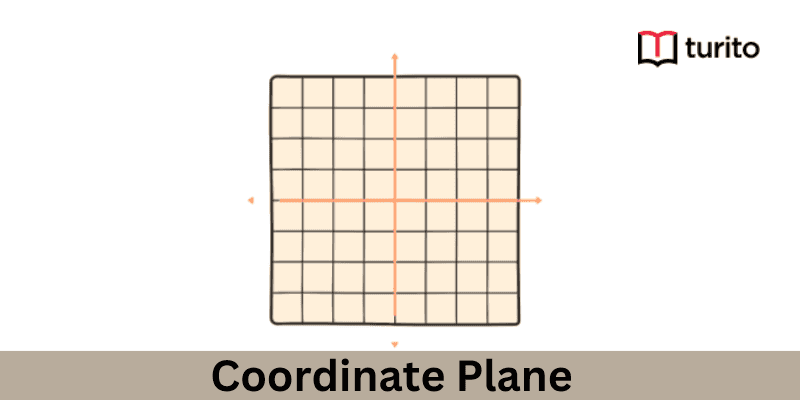
Coordinate Plane

Key Concept
- Rotation
- Rotations in a coordinate plane
- Describe rotation
Rotation
The rotation occurs when we turn around a given point. We can define rotation as a transformation around a fixed point called the centre of rotation.
Rotations can occur either clockwise or anti-clockwise.
The figure does not change the size.
The point (x, y) in different quadrants in the x y plane or coordinate plane.

Understanding Rotations
Rotation in different quadrants in a coordinate plane
Let the image be in the first quadrant

- If the image is moving in an anti-clockwise direction at 90°, it will move to the second quadrant, and if the image is moving in a clockwise direction at 90°, the image will move to the fourth quadrant.
- If the image is moving 180°, it will move to the third quadrant in both clockwise and anti-clockwise directions.
- If the image is moving in an anti-clockwise direction at 270°, it will move to the fourth quadrant, and if the image is moving clockwise direction 270°, the image will move to the second quadrant.
- The rotation of 360° would match the image with its preimage.
Rules of rotation in different quadrants in a coordinate plane in both clockwise and counter-clockwise directions.

Rotations in the coordinate plane about the origin
Coordinates of the point after transformation or rotation of 90° and 180° around the origin.
Example 1
Rotation of 90° counter-clockwise about the origin

Example 2
Rotation of 180° about the origin

Example 3
Coordinates of the point after transformation or rotation
V’(3, 2), E’(-2, 1), G’(0, 3)

Example 4
Coordinates of the point after transformation or rotation
A’(3, 3), B(7, –5), C(10, –10)

What did we discuss in this session?
Based on the figure, answer the following:

Points are R(1, 3), S(4, 4), T(2, 1)
If the image is moving 90° clockwise, what will be the coordinates of R’S’T’?
The points are R’ (3, -1), S’(4, -4), T’(1, -4)
If the image is moving 90° counter-clockwise, what will be the coordinate of R’S’T’?
The points are R’ (-3, 1), S’(-4, 4), T’(4, 1)
If the image is moving 180° clockwise, what will be the coordinates of R’S’T’?
The points are R’(-1, -3), S’(-4, -4), T’(-2, -1)
If the image is moving 180° counter-clockwise, what will be the coordinates of R’S’T’?
The points are R’(-1, -3), S’(-4, -4), T’(-2, -1)
If the image is moving 270° counter-clockwise, what will be the coordinates of R’S’T’?
Exercise:
- 1. Why rotation is called a rigid transformation?
- 2. In what quadrant will an image be if a figure is in quadrant II and is rotated 90° clockwise?
- 3. In what quadrant will an image be if a figure is in quadrant III and is rotated 180° clockwise?
- 4. In what quadrant will an image be if a figure is in quadrant I and is rotated 90° counterclockwise?
- 5. Rotate the figure 90° counter-clockwise and write the coordinates.

6. Rotate the figure 180° clockwise and write the coordinates.

The points are R’ (-3, 1), S’(-4, 4), T’(4, 1)
2. 90°C W. Give the coordinates after rotation. T (5,2), I (4,0), H (-1,6), G (2,8)
3. 180° CW. Give the coordinates after rotation. M (2,0), T (3,2), A (-3, 4), and R (7,-1)
4. Rotate LEG 90° CW from the origin. Call it L’E’G’.
Concept Map

Related topics

Obtuse Angle: Definition, Degree Measure, and Examples
What is an Obtuse Angle? In geometry, an angle that is greater than 90 degrees but lesser than 180 degrees is called an obtuse angle. We can easily recognize an obtuse angle because it extends past a right angle. Obtuse angle explained in detail with examples but first learn about angles. Type of Angles Geometry […]
Read More >>
Line Segment in Geometry: Definition, Symbol, Formula, and Examples
A line is a straight, one-dimensional figure that extends endlessly in both directions in geometry. It has no starting and ending points. When we define a starting point but not an ending point of a line, it is called a ray. Another important term associated with the line is a line segment. Line Segment Definition […]
Read More >>Area of Irregular Shapes for Grade 3 – Simple Methods & Examples
What Is the Area of an Irregular Shape? The area of an irregular shape is the space that it occupies, although it does not follow a clean formula. In contrast to the squares or perfect rectangles, irregular shapes have sides that are uneven or their angles don’t line up evenly. That is what makes them […]
Read More >>
Addition and Multiplication Using Counters & Bar-Diagrams
Introduction: We can find the solution to the word problem by solving it. Here, in this topic, we can use 3 methods to find the solution. 1. Add using counters 2. Use factors to get the product 3. Write equations to find the unknown. Addition Equation: 8+8+8 =? Multiplication equation: 3×8=? Example 1: Andrew has […]
Read More >>

Other topics



Comments: