



Customary Units – Concept and Its Conversion

Key Concepts
■ Convert customary unit of lengths.
■ Convert customary units of capacity.
■Convert customary units of weight
5.8 Convert customary units
The customary units are a system of measurement. To move between different customary units of length, mass and capacity you will multiply or divide by a conversion factor.
- Anytime you are converting a smaller unit of measure to a larger unit of measure we need to divide by a conversion factor.
- Anytime you are converting a larger unit of measure to a smaller unit of measure we need to multiply by a conversion factor.

Example 1: Convert 240 inches to feet.

Solution: At first glance, we observe that inches are smaller than feet. This implies conversion of a smaller unit to a bigger unit. This means we need to divide. There are 12 inches in a foot, so the conversion factor becomes 12.
Now, take the given number of inches and divide by 12.
240÷12 = 20 feet
Example 2: Convert 12 feet to inches.
Solution: At first glance, we observe that feet are bigger than inches, which implies conversion of a bigger unit to a smaller unit.This means we need to multiply. There are 12 inches in a foot, so the conversion factor becomes 12.
Now, take the given number of inches and multiply by 12.
12 × 12 = 144 inches
The following charts provides an overview on customary units of length, capacity and weight.
Customary units of length:
1 Foot (ft.) = 12 Inches (in)
1 Yard (yd.) = 3 Feet (ft.)
1 Yard (yd.) = 36 Inches (in)
1 Mile (mi) = 1760 Yards (yd.)
1 Mile (mi) = 5280 Feet (ft.)
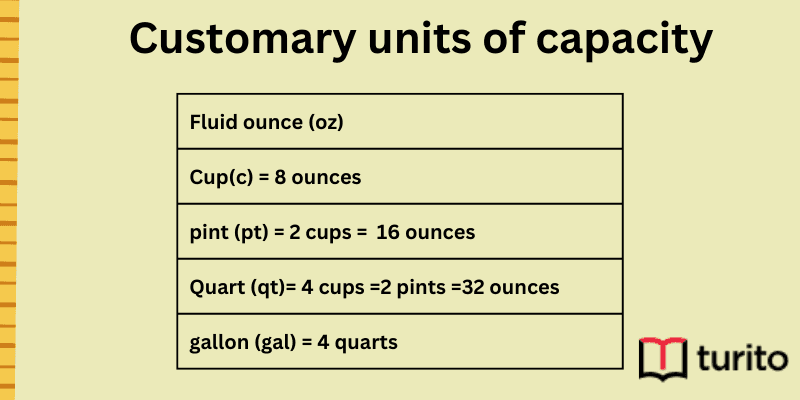
Customary units of capacity:
| Fluid ounce (oz) |
| Cup(c) = 8 ounces |
| pint (pt) = 2 cups = 16 ounces |
| Quart (qt)= 4 cups =2 pints =32 ounces |
| gallon (gal) = 4 quarts |
Customary units of capacity used in cooking:
| Teaspoon (tsp) |
| Tablespoon (tbsp) = 3 teaspoons |
| Cup (c) = 16 tablespoons |
Customary units of weight:
1 pound(Ib) = 16 Fluid Ounces(oz)
1 Ton (t) = 2000 Pounds
5.8.1 Convert customary units of length
Example 1:
If a ball fell 25 feet from the top of a building. How many inches did it fall?
Method: 1
Solution: We know that feet are bigger than inches, which implies conversion of a bigger unit to a smaller unit.This means we need to multiply. There are 12 inches in a foot, so the conversion factor becomes 12.
Now, take the given number of inches and multiply by 12.
25 × 12 = 300 inches
Therefore, the ball fell 300 inches.
Method: 2 (Using conversion factor)
Conversion factor: A conversion factor is a rate that compares equivalent measures.
Step 1: Multiply by the conversion factor that relates the measures and leaves you with the units needed to solve the problem.
66 inches ×
1 feet 12 inches1 feet 12 inches
Step 2: Divide the common units.
25 × 12 inches = 300 inches
Example 2: The sidewalk in front of a park is 66 inches wide. The city regulations establishe a maximum width of 6 ft. Does the park meet the city regulations?
Method: 1
Solution: We know that inches are smaller than feet, which implies conversion of a smaller unit to a bigger unit.This means we need to divide. There are 12 inches in a foot, so the conversion factor becomes 12.
Now, take the given number of inches and divide by 12.
66 ÷ 12 = 5.5 feet
Therefore, the park meets the city regulations.
Method: 2 (Using conversion factor)
Conversion factor: A conversion factor is a rate that compares equivalent measures.
Step 1: Multiply by the conversion factor that relates the measures and leaves you with the units needed to solve the problem.
66 inches ×
1 feet12 inches
Step 2: Divide the common units.
66 feet ÷ 12 = 5.5 feet
5.8.2 Convert customary units of capacity
Example 1: Luke bought 15 gallons of berry juice to distribute among his friends during a school trip. How many quarts of juice does he have?
Method: 1
Solution: At first glance, we observe that gallons are bigger than quarts, which implies conversion of a bigger unit to a smaller unit.This means we need to multiply. There are 4 quarts in a gallon, so the conversion factor becomes 4.
Now, take the given number of gallons and multiply by 4.
15 × 4 = 60 quarts
Therefore, Luke bought 60 quarts.
Method: 2 (Using conversion factor)
Step 1: Multiply by the conversion factor that relates the measures and leaves you with the units needed to solve the problem.
15 gallons ×
4 quarts 1 gallon4 quarts 1 gallon
Step 2: Divide the common units.
15 × 4 quarts = 60 quarts
5.8.3 Convert customary units of weight
Example 1: Weight of an elephant is 3 tons. What is its weight in pounds?
Method: 1
Solution: Tons is bigger than pounds, which implies conversion of a bigger unit to a smaller unit. This means we need to multiply. There are 2000 pounds in a ton, so the conversion factor becomes 2000.
Now, take the given number of tons and multiply by 2000.
3 × 2000 = 6000 pounds
Therefore, weight of an elephant is 6000 pounds.
Method: 2 (Using conversion factor)
Step 1: Multiply by the conversion factor that relates the measures and leaves you with the units needed to solve the problem.
3 tons ×
2000 lb 1 ton2000 lb 1 ton
Step 2: Divide out the common units.
3 × 2000 lbs. = 6000 lbs.= 6000 pounds
Example 2: Convert 48 ounces to pounds.
Method: 1
Solution: It is known that ounces are smaller than pounds, which implies conversion of a smaller unit to a bigger unit.This means we need to divide. There are 16 ounces in a pound, so the conversion factor becomes 16.
Now, take the given number of ounces and divide by 16.
48 ÷ 16 = 3 pounds
Method: 2 (Using conversion factor)
Conversion factor: A conversion factor is a rate that compares equivalent measures.
Step 1: Multiply by the conversion factor that relates the measures and leaves you with the units needed to solve the problem.
48 ounces ×
1 pound16 ounces1 pound16 ounces
Step 2: Divide out the common units.
48 pounds ÷ 16 = 3 pounds
Exercise:
1. Steve prepares 50 pints of juice. In how many cups can this juice be distributed?
2. Bratt is making doughnut It requires 10 teaspoons of sugar. How many tablespoons will it be equivalent to?
3. The weight of a dog is 20 pounds. How much does it weigh in ounces?
4. The weight of a parcel is 1350 ounces. What is its weight in pounds?
5. The capacity of a car tank is 120 quarts. What is the capacity of the tank in terms of gallon?
6. Convert 16 yards into feet
7. Convert 12 feet 8 inches into inches.
8. The capacity of a water container on the top of the house is 400 quarts. Find its capacity in gallons.
9. A motorbike weighs 200 pounds. Find the weight in terms of ton.
10. The distance along the boundary of the house is 1000 yards. Find the distance in terms of miles.
What have we learned?
■ Convert customary unit of lengths.
■ Convert customary units of capacity.
■ Convert customary units of weight
Related topics

Obtuse Angle: Definition, Degree Measure, and Examples
What is an Obtuse Angle? In geometry, an angle that is greater than 90 degrees but lesser than 180 degrees is called an obtuse angle. We can easily recognize an obtuse angle because it extends past a right angle. Obtuse angle explained in detail with examples but first learn about angles. Type of Angles Geometry […]
Read More >>
Line Segment in Geometry: Definition, Symbol, Formula, and Examples
A line is a straight, one-dimensional figure that extends endlessly in both directions in geometry. It has no starting and ending points. When we define a starting point but not an ending point of a line, it is called a ray. Another important term associated with the line is a line segment. Line Segment Definition […]
Read More >>Area of Irregular Shapes for Grade 3 – Simple Methods & Examples
What Is the Area of an Irregular Shape? The area of an irregular shape is the space that it occupies, although it does not follow a clean formula. In contrast to the squares or perfect rectangles, irregular shapes have sides that are uneven or their angles don’t line up evenly. That is what makes them […]
Read More >>
Addition and Multiplication Using Counters & Bar-Diagrams
Introduction: We can find the solution to the word problem by solving it. Here, in this topic, we can use 3 methods to find the solution. 1. Add using counters 2. Use factors to get the product 3. Write equations to find the unknown. Addition Equation: 8+8+8 =? Multiplication equation: 3×8=? Example 1: Andrew has […]
Read More >>

Other topics


Comments: