



Decimals – Concept and Explanation

Key Concepts
• Fraction
• Decimal number
• Repeating decimal
• Non-repeating/terminating decimal
Real Numbers: Rational Numbers as Decimals
Introduction to Decimal Numbers:
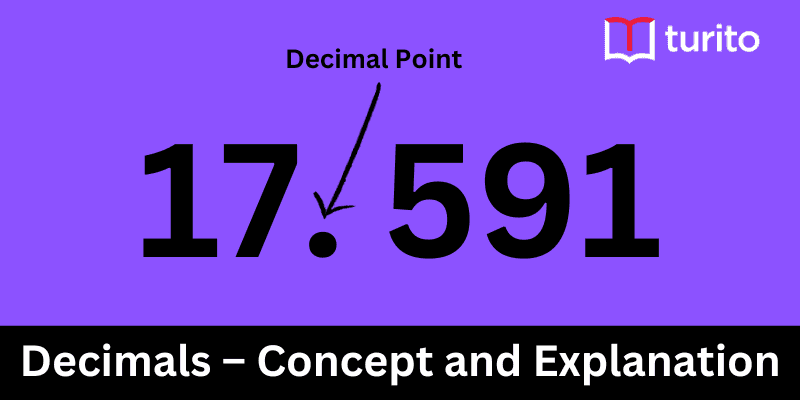
A decimal number can be defined as a number whose whole number part and the fractional part is separated by a decimal point.

The dot in a decimal number is called a decimal point.
The digits following the decimal point show a value smaller than one.

Understanding the parts of a decimal number:

Representation of decimal numbers on a scale:
Decimal numbers in everyday life:

Writing decimals as fractions:
To convert a decimal to a fraction, we write the decimal number as a numerator and its place value as the denominator.
Example 1: 0.07

1.1.1 Writing repeating decimals as fractions
Steps to writing a repeating decimal as a fraction:
Begin by writing x = the repeating number.
Multiply both sides of the equation by a power of 10, which will move the decimal to the right of the repeating number.
Subtract the equation from step 1 from the equation in step 2.
Solve the resulting equation.
Example:
Write
0.7−
as a fraction.
Step1: Begin by writing x = the repeating number.
x=0.7−
Step 2: Multiply both sides of the equation by a power of 10, which will move the decimal to the right of the repeating number.
The repeating number is seven. To move the decimal to the right of the 7, you need to multiply by 10. This gives you the following:
10x= 7.7−
Step 3: Subtract the equation from step 1 from the equation in step 2.
10x= 7.7−
− x=0.7−9x=7
Step 4: Solve the resulting equation.
9x=7
x=79
1.1.2 Repeating decimals with non-repeating digits as fractions
A mixed repeating decimal is a decimal that does not repeat until after the tenths place. The value
712
=0.583− is an example of this. To write a mixed repeating decimal, you will use the same steps as before.
Begin by writing x = the repeating number.
Multiply both sides of the equation by a power of 10, which will move the decimal to the right of the repeating number.
Subtract the equation from step 1 from the equation in step 2.
Solve the resulting equation.
Example
Write
0.86−
as a fraction.
Step 1: Begin by writing x = the repeating number.
x= 0.86−
Step 2: Multiply both sides of the equation by a power of 10, which will move the decimal to the right of the repeating number.
The repeating number is six. To move the decimal to the right of the 6, you need to multiply by 100, which gives you the following:
100x= 86.6−
Step 3: Subtract the equation from step 1 from the equation in step 2.
100x= 86.6−
− x=0.86− 99x=85.8− x=0.86- 99x=85.8
Step 4: Solve the resulting equation.
99x= 85.8 99x= 85.8
x=85.8 99 x=85.8 99
Since your answer has a decimal in the fraction, you must multiply the numerator and denominator by a power of ten, producing an equivalent fraction with no decimals. Multiplying the numerator and denominator by 10 gives you your answer:
x=858990 x=858990
We can reduce this fraction to
429/495=143/165=13/15
1.1.3 Decimals with multiple repeating digits as fractions
Let us see how to simplify a repeating decimal like 0.63636363…
Step-1: Let x = recurring number
X = 0.63
Step-2: Two digits (63) are repeating.
So, multiply both sides by 102, i.e., 100.
100x = 100
××
0.63…
100x = 63.63
Step-3: Subtract x from left side and 0.63… from right side
100x – x = 63.63 – 0.63
99x = 63
Step-4: Solve for x
99x = 63
X = 63/99
X = 7/11
Exercise:
Exercise:
- Rewrite as a simplified fraction
0.2 ̅= ? - Rewrite as a simplified fraction
2.6 ̅=? - Rewrite as a simplified fraction
1.83 ̅=? - Convert the fraction 4/3 into decimals. If necessary, use a bar to indicate which digit or group of digits repeat.
- Convert the fraction 7/6 into decimals. If necessary, use a bar to indicate which digit or group of digits repeat.
- Convert the fraction 10/9 into decimals. If necessary, use a bar to indicate which digit or group of digits repeat.
- Convert the fraction 8/7 into decimals. If necessary, use a bar to indicate which digit or group of digits repeat.
- Convert the fraction 5/3 into decimals. If necessary, use a bar to indicate which digit or group of digits repeat.
- Convert the fraction 7/3 into decimals. If necessary, use a bar to indicate which digit or group of digits repeat.
- Convert the fraction 11/6 into decimals. If necessary, use a bar to indicate which digit or group of digits repeat.
- Convert the fraction 8/3 into decimals. If necessary, use a bar to indicate which digit or group of digits repeat.
- Convert the fraction 13/6 into decimals. If necessary, use a bar to indicate which digit or group of digits repeat.
- Convert the fraction 11/3 into decimals. If necessary, use a bar to indicate which digit or group of digits repeat.
What we have learned:
1.1 About decimal numbers, parts of a decimal number, representation of decimal numbers on a scale, application of decimal numbers in everyday life, writing decimals as fractions and How to write repeating decimals as fractions.
1.2 How to write repeating decimals with non-repeating digits as fractions.
1.3 How to write decimals with multiple repeating digits as fractions.
Concept Map:

Related topics

Obtuse Angle: Definition, Degree Measure, and Examples
What is an Obtuse Angle? In geometry, an angle that is greater than 90 degrees but lesser than 180 degrees is called an obtuse angle. We can easily recognize an obtuse angle because it extends past a right angle. Obtuse angle explained in detail with examples but first learn about angles. Type of Angles Geometry […]
Read More >>
Line Segment in Geometry: Definition, Symbol, Formula, and Examples
A line is a straight, one-dimensional figure that extends endlessly in both directions in geometry. It has no starting and ending points. When we define a starting point but not an ending point of a line, it is called a ray. Another important term associated with the line is a line segment. Line Segment Definition […]
Read More >>Area of Irregular Shapes for Grade 3 – Simple Methods & Examples
What Is the Area of an Irregular Shape? The area of an irregular shape is the space that it occupies, although it does not follow a clean formula. In contrast to the squares or perfect rectangles, irregular shapes have sides that are uneven or their angles don’t line up evenly. That is what makes them […]
Read More >>
Addition and Multiplication Using Counters & Bar-Diagrams
Introduction: We can find the solution to the word problem by solving it. Here, in this topic, we can use 3 methods to find the solution. 1. Add using counters 2. Use factors to get the product 3. Write equations to find the unknown. Addition Equation: 8+8+8 =? Multiplication equation: 3×8=? Example 1: Andrew has […]
Read More >>

Other topics


Comments: