



Decompose Fractions

Key Concepts
- Compose and decompose
- Compose and decompose fractions
- Mixed numbers
- Equivalent fractions
Compose and Decompose Fractions
We know that fractions show part of a whole, but they can be broken down further and combined again.
Combining fractions together is also called composing the fractions.
- To compose means “putting a number together using its parts”.
For example, 300+40+5 = 345
- Composing fractions means connecting fractions together by adding.
For example, 2/5+1/5+1/5= 4/5
Here, we composed the fraction 4/5 by adding fractions with like denominators.


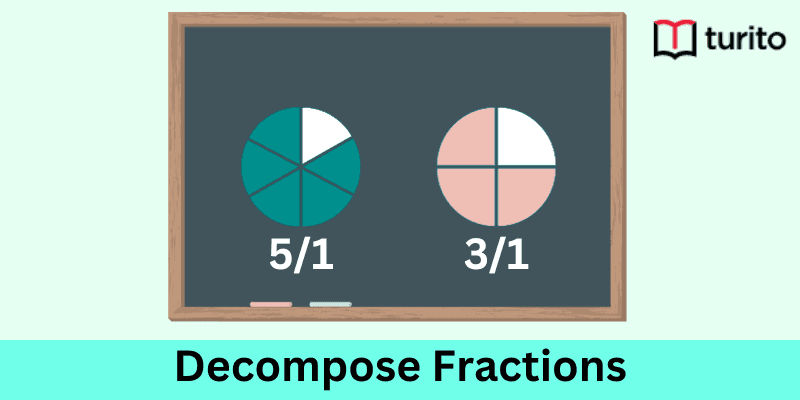
Writing a fraction as a sum of smaller fractions is also known as decomposing fractions.
- To decompose means “to break apart.”
To decompose a fraction means dividing a fraction into smaller parts such that on adding all the smaller parts together, it results in the initial fraction.
For example, 3/4 can be decomposed as 1/4+1/4+1/4

DIFFERENT METHODS OF DECOMPOSING FRACTIONS:
There are different ways to decompose a fraction
- Breaking into unit fractions
- Using the sum of smaller fractions which are not unit fractions
- Breaking mixed fractions
- Breaking into unit fractions
To decompose a fraction using unit fractions, we should know what unit fractions are.
Unit fractions are those fractions in which the numerator is always 1.
For example, 1/2 , 1/3 , 1/4, 1/5 etc.,
Unit Fractions

Let us look at this situation.
Ms. Charlie wants to leave 1/6 of her garden empty and wanted to plant 5 types of plants in an equal area in the rest of her garden. What could be the area of each part of the garden?
Here, let us assume the garden is in a rectangular shape and is divided into 6 equal parts.

That means each partition shows 1/6 part of the garden.
If she wants to leave 1/6 part of the garden empty, then she is left with 5/6 parts of the garden.
5/6 can be decomposed as
1/6+1/6+1/6+1/6 +1/6

Example 2:
Decompose 7/9 using unit fractions.
7/9= 1/9+1/9+1/9+1/9+1/9+1/9+1/9
- Using the sum of smaller fractions which are not unit fractions
We can also decompose fractions using the sum of smaller fractions. This is just like writing a number as the sum of different smaller numbers; fractions also can be decomposed using smaller fractions other than unit fractions.
Like 5 can be written as 3 + 2 (or) 4 + 1 (or) 1 + 1 + 3
Let us consider the same situation.
Ms Charlie can plant different parts in different ways. Because 5/6.
can be written as the sum of smaller like fractions. Like 5/6= 2/6+ 3/6 (or) 1/6+ 4/6 (or) 1/6+ 1/6+ 3/6

(or)

(or)

Example 2: Decompose 9/12 using smaller fractions.
9/12= 3/12+5/12+1/12 (or) 2/12+4/12+3/12 (or) 4/12+5/12 etc.,
9/12 can be decomposed in many different combinations.
- Breaking mixed fractions
We know that fractions are of three types; proper fractions, improper fractions and mixed fractions.

Among all the above three, we can convert mixed fractions to improper fractions and improper fractions to mixed fractions.
For example,

In an improper fraction, the numerator is greater than the denominator, like in the above example, in the fraction 17/3, 14 is greater than 3.
17/3 can be decomposed as 1 whole + 1 whole + 1 whole + 1 whole + 2/3.
Likewise, a mixed fraction 4*2/3 can be decomposed as
1 + 1 + 1 + 1 + 2/3.
(or)
1 + 1 + 1 + 1 + 1/3
Example 2: Decompose 3*2/4

Exercise:
- Decompose the following fractions using unit fractions.
- 2/4 b. 4/6 c. 3/5 d. 7/8
- There were 10 bowling pins standing before John took his first turn. On his first turn, he knocked down 6 pins. On his second turn, he knocked down 2 pins. Write them as fractions and compose the fractions.
- At lunch, Alice ate 3/8 of her sandwich. Later, for a snack, she ate another 3/8 of the sandwich. Write an addition sentence that shows how much of the sandwich Alice ate. Suppose Alice ate the same total amount of her sandwich in 3 different times instead of 2. Write an addition problem that shows the amount she ate as a sum of 3 fractions.
- Draw pictures or use fraction strips to show why the equation is correct.
- What is one way you can decompose ?
Look at the diagram given and fill in the blank .
Look at the area model given here. What fraction with a greater numerator than denominator is equivalent to the given fraction?
- Decompose each fraction or mixed number in two different ways.
- a. 4/5 b. 3*3/8
- Write the number sentence to show how would you decompose 5/7 .
- In a class of 12 students, 8 of them are girls. Write two equivalent fractions that tell which part of the class is girls.
Concept Map:

What have we learned:
- Composing fractions
- Decomposing fractions using unit fractions
- Decomposing fractions using smaller fractions which are not unit fractions
- Decomposing mixed fractions
- Generating a graph based on the ordered pairs.
Related topics

Obtuse Angle: Definition, Degree Measure, and Examples
What is an Obtuse Angle? In geometry, an angle that is greater than 90 degrees but lesser than 180 degrees is called an obtuse angle. We can easily recognize an obtuse angle because it extends past a right angle. Obtuse angle explained in detail with examples but first learn about angles. Type of Angles Geometry […]
Read More >>
Line Segment in Geometry: Definition, Symbol, Formula, and Examples
A line is a straight, one-dimensional figure that extends endlessly in both directions in geometry. It has no starting and ending points. When we define a starting point but not an ending point of a line, it is called a ray. Another important term associated with the line is a line segment. Line Segment Definition […]
Read More >>Area of Irregular Shapes for Grade 3 – Simple Methods & Examples
What Is the Area of an Irregular Shape? The area of an irregular shape is the space that it occupies, although it does not follow a clean formula. In contrast to the squares or perfect rectangles, irregular shapes have sides that are uneven or their angles don’t line up evenly. That is what makes them […]
Read More >>
Addition and Multiplication Using Counters & Bar-Diagrams
Introduction: We can find the solution to the word problem by solving it. Here, in this topic, we can use 3 methods to find the solution. 1. Add using counters 2. Use factors to get the product 3. Write equations to find the unknown. Addition Equation: 8+8+8 =? Multiplication equation: 3×8=? Example 1: Andrew has […]
Read More >>

Other topics


Comments: