



Equivalent Fraction : Concept with Examples

Key Concepts
- Equivalent fractions: Use models
- Equivalent fractions: Use the number line
Introduction:
Equivalent Fraction
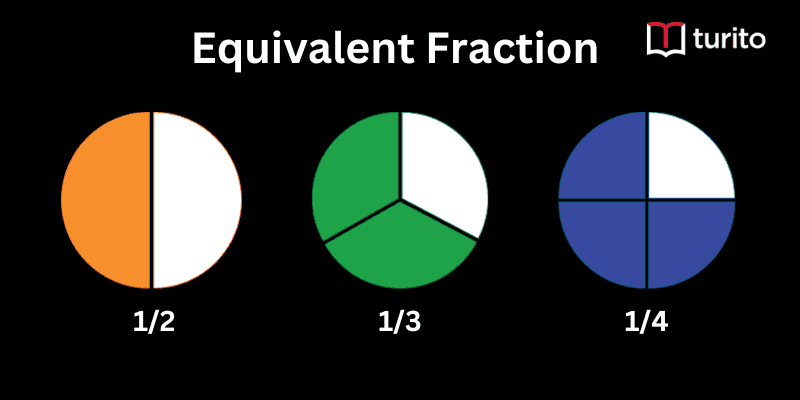
Equivalent fractions are fractions that have the same value, even though they may look different

The fractions 1/2, 2/4, 4/8 are equivalent since each represents the same number
Example
Use the below fraction strips to show that the fractions 1/2, 2/4, and 4/8 are equivalent

Step 1
Given fraction strips represent the parts of a whole

Consider the fractions 1/2 , 2/4

Now we have to show 1/2 and 2/4 are equivalent
Step 2

From the whole, divide the fraction and represent on the same number line, i.e., when we compare 1/2 and 1/4 as shown in the above figure, both the fractions represent the same number on the number line with equal fractions
Then we have = 1/2 = 2/4
Step 3
Similarly, the other fractions also represent the same part of the whole

Then we have = 1/2 = 2/4 = 4/8
Thus, the fractions ,1/2, 2/4 and 4/8 are equivalent since each represent the same number.
Example 2
Find a fraction that is equivalent to 2/3
Step 1
Let us draw an area model for 2/3

Step 2
Draw an identical model

The other model also shows the fraction 2/3
Step 3
To make an equivalent fraction, divide each part into equal parts.
Let us divide each part of the identical model into 2 equal parts.

Step 4
What fraction does the identical model show now?
The identical model is divided into 6 equal parts, and 4 parts are colored
So the identical model shows the fraction 4/6

Here we can see that 2/3 = 4/6 because the two fractions show the same part of a whole
13.2 Equivalent Fractions: Use the number line
Fractions on a number line:
How to recognize equivalent fractions using number lines?
- Draw a number line that goes from 0 to 1 since fractions are values that are less than 1.
- To show a fraction, first, divide the line into equal parts.
- The denominator of a fraction tells about the number of equal parts into which a number line should be divided.
- The numerator tells about the parts.
Here are some of the fractions marked on a number line


Example
Use the number line to represent a fraction equivalent to 2/3
Step 1
Draw a number line model for 2/3

Step 2
Draw an identical number line below it, with the same number of equal parts

Now, divide each part into smaller parts

What fraction of the number line is colored?
4 out of 6 parts are colored
Comparing the length of the two fractions
Therefore, the length of 2/3 is equal to the length of 4/6
This means that 2/3 is equivalent to 4/6
Exercise:
- Find the equivalent fraction in each case. Show on the fraction strip why your answer makes sense.

2. Find the following equivalent fractions:

3. Jane got 10 out of 15 for her test, and Mark got 15 out of 20 on his test. Rita said that they both did equally well because they both got 5 wrong. Is Rita correct? Explain your answer.
4. Are there fractions between 1/7 and 1/8? If so, name a fraction between 1/7 and 1/8.
5. A mural is divided into 3 equal parts. What fraction represents the entire mural?
6. Does ¼ name the unshaded part of the model? Explain.
7. Which is greater, 3/6 or 4/6? Use a number line to compare the fractions.
8. How can number lines show that two fractions are equivalent? Explain.
9. Rita says the fraction strips show fractions that are equivalent to ½. Explain what you could do to the diagram to see if she is correct.
10. Complete the number line to show that 2/6 and 1/3 are equivalent fractions.
What we have learned:
- How to develop an understanding of equivalent fractions using fraction strips
- How to identify and recognize equivalent fractions as part of a whole fraction
- How to write equivalent fractions on a number line
- Learned how to use number lines to represent equivalent fractions
- How to find equivalent fractions
Concept Map:


Fraction Strips Chart

Related topics

Obtuse Angle: Definition, Degree Measure, and Examples
What is an Obtuse Angle? In geometry, an angle that is greater than 90 degrees but lesser than 180 degrees is called an obtuse angle. We can easily recognize an obtuse angle because it extends past a right angle. Obtuse angle explained in detail with examples but first learn about angles. Type of Angles Geometry […]
Read More >>
Line Segment in Geometry: Definition, Symbol, Formula, and Examples
A line is a straight, one-dimensional figure that extends endlessly in both directions in geometry. It has no starting and ending points. When we define a starting point but not an ending point of a line, it is called a ray. Another important term associated with the line is a line segment. Line Segment Definition […]
Read More >>Area of Irregular Shapes for Grade 3 – Simple Methods & Examples
What Is the Area of an Irregular Shape? The area of an irregular shape is the space that it occupies, although it does not follow a clean formula. In contrast to the squares or perfect rectangles, irregular shapes have sides that are uneven or their angles don’t line up evenly. That is what makes them […]
Read More >>
Addition and Multiplication Using Counters & Bar-Diagrams
Introduction: We can find the solution to the word problem by solving it. Here, in this topic, we can use 3 methods to find the solution. 1. Add using counters 2. Use factors to get the product 3. Write equations to find the unknown. Addition Equation: 8+8+8 =? Multiplication equation: 3×8=? Example 1: Andrew has […]
Read More >>

Other topics


Comments: