



Perimeter of a Rectangle – Definition with Solved Examples

A rectangle is a quadrilateral (four-sided polygon) with opposite sides equal and parallel to one another and all four vertices 90 degrees. Since the opposite sides of a rectangle are equal and parallel, it is also known as a parallelogram. A rectangle is defined by its length and breadth, which are distinct sizes, making it different from a square.
The following are the characteristics of a rectangle:
- It has four sides and four vertices
- The opposite two pairs of sides are parallel and equal.
- Each vertex is at a 90-degree angle.
- Diagonals are bisectors of each other.
- It’s a right-angled parallelogram.
- Sum of all interior angles equal to 360 degrees
How to find the perimeter of a rectangle?
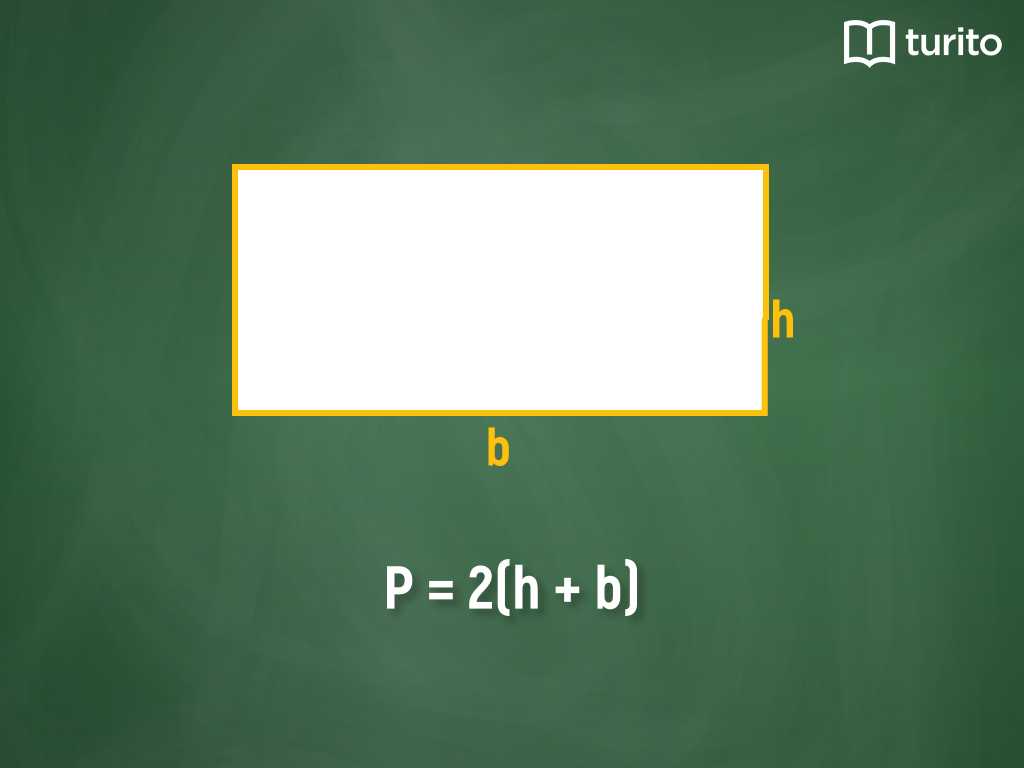
The perimeter of a rectangle is defined as the total distance covered by the outer boundary of the rectangle. It is measured in unit length. The formula of the perimeter is given by:
Perimeter, P = 2 (Length + Width)
The perimeter of the rectangle could be considered one of the important formulae of the rectangle. It is the total distance covered by the rectangle around its outside. The perimeter gives the length of the figure.

The perimeter of a rectangle is equal to its sides added together. The entire distance around the sides of any object is calculated using perimeter formulas. Since the opposite sides of a rectangle are equal, the perimeter is equal to twice the length plus twice the rectangle’s width, denoted by the letter “P.”
The perimeter of a rectangle, according to the definition of the perimeter, is P = 2(a+b) units
where,
“a” is the length of the rectangle
“b” is the breadth of the rectangle
Derivation of Perimeter of Rectangle
Since the perimeter is equal to the sum of the polygon’s sides. As a result, the perimeter (P) of a rectangle is:-
P = all four sides added up
P = a + b + a + b (Opposite sides of rectangle are equal)
P = 2(a + b)
where,
“a” is the length of the rectangle
“b” is the breadth of the rectangle
Therefore,
Perimeter of a rectangle = 2(Length + Width) square units
The perimeter of a Rectangle Problems
Q. Find the perimeter of a rectangle with 20 cm and 12 cm, length and breadth respectively.
- We know that, Perimeter of a rectangle = 2(a + b)
where,
“a” is the length of the rectangle
“b” is the breadth of the rectangle
∴ P = 2(20+12) = 2(32) = 64 cm
Q. What is the perimeter of a rectangle 12 meters long with a 4-meter wide base?
- We know that, Perimeter of a rectangle = 2(a + b)
where,
“a” is the length of the rectangle
“b” is the breadth of the rectangle
∴ P = 2(12+4) = 2(16) = 32 m
Q. What is the length of the rectangular field which has a perimeter of 120 cm and a width of 50 cm?
- We know that, Perimeter of a rectangle = 2(a + b)
where,
“a” is the length of the rectangle
“b” is the breadth of the rectangle
Let P be the perimeter,
∴ P = 2(a+b)
Or 120 = 2(a+50)
120/2 = a+50
a = 60-50
a = 10 cm
Hence, the length of the rectangular field is 10 cm.
Q. A rectangular yard has a length of 53 m and a perimeter of 136 m. Determine its breadth.
- P = 136m (Perimeter of the yard)
L = 53m (Length of the yard)
Let B be the breadth of the yard.
We know that, Perimeter, P = 2(length + breadth)
Therefore,
136= 2(53 + breadth)
53 + B = 68
W = 68 – 53 = 15 m
Hence, the breadth of the yard is 15m
Q. A garden has a length of 120 inches and a width of 85 inches. How much fence will be required to surround it?
- To determine how much fence will be required for the garden’s border, we will calculate the perimeter of the garden using the perimeter of the rectangle formula. (Since the fence is built on a garden’s border)
Given,
Length (L) = 120 inches
Breadth (B) = 85 inches
A rectangle’s perimeter equals 2(l + w). When we substitute the length and width numbers in this calculation, we obtain Perimeter = 2(l + w) = 2(120 + 85) = 2×205 = 410 inches.
We’ll need 410 inches of lace to wrap around the bedsheet.
Q. A chocolate bar is made up of equal-sized squares with 1-inch sides. Determine the perimeter of the rectangular chocolate bar.
- Each small square has one inch on all of its sides.
Therefore, if we count and add the sides of the squares along the length of the bar, We obtain 6 inches as the length (L).
Squares along the width of the bar have sides that sum up to 2 inches.
As a result, the length of the bar is 6 inches, and the width is 2 inches.
Perimeter=2(l + w) = 2 (6 + 2) = 2×8 = 16 inches
As a result, the perimeter is 16 inches.
Relation between a Rectangle and a Square
A square is a quadrilateral with all sides equal and parallel to one another and all four vertices 90 degrees. The sole difference between this and a rectangle is that adjacent sides are also equal in addition to opposite sides, resulting in a square with equal length and width.
Therefore, The method for calculating the perimeter of a rectangle differs from the formula for calculating the perimeter of a square:-
The Formula for Calculating the Perimeter of a Rectangle is
Perimeter of rectangle = 2(a + b),
where ‘a’ denotes the length
and ‘b’ denotes the width.
The perimeter of a square formula, on the other hand, is defined as the
The perimeter of a square = 4s,
where ‘s’ is the side length.
A rectangle’s perimeter formula differs from that of a square. This is because only the opposite sides of a rectangle are equal. On the other hand, a square’s sides are all the same length.
As a Result, we can Rewrite the Formula for Calculating the Perimeter of a Rectangle into a Square as Follows:
Perimeter of rectangle = 2(a + b),
where ‘a’ denotes the length
and ‘b’ denotes the width.
As we know, a square’s all sides are equal, a=b=s (sides of the square),
Perimeter of rectangle = 2(a + b) = 2(s + s) = 2 x 2s = 4s
A shape’s perimeter is the distance around its edges. The distance would take to walk around the shape once along its edge. A shape’s perimeter can alternatively be defined as the sum of the lengths of all its sides.
A rectangle is a four-sided polygon (quadrilateral) with opposite sides of the same length and interior angles that are all 90 degrees. Since opposite sides have the same length, we sum the lengths of two adjacent sides and multiply by 2. The perimeter of a rectangle is calculated as 2(a + b), where a and b are the rectangle’s length and breadth, respectively.
The perimeter formula for a rectangle varies from that of a square. This is because only the opposite sides of a rectangle are equal. The sides of a square, on the other hand, are all the same length.
Frequently Asked Questions
1. What Is the Perimeter of a Triangle in Math?
Ans. The perimeter of a triangle is the distance around the entire shape. It is usually measured in meters and its formula is calculated by adding up the lengths of each side of the triangle.
2. What Is the Formula of Perimeter of Triangle?
Ans. The perimeter of a triangle is the distance around the outside of the triangle. The formula for calculating the perimeter is: Perimeter = (2a + 2b + 2*c).
3. How Do You Find the Perimeter of a Triangle With Three Equal Sides?
Ans. To find the perimeter of a triangle with three equal sides, you’ll need to use a special formula.
First, you have to figure out each of the three sides. For example, let’s say your triangle has side lengths of 1 unit, 2 units, and 3 units. Now you can use this equation:
Perimeter=2(sum of all 3 sides)
4.How Do You Find the Perimeter of a Triangle With Coordinates?
Ans. The perimeter of a triangle is the distance around the outside of it. It’s what you get when you add up all of the sides. The formula for finding perimeter is as follows:
P = sum(a, b, c)
5. How Do You Find the Perimeter of a Triangle With Two Equal Sides?
Ans. The perimeter of a triangle with two equal sides can be found by using the formula:
perimeter = 2 * length of side + length of side + length of side
For example, if we have a triangle with two equal sides that are each 10 inches long, we would find the perimeter of the triangle by multiplying 20 by 2 and then adding 20 to that result.
6. What are the distinguishing characteristics of a rectangle?
A rectangle has four sides and four vertices, of which Opposite two sides are parallel and equal, and each vertex forms a 90-degree angle. The diagonals of a rectangle are bisectors to each other. We can also call a rectangle a right-angled parallelogram.
7. What is the sum of a rectangle’s all internal angles?
The sum of a rectangle’s all internal angles equals 360 degrees.
Related topics

Obtuse Angle: Definition, Degree Measure, and Examples
What is an Obtuse Angle? In geometry, an angle that is greater than 90 degrees but lesser than 180 degrees is called an obtuse angle. We can easily recognize an obtuse angle because it extends past a right angle. Obtuse angle explained in detail with examples but first learn about angles. Type of Angles Geometry […]
Read More >>
Line Segment in Geometry: Definition, Symbol, Formula, and Examples
A line is a straight, one-dimensional figure that extends endlessly in both directions in geometry. It has no starting and ending points. When we define a starting point but not an ending point of a line, it is called a ray. Another important term associated with the line is a line segment. Line Segment Definition […]
Read More >>Area of Irregular Shapes for Grade 3 – Simple Methods & Examples
What Is the Area of an Irregular Shape? The area of an irregular shape is the space that it occupies, although it does not follow a clean formula. In contrast to the squares or perfect rectangles, irregular shapes have sides that are uneven or their angles don’t line up evenly. That is what makes them […]
Read More >>
Addition and Multiplication Using Counters & Bar-Diagrams
Introduction: We can find the solution to the word problem by solving it. Here, in this topic, we can use 3 methods to find the solution. 1. Add using counters 2. Use factors to get the product 3. Write equations to find the unknown. Addition Equation: 8+8+8 =? Multiplication equation: 3×8=? Example 1: Andrew has […]
Read More >>

Other topics



Comments: