



Piecewise Linear Transformation

Key Concepts
- Translate step functions.
- Do vertical translations of the absolute value function.
- Do horizontal translations of the absolute value function.
- Understand vertical and horizontal translations.
- Understand vertical stretches and compressions.
- Understand transformations of the absolute value function.
Piecewise Linear Transformation
Translate Step Functions: Piecewise Linear Transformation
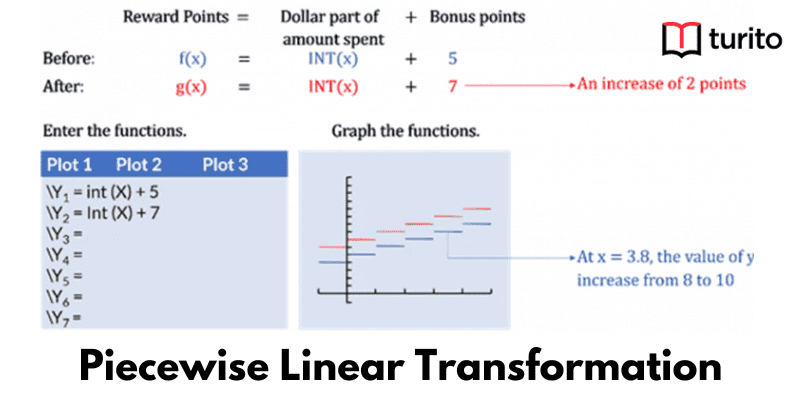
Uptown Sandwich Shop is increasing the number of bonus points by 2 in the shop’s rewards program. How will the total points awarded for a $3.80 item change?

You can represent the two versions of the reward program with step functions. Use the INT function on a graphing calculator to graph the two functions. INT is another name for floor function.

The graph is translated up by 2 units. The points for a $3.80 item increase from 8 to 10.
Vertical and Horizontal Translations
1. Vertical Translations of the Absolute Value Function
How does adding a constant to the output affect the graph of f(x) = |x|?
Compare the graphs of h(x) = |x| – 4 and g(x) = |x| + 2 with the graph of f(x) = |x|.


Adding a constant, k, outside of the absolute value bars changes the value of f(x), or the output.
It does not change the input. The value of k, in g(x) = |x| + k, translates the graph of f(x) = |x| vertically by k units. The axis of symmetry does not change.
2. Horizontal Translations of the Absolute Value Function
How does adding a constant to the input affect the graph of f(x) = |x|?
Compare the graphs of g(x) = |x – 4| with the graph of f(x) = |x|.

Adding a constant, h, inside the absolute value bars changes the value of x, the input, as well as the value of f(x), the output.
The value of h, in g(x) = |x – h| translates the graph of f(x) = |x| horizontally by h units. If h > 0, the translation is to the right. If h < 0, the translation is to the left. Because the input is changed, the translation is horizontal, and the axis of symmetry also shifts.
Translations, Stretches, and Compressions
1. Understand Vertical and Horizontal Translations
What information do constants h and k provide about the graph of g(x) = |x – h| + k?
Compare the graphs of g(x) = |x – 4| – 2 and g(x) = |x + 5| + 1 with the graph of f(x) = |x|.

The value of h translates the graph horizontally and the value of k translates it vertically. The vertex of the graph
g(x) = |x – h| + k is at (h, k).
2. Understand Vertical Stretches and Compressions
How does the constant an affect the graph of g(x) = a|x|?
Compare the graphs of g(x) = ½ |x| and g(x) = –4|x| with the graph of f(x) = |x|.

In g(x) = a|x|, the constant a multiplies the output of the function f(x) = |x| by a.
- When 0 < |a| < 1 the graph of g(x) = a|x| is a vertical compression towards the x-axis of the graph of f(x) = |x|.
- When |a| > 1, the graph of g(x) = a|x| is a vertical stretch away from the x-axis of the graph of f(x) = |x|.
- When a < 0, the graph of g is reflected across the x-axis.
The value of a stretches or compresses the graph vertically.
Understand Transformations of the Absolute Value Function
A. How do the constants a, h, and k affect the graph of g(x) = a|x – h| + k?
Graph g(x) = -2|x + 3| + 4.
The values of h and k determine the location of the vertex and the axis of symmetry. The value of a determines the direction of the graph and whether it is a vertical stretch or compression of the graph of f(x) = |x|.

Since |a| > 1 and a is negative the graph is a vertical stretch of the graph of f(x) = |x| that is reflected across the x-axis.
B. How can you use the constants a, h, and k to write a function whose graph is as shown below??

Step 1:
Identify the vertex of the graph.
The vertex is (4, 1), so h = 4 and k = 1.
The function has the form
f(x) = a|x – 4| + 1.
Step 2:
Find the value of a. Select another point on the graph, (x, f(x)), and solve for a.

The graph represents the function f(x) = 3|x – 4| + 1.
Questions
Question 1
In the example about Uptown Sandwich in section 1, how will the total points be awarded for a $1.25 juice drink change if the bonus points are decreased by 2 points?
Solution:
f(x) = Reward points and x = Dollars spent
Before: f(x) = INT(x) + 5
After: f(x) = INT(x) + 3
Before: f(1.25) = INT(1.25) + 5 = 1 + 5 = 6
After: f(1.25) = INT(1.25) + 3 = 1 + 3 = 4
The graph is translated down 2 units. The points for a $1.25 item decrease from 6 to 4.
Question 2
For each function, identify the vertex and axis of symmetry.
- p(x) = |x| – 2
- p(x) = |x + 5|
Solution:
- p(x) = |x| – 2
Here, the value of output changes and it decreases by 2 units.
The graph translates down vertically by 2 units.
Vertex: (0, -2)
Axis of symmetry remains the same, i.e., y-axis.

- p(x) = |x + 5|
Here the value of h is -5, which is less than 0. So the graph moves horizontally to the left by
5 units.
Vertex is (-5, 0) and the axis of symmetry is x = -5.

Question 3
Find the vertex of the graph of g(x) = |x – 1| – 3
Solution:
f(x) = |x – h| + k
f(x) = |x – 1| – 3
h = 1, k = –3,
Vertex is (h, k) i.e. (1, –3)
Question 4
- Write a function of the graph shown.
- Write the function of the graph after a translation 1 unit right and 4 units up.

Solution:
a.
f(x) = a|x – h| + k
Vertex is (-1, 2)
So, h = -1 and k = 2
f(x) = a|x + 1| + 2
(1, 5) lies on the graph. So let’s find the value of a.
5 = aI1 + 1I + 2 …. 2a = 3… a = 1.5
Function: f(x) = 1.5|x + 1| + 2
b.
4 units up means f(x) increases by 4 and 1 unit right means h > 0 and h is 1.
f(x) = 1.5|x + 1 – 1| + 2 + 4
New Function: f(x) = 1.5|x| + 6
Key Concepts Covered

Exercise
For each function, identify the vertex and the axis of symmetry.
- f(x) = |x + 5|
- f(x) = |x| – 2
- f(x) = 3|x – 2| + 4
- f(x) = 0.5|x|
- f(x) = |x + 4|
- f(x) = |x – 5| – 2
- f(x) = |x + 6|
- f(x) = 2|x|
- f(x) = |x| + 2
- f(x) = 2|x – 2| + 3
Related topics

Obtuse Angle: Definition, Degree Measure, and Examples
What is an Obtuse Angle? In geometry, an angle that is greater than 90 degrees but lesser than 180 degrees is called an obtuse angle. We can easily recognize an obtuse angle because it extends past a right angle. Obtuse angle explained in detail with examples but first learn about angles. Type of Angles Geometry […]
Read More >>
Line Segment in Geometry: Definition, Symbol, Formula, and Examples
A line is a straight, one-dimensional figure that extends endlessly in both directions in geometry. It has no starting and ending points. When we define a starting point but not an ending point of a line, it is called a ray. Another important term associated with the line is a line segment. Line Segment Definition […]
Read More >>Area of Irregular Shapes for Grade 3 – Simple Methods & Examples
What Is the Area of an Irregular Shape? The area of an irregular shape is the space that it occupies, although it does not follow a clean formula. In contrast to the squares or perfect rectangles, irregular shapes have sides that are uneven or their angles don’t line up evenly. That is what makes them […]
Read More >>
Addition and Multiplication Using Counters & Bar-Diagrams
Introduction: We can find the solution to the word problem by solving it. Here, in this topic, we can use 3 methods to find the solution. 1. Add using counters 2. Use factors to get the product 3. Write equations to find the unknown. Addition Equation: 8+8+8 =? Multiplication equation: 3×8=? Example 1: Andrew has […]
Read More >>

Other topics



Comments: