



Polygon

Key Concepts
Introduction
Geometric shapes can be defined as a figure or area closed by a boundary which is created by combining the specific number of curves, points, and lines.
The combination of the lines and curves form different shapes. We got different names for the different types of figures. In this chapter, we will learn the names and the properties of the figures.
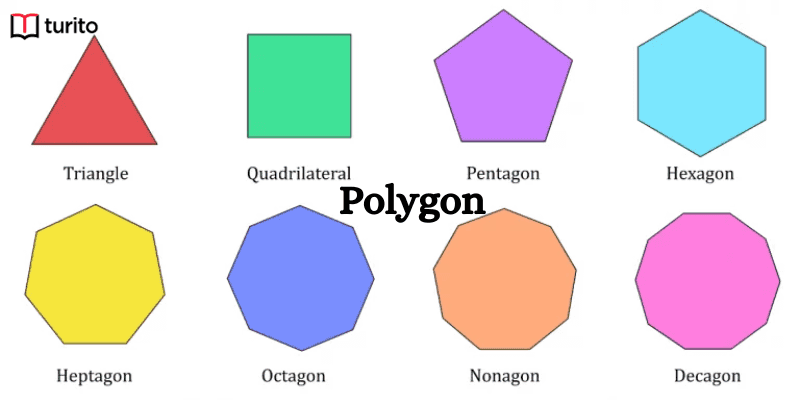
The polygon with 4 sides is called a quadrilateral. The different types of polygons and their properties will be covered in this chapter.
1.1 Closed Figures
Figures in which initial and endpoints coincide with each other are called closed figures.

1.2 Open Figures
Figures that have different initials and endpoints are called open figures.


1.3 Polygons:
In geometry, a polygon can be defined as a flat or plane, two-dimensional, closed shape with straight sides. It does not have curved sides.
Here are a few examples of polygons.
1.4 Types of Polygons:
Depending on the sides and angles, the polygons are classified into different types, namely:
- Regular polygon
- Irregular polygon
- Convex polygon
- Concave polygon
1.4.1 Regular Polygon
If all the sides and interior angles of the polygon are equal, then it is known as a regular polygon. The examples of regular polygons are square, rhombus, equilateral triangle, etc.

1.4.2 Irregular Polygon
If all the sides and the interior angles of the polygon are of different measure, then it is known as an irregular polygon, for example, a scalene triangle, a rectangle, a kite, etc.
1.4.3 Convex Polygon
If all the interior angles of a polygon are strictly less than 180°, then it is known as a convex polygon. The vertex will point outwards from the center of the shape.

1.4.4 Concave Polygon
If one or more interior angles of a polygon are more than 180°, then it is known as a concave polygon. A concave polygon can have at least four sides, the vertex points towards the inside of the polygon.

Types of Polygons:
- Line segments forming a polygon are called sides of the polygon.
- The point where two sides of a polygon meet is called the vertex of the polygon.
- The line segment containing two non-adjacent vertices is called the diagonal of the polygon.
- The angles formed at the vertices inside the closed figure are called interior angles.
Note: The number of sides in a polygon is equal to the number of vertices.
1.5 Pentagon:
The five-sided polygon is called the pentagon polygon. When all the five sides of the polygon are equal in length, then it is called a regular pentagon; otherwise, it is called an irregular pentagon.

1.6 Quadrilateral:
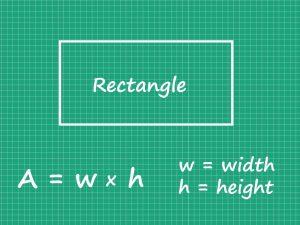
A quadrilateral polygon is also called a four-sided polygon or a quadrangle. The different types of the quadrilateral polygons are square, rectangle, rhombus, and parallelogram.

1.6.1 Rhombus:
Let us go with an example of a rhombus, this is an equilateral polygon because it has equal sides, but it has unequal angles; therefore, it is an irregular polygon:

1.6.2 Parallelogram:
A parallelogram is a special type of quadrilateral that has equal and parallel opposite sides.
The given figure shows a parallelogram ABCD in which AB is parallel to CD and AD is parallel to BC.
Also, AD = BC and AB = CD.

1.6.3 Octagon:
It is a polygon as it has eight sides.
Angles of an octagon: An octagon consists of eight angles. The sum of the angles of an octagon is 1080°.
- The octagon having eight congruent sides and angles is known as a regular octagon.
- Every regular octagon has the same angle measures.
- All sides are equal in length, and all the angles are equal in measure.
- The interior angles add up to 1080° (135×8), and the exterior angles add up to 360°.

1.7 Combination and Separation of Polygons:
- Triangle 1 and triangle 2 can be combined to form a large triangle.
- A large triangle can be subdivided into triangle 1 and triangle 2.
1.8 Example- Combination of Polygon:
You can combine two or more polygons into one polygon.
Exercise:
1. Which of the following are polygons? Give reasons.

2. Which of the following are polygons? Circle them.

3. Draw the shapes of the following:
i. A triangle
ii. A quadrilateral.
4. Name the kind of shapes given below

5. Guess the polygon I am a plane figure with 4 sides of equal lengths and 90-degree angles on the sides. I am a plane figure with 2 sides, each of equal length and 90-degree angles on the sides. I am a plane figure with 6 sides, and all interior angles are greater than 90 degrees.
6. Match the following:
Column-A Column-B
(a) Pentagon (i) 8-sided polygon
(b) Hexagon (ii) 3-side polygon
(c) Quadrilateral (iii) 5-side polygon
(d) Triangle (iv) 6-side polygon
(e) Octagon (v) 4-side polygon
7. What is the sum of the interior angles of a quadrilateral?
8. An irregular octagon has one interior angle of 130°. What is the size of the adjacent exterior angle?
9. The three angles of a quadrilateral are 769,54°, and 108°. Find the measure fourth angle.
10. Draw pair of parallel lines?
What we have learnt:
- The Closed and open figures
- The polygon and the types of polygons
- The properties of polygons
- Quadrilaterals
- Different types of quadrilaterals
- Properties of the quadrilaterals
Related topics

Obtuse Angle: Definition, Degree Measure, and Examples
What is an Obtuse Angle? In geometry, an angle that is greater than 90 degrees but lesser than 180 degrees is called an obtuse angle. We can easily recognize an obtuse angle because it extends past a right angle. Obtuse angle explained in detail with examples but first learn about angles. Type of Angles Geometry […]
Read More >>
Line Segment in Geometry: Definition, Symbol, Formula, and Examples
A line is a straight, one-dimensional figure that extends endlessly in both directions in geometry. It has no starting and ending points. When we define a starting point but not an ending point of a line, it is called a ray. Another important term associated with the line is a line segment. Line Segment Definition […]
Read More >>Area of Irregular Shapes for Grade 3 – Simple Methods & Examples
What Is the Area of an Irregular Shape? The area of an irregular shape is the space that it occupies, although it does not follow a clean formula. In contrast to the squares or perfect rectangles, irregular shapes have sides that are uneven or their angles don’t line up evenly. That is what makes them […]
Read More >>
Addition and Multiplication Using Counters & Bar-Diagrams
Introduction: We can find the solution to the word problem by solving it. Here, in this topic, we can use 3 methods to find the solution. 1. Add using counters 2. Use factors to get the product 3. Write equations to find the unknown. Addition Equation: 8+8+8 =? Multiplication equation: 3×8=? Example 1: Andrew has […]
Read More >>

Other topics



Comments: