



Polynomial Identities

Key Concepts
- List polynomial identities
- Use polynomial identities to multiply
- Use polynomial identities to factor and simplify
- Expand a power of a binomial
- Apply the binomial theorem
Polynomial Identities
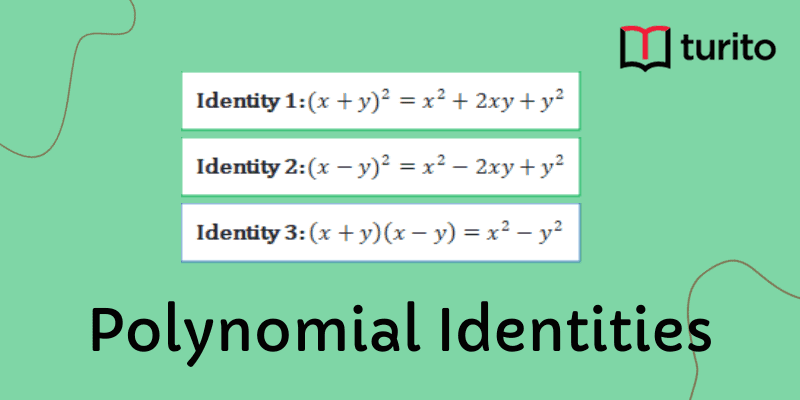
A mathematical statement that connects two polynomial expressions is an identity if one side can be transformed into the other side using mathematical operations. These polynomial identities are used to multiply and factor polynomials.
Difference of squares:
a² – b² = (a + b)(a – b)
Square of a sum:
(a+b)2 = a2+2ab+b2

Difference of cube:
a3−b3 = (a−b)(a2+ab+b2)
Sum of cubes:
a3+b3 = (a+b)(a2−ab+b2)
Example:
Find the difference of squares.
16x² – 9y²
Solution:
Substitute 4x for a 3y for b.
16x² – 9y² = (4x + 3y) (4x – 3y) (∵ a² – b² = (a + b)(a – b))
Example:
Find the square of a sum.
(36x+ 25y)²
Solution:
Substitute 6x for a 5y for b.
(36x + 25y)² = (6x)² + 2(6x)(5y) + (5y)²
(∵ (a + b)² = (a) ² + 2(a)(b) + (b)²)
= 36x² + 60xy + 25y²
Use polynomial identities to multiply
The given polynomial identities are multiplied to get the required expression.
Square of a sum:
(a+b)2 = a2+2ab+b2
Example:
Use polynomial identities to multiply the expressions.
(12 + 15)²
Solution:
Find the multiplication of the expression by using the square of a sum identity.
(a + b)² = (a) ² + 2(a) (b) + (b) ²
(12 + 15) ² = (12) ² + 2(12)(15) + (15) ²
= 144 + 360 + 225
= 729
So, (12 + 15) ² = 729
Use polynomial identities to factor and simplify
To find the factor of a polynomial identity, first, we have to find out the difference of square identity and the difference of cube identity.
Sum of cubes identity,
a3+b3 = (a+b)(a2−ab+b2)
Example:
Use polynomial identities to factor each polynomial.
12³ + 2³
Solution:
Use the sum cube property.
a³ + b³ = (a + b) (a² – ab + b²)
12³ + 2³ = (12 + 2) (12² – 12(2) + 2²)
= 14(144 – 24 + 4)
= 14(124)
= 1,736
So, 12³ + 2³ = 1,736
Example:
Find the value of k, if x – 3 is a factor of 5x3 – 2x2 + x + k.
Solution:
Here, x – a is a factor of p(x) if p(a) = 0.
It is given that x – 3 is a factor of 5x3 – 2x2 + x + k.
Therefore, p (3) must be equal to zero.
p(3) = 5(3)3 – 2(3)2 + 3 + k = 0
Therefore,
5(27) – 2(9) + 3 + k = 0
135 – 18 + 3 + k = 0
120 + k = 0
Therefore, k = –120
Expand the power of a binomial
The binomial theorem describes the algebraic expansion of powers of a binomial. According to the theorem, it is possible to expand the polynomial (x+y)n into a sum involving terms of the form axbyc where the exponents b and c are non-negative integers with b + c = n, and the coefficient a of each term is a specific positive integer depending on n and b.
Pascal’s triangle gives us the coefficients for an expanded binomial of the form (a + b)n, where n is the row of the triangle. The binomial theorem tells us we can use these coefficients to find the expanded binomial.

Example:
What is the binomial expansion of (x2 + 1)5 using the binomial theorem?
Solution:
The following formula derived from the binomial theorem.


Example:
Expand the term (1+x)3
Solution:
We use the theorem with n = 3 and stop when we have written down the term in x3

Apply the binomial theorem
Binomial theorem
The binomial theorem states that for every positive integer n,

The coefficients

are the numbers in row n of Pascal’s triangle.
By using the binomial theorem, we can expand the expression and solve the problem by using Pascal’s triangle to write the coefficients.
Example:
Use the binomial theorem to expand the expression.

Solution:
Apply the binomial theorem

Here a = x and b = –1.


Therefore,

Example:
What is the middle term of (xyz + 3)80?
Solution:
Since the power is even, there are an odd number of terms.
The middle term is the (n/2 + 1)th term.


Exercise
- Use polynomial identities to factor each polynomial.
m8 – 9n10
- Use polynomial identities to multiply the expression.
(3x2 – 5y3) (3x3 – 5y2)
- Use Pascal’s triangle to expand
(x-y)6
- Use polynomial identities to multiply the expression.
(12-15)2
- Use binomial theorem to expand the expression.
(2c-d)6
- Use polynomial identities to factor each polynomial.
27x9 – 343y6
- Use Pascal’s triangle to expand
(2x-7)3
- Expand
(1+2/x)3
- Expand
(1+x)2
- Use Pascal’s triangle to expand
(1+p)4
Concept Map
If an equality holds true for all values of the variable, then it is called an identity.


What have we learned
- What is polynomial identity?
- How to use polynomial identity to multiply?
- How to use polynomial identities to factor and simplify the expression?
- How to expand the power of a binomial?
- How to apply binomial theorem
Related topics

Obtuse Angle: Definition, Degree Measure, and Examples
What is an Obtuse Angle? In geometry, an angle that is greater than 90 degrees but lesser than 180 degrees is called an obtuse angle. We can easily recognize an obtuse angle because it extends past a right angle. Obtuse angle explained in detail with examples but first learn about angles. Type of Angles Geometry […]
Read More >>
Line Segment in Geometry: Definition, Symbol, Formula, and Examples
A line is a straight, one-dimensional figure that extends endlessly in both directions in geometry. It has no starting and ending points. When we define a starting point but not an ending point of a line, it is called a ray. Another important term associated with the line is a line segment. Line Segment Definition […]
Read More >>Area of Irregular Shapes for Grade 3 – Simple Methods & Examples
What Is the Area of an Irregular Shape? The area of an irregular shape is the space that it occupies, although it does not follow a clean formula. In contrast to the squares or perfect rectangles, irregular shapes have sides that are uneven or their angles don’t line up evenly. That is what makes them […]
Read More >>
Addition and Multiplication Using Counters & Bar-Diagrams
Introduction: We can find the solution to the word problem by solving it. Here, in this topic, we can use 3 methods to find the solution. 1. Add using counters 2. Use factors to get the product 3. Write equations to find the unknown. Addition Equation: 8+8+8 =? Multiplication equation: 3×8=? Example 1: Andrew has […]
Read More >>

Other topics





Comments: